My father, Frank, never talked about death.
Even after the doctors told him pancreatic cancer would likely take him within 6 months, he kept asking about my tires, his tomato plants, and whether I’d remembered to change the furnace filter.
Six months suddenly felt impossibly short for all the things I still wanted to ask him.
He made it four.
During those final months, my brothers visited when they could.
I visited every day. I drove him to appointments, picked up his prescriptions, and cooked meals he rarely managed to eat.
Sometimes we’d spend an entire afternoon sitting on his porch without saying much at all.
Toward the end, silence became easier than pretending everything would be okay.
Looking back, I realize there was one thing he never mentioned.
Garage B12.
Not once.
That garage had been part of my life for as long as I could remember.
A faded red metal door at the back of an old industrial storage complex on the edge of town. Dad rented it before I was born and kept renting it long after he retired.
Every month, without fail.
When we were kids, my brothers and I invented wild stories about what was inside.
Gold bars.
A race car.
Stacks of cash.
Ryan swore Dad had buried pirate treasure; Derek insisted he was secretly building an airplane.
Only Dad never laughed.
The first and only time I asked to see inside, I couldn’t have been older than ten. He knelt in front of me, placed both hands on my shoulders, and said quietly,
“Don’t touch that door.”
His voice was so serious it startled me.
“Not until I’m gone.”
I never asked again. Life moved on; I got married, got divorced, and started over.
My brothers built their own families. Dad grew older.
But the garage stayed locked.
Twenty-seven years.
The morning after the funeral, the four of us gathered inside Mr. Collins’ law office. Derek sat beside his wife, already checking his phone every few minutes.
Ryan bounced one knee impatiently beneath the table.
Our cousin Mike had somehow been invited too.
Apparently Dad had remembered him in the will.
Mr. Collins adjusted his glasses.
“Frank was very specific about his wishes.”
Nobody said anything.
He opened the folder.
“The family home will pass to Derek.”
My older brother nodded solemnly.
“Frank’s pickup truck and savings account will pass equally to Ryan.”
Ryan whispered, “Wow.”
“The watch collection will pass to Michael.”
Mike blinked.
“I… really?”
Mr. Collins smiled politely.
“Yes.”
Then he looked at me.
“And Nathan…”
Everyone turned. Mr. Collins reached beneath the desk and placed a tiny envelope in front of me.
Inside was one rusty brass key.
Nothing else.
No explanation.
No note.
Just a key.
I frowned.
“I’m sorry…” Mr. Collins looked sympathetic. “Your father insisted this be delivered exactly as written.”
I turned the key over in my hand.
Stamped into the metal was one small marking.
B12.
Ryan leaned across the table.
“Seriously?”
Derek frowned.
“That’s it?”
I looked at the lawyer.
“There isn’t… another page?”
“I’m afraid not.”
Ryan laughed.
“I guess we’ll finally find out what’s in the garage.”
He nudged Derek.
“Probably 20 years’ worth of junk.”
Mike chuckled.
“Maybe he hid those pirate gold bars after all.”
Nobody noticed I wasn’t laughing. I kept staring at the key. Part of me wanted to be angry. I had been the one sitting beside Dad’s hospital bed, the one helping him shower when he became too weak to stand, the one holding his hand during chemotherapy.
And somehow I’d inherited less than everyone else.
Mr. Collins cleared his throat.
“Your father did leave one instruction.”
I looked up.
“He asked that you—and only you—use that key.”
Ryan smirked.
“Good luck.”
Derek stood, already pocketing the keys to Dad’s house. “If there’s anything valuable in there, let us know.”
I almost answered.
Instead, I slipped the rusty key into my pocket. An hour later, I found myself standing in front of Garage B12.
The storage complex looked exactly as I remembered. Rows and rows of faded metal doors, cracked asphalt, weeds pushing through concrete.
And there it was.
The red door with peeling paint.
The white letters B12 were barely visible beneath years of rust and dust.
I stood there for a long moment.
Part of me wanted to walk away.
Maybe Dad had made a mistake, maybe he’d forgotten to update the will, or maybe there really was nothing inside except broken tools and old boxes.
I slid the key into the lock.
For a terrifying second, it wouldn’t turn.
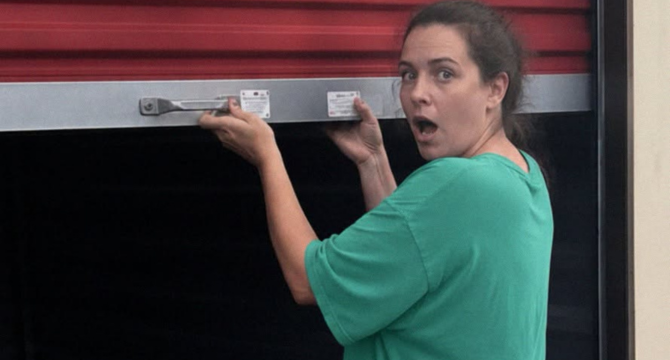
Then, with a loud metallic click, the lock released. I grabbed the handle at the bottom of the door and pulled upward.
The door lifted barely a foot, then slammed to a stop.
Something heavy was blocking it from inside. I crouched, squinting into the darkness.
At first all I saw was dust.
Then my eyes adjusted.
Chrome.
A headlight.
The unmistakable curve of a front fender beneath a faded canvas cover.
My heart began to pound.
No.
It couldn’t be.
I dropped to one knee and crawled under the half-open door.
The smell of old motor oil and sawdust filled the air.
I reached out with trembling fingers and slowly pulled the canvas back. It slid away in a cloud of dust.
A 1967 Ford Mustang Fastback sat in front of me.
Deep midnight blue.
Or at least it had been once.
Years of dust dulled the paint, but the lines were unmistakable. The chrome trim still caught what little light filtered through the gap beneath the garage door.
I simply stared.
Then I laughed.
Not because it was funny.
Because it made absolutely no sense.
Dad had never owned a Mustang.
At least, not that I knew of.
I stepped farther inside and found the chain hanging beside the door. When I pulled it, fluorescent lights flickered overhead one by one until the garage was bathed in pale yellow light.
The space was nothing like I’d imagined.
It wasn’t cluttered.
It was immaculate.
Every wrench hung neatly on a pegboard.
Shelves lined the walls, each filled with labeled plastic bins.
Engine.
Interior.
Electrical.
Chrome.
A large workbench stretched across the back wall.
The Mustang sat at the center of the room as though everything else had been arranged around it.
I walked slowly around the car.
The body had already been stripped and repainted. And the seats had been removed, but new leather upholstery waited inside sealed boxes.
Fresh tires leaned against one wall.
The dashboard had been restored, and the steering wheel gleamed.
This wasn’t an abandoned project.
Someone had spent years working on it.
Then I noticed something else.
A framed photograph sat on the workbench.
It was not a family picture.
It showed the Mustang exactly as it had looked when Dad first bought it.
Rust covered nearly every panel.
The windshield was cracked.
Half the grille was missing.
Across the bottom, written in Dad’s unmistakable handwriting, were four words.
“The day we started.”
I read the words again.
We?
I looked around again.
There was no one else, only me.
Then, like someone turning on a light inside my memory, I saw it.
Not the car.
The garage.
I was ten years old again, sitting cross-legged on this same concrete floor while Dad handed me a socket wrench almost too big for my hands.
“Wrong one,” he’d said with a grin.
“The twelve millimeter.”
I’d proudly held up the thirteen.
He’d laughed.
“Close enough.”
Saturday mornings.
Every weekend.
I’d completely forgotten.
While Ryan played baseball and Derek stayed home with his friends, I’d spent hours here.
Dad never forced me.
I simply liked being with him.
Sometimes we’d work for hours without saying much; sometimes he’d explain what every part of the engine did. Other times he’d tell stories about rebuilding cars with his own father.
He had one saying he repeated almost every weekend.
“Anything worth having is worth building.”
Back then I thought he was talking about cars.
Standing in that garage, I wasn’t so sure anymore.
I walked to the driver’s side and opened the door. The interior smelled of fresh leather and machine oil.
The ignition was empty.
The engine wasn’t installed.
A clipboard rested on the passenger seat.
I picked it up.
Every page listed completed work.
Suspension rebuilt, brakes replaced, fuel system restored, body repaired, paint completed.
Each task had a date beside it.
The final entry was almost eight months earlier.
Then…nothing.
The remaining pages were blank.
I swallowed hard.
Eight months ago.
That was when Dad had first started feeling sick.
My eyes wandered to the back of the garage. A large wooden cabinet stood beside the workbench.
Inside were dozens of carefully labeled drawers: every screw, every bolt, every bracket.
Nothing was random.
Everything had a place.
Dad had prepared this garage so someone else could finish the work.
Someone.
Or… me.
A small envelope rested on the top shelf.
My name was written across the front.
Just “Nathan.”
I opened it carefully.
Inside was a single sheet of paper.
It wasn’t a long letter.
Just a few handwritten lines.
“Nathan,”
“I always hoped we’d finish her together.”
“Since we can’t, finish her for me.”
“Good things take time.”
“Love,”
“Dad”
I read it twice.
Then a third time.
My throat tightened.
There were no explanations, no apology, no speech about inheritance.
Just trust.
He believed I would understand.
For the first time since the lawyer handed me that rusty key, I realized Dad hadn’t left me a mystery.
He’d left me a promise.
And I intended to keep it.
I drove back to the garage the following Saturday.
Then again the Saturday after that.
Before long, it became a routine.
I’d unlock the red door just after sunrise, turn on the lights, put an old radio on the workbench, and spend the next several hours picking up exactly where Dad had left off.
Some jobs were easy.
Installing the new carpet.
Reattaching trim pieces.
Polishing chrome.
Others took days.
The engine sat on a stand in the corner, already rebuilt but waiting to be lowered into the car. I had never done that by myself before.
Several times I caught myself reaching for my phone to call Dad.
Then I’d remember.
The garage would suddenly feel much quieter.
One afternoon, while trying to reconnect part of the wiring harness, I became so frustrated I threw the wrench onto the workbench.
It clattered across the wood.
I rubbed my face.
“I know,” I muttered to the empty room.
“Anything worth having is worth building.”
The words escaped before I realized I was smiling.
I could almost hear Dad laughing.
“Now quit complaining and find the right socket.”
I shook my head.
“You always made it sound easier.”
Of course, there was no answer.
Only silence.
But somehow, it wasn’t an empty silence anymore.
It felt familiar, almost comforting.
The more time I spent in that garage, the more I noticed things I hadn’t seen the first day.
Dad hadn’t just restored a car.
He’d built a classroom.
Every drawer had labels explaining what belonged inside, and every tool hung in the exact outline painted onto the pegboard.
Plastic containers held handwritten notes.
“Use anti-seize here.”
“Don’t overtighten these bolts.”
“Test before installing.”
They weren’t instructions for himself.
They were instructions for me.
I sat down on the rolling mechanic’s stool and looked around the garage. For years, I’d imagined Dad was hiding something from us.
The truth was almost funny.
He hadn’t been hiding anything.
He’d been building something.
Every weekend.
Every spare afternoon.
Every retirement project.
Not for Derek.
Not for Ryan.
For me.
Because he knew I’d come back.
A month passed before either of my brothers called.
Ryan was first.
“So?”
“So what?”
“The garage.”
“What about it?”
“Was there anything worth keeping?”
I looked across the garage at the Mustang.
“It depends what you mean by ‘worth.'”
He laughed.
“Come on.”
“Was there money?”
“No.”
“Jewelry?”
“No.”
“So it really was just an old garage.”
“I guess.”
He sounded almost relieved.
“Well, at least Dad didn’t hide a fortune from us.”
When we hung up, I smiled to myself.
Ryan had asked the same question we’d asked as kids.
“What was it worth?”
He never asked why Dad had spent over two decades there.
Two weeks later, Derek stopped by unexpectedly.
He leaned against the open garage door with his hands in his pockets.
“So this is where you’ve been hiding.”
“I’ve been busy.”
His eyes landed on the Mustang.
“I’ll admit…” He whistled softly. “I wasn’t expecting that.”
“It’s coming along.”
He walked around it slowly.
“What do you think it’s worth?”
I laughed.
“That’s your first question?”
“What?”
“I’m just curious.”
“No.”
“You want to know if Dad accidentally left me something more valuable than the house.”
His expression hardened.
“I didn’t say that.”
“You didn’t have to.”
For a long moment neither of us spoke.
Finally he shrugged.
“I just think Dad would’ve wanted things to be fair.”
I looked at the Mustang.
“I think he was fair.”
Derek frowned.
“You got a garage.”
“I got exactly what he wanted me to have.”
He looked at me as though I’d lost my mind. Then he climbed back into his truck and drove away.
I watched the dust settle behind him before returning to the garage. As I reached for a box of newly restored gauges, something slid from beneath it.
A large manila envelope. I’d never seen it before.
Across the front, in Dad’s handwriting, were four words.
“Open after she’s finished.”
I turned the envelope over in my hands. The temptation to open it was almost unbearable.
Dad had written one instruction.
I decided to listen. I slid the envelope into the top drawer of the workbench and went back to work.
The next six weeks became some of the busiest I’d had in years. Friends from work stopped by to help lower the engine into place. A retired mechanic from the next garage unit showed me a trick for aligning the transmission.
Piece by piece, the Mustang came together.
The first time I bolted the driver’s seat into place, I sat behind the wheel for nearly ten minutes without saying a word.
It already felt alive.
There was only one job left.
The final bolt securing the air cleaner assembly.
My hand hovered over the wrench.
A memory surfaced so clearly it almost made me laugh.
I was 12.
Dad had just rebuilt the carburetor.
I’d reached for the wrench.
“Can I tighten the last one?”
He smiled.
“Not yet.”
“Why not?”
“Because rushing the last step is how people ruin all the ones before it.”
I’d rolled my eyes. “When?”
“When you’ve earned it.”
Back in the garage, I tightened the bolt until the wrench clicked. Then I set it down and rested my hand on the hood.
“Now?”
The breeze stirred through the trees. The garage was silent, but somehow, I already knew what Dad would’ve said.
“Yeah. We finished it.”
I climbed into the driver’s seat and turned the key.
The engine cranked once.
Twice.
On the third turn, it roared to life.
The sound filled the garage.
Deep.
Smooth.
Confident.
I laughed before I realized tears were running down my face.
“We did it,” I whispered.
The words echoed softly off the concrete walls. Only then did I walk over to the workbench.
The envelope was exactly where I’d left it. This time, I opened it.
Inside were three documents.
The first was the title.
“Owner: Frank.”
“Transfer Upon Death: Nathan.”
The second document was an appraisal completed less than a year earlier.
I stared at the number.
“Appraised Value: $168,400 after restoration.”
I read it twice, convinced I’d misunderstood.
I hadn’t.
The third page was only a few sentences long.
“Nathan,”
“If you’re reading this, you finished what I couldn’t.”
“Your brothers wanted what I owned. But I wanted to leave you something we built together.”
“Love,”
“Dad.”
That was it.
No speech or explanation. Just six sentences.
I sat there for a long time.
Not thinking about the appraisal.
Not thinking about the money.
I was thinking about every Saturday morning I’d spent in that garage as a boy. I’d always believed Dad had been teaching me about engines.
He’d been teaching me patience.
And he knew patience couldn’t be inherited; it had to be practiced.
Word travels quickly among classic-car collectors.
A week later, my phone rang.
It was Mr. Collins.
“I thought you’d like to know your brothers have been asking questions.”
“I can imagine.”
“They’ve learned the Mustang has considerable value.”
I smiled.
“I’m not surprised.”
“They’re wondering whether your father knew.”
I looked across the garage at the freshly restored car.
“He knew.”
Mr. Collins chuckled softly.
“I thought so. They also asked whether the estate could be reopened.”
“And?”
“He anticipated that.”
I frowned.
“What do you mean?”
“Frank added a handwritten instruction to the file.”
I leaned back in my chair.
“What did it say?”
Mr. Collins cleared his throat.
“If my sons suddenly become interested in Garage B12 after learning what’s inside, tell them they already received the inheritance they were looking for.”
I closed my eyes.
Even now, Dad was still one step ahead.
Then Mr. Collins said, “There was one more thing.”
“What?”
“I assumed you already knew.”
“Knew what?”
“Your father didn’t rent Garage B12.”
I frowned.
“What are you talking about?”
“He owned it.”
I actually laughed.
“No, he rented that garage for decades.”
“That’s what everyone believed.”
I stared at the wall, trying to process what I’d just heard.
“The entire row of garages sits on privately owned land,” Mr. Collins continued. “Your father purchased the unit nearly 30 years ago. The land beneath every garage in the complex is included in each deed. He simply told everyone he rented it.”
“Why would he do that?”
“I imagine he didn’t want anyone asking questions.”
He paused.
“Ownership transferred to you the moment he passed away.”
I looked around the garage.
The Mustang.
The workbench.
The red door.
Everything Dad had spent decades protecting.
Mr. Collins cleared his throat.
“There have been offers.”
“Offers?”
“A development company has been trying to purchase the entire block for almost two years.”
“How much?”
“The latest offer was just over two million dollars.”
I couldn’t speak.
Mr. Collins laughed softly.
“I reviewed the estate myself.”
“The garage and the Mustang together are worth considerably more than everything your brothers inherited combined.”
For the longest time, I simply sat there.
Not thinking about the money.
Thinking about Dad.
He’d known exactly what everyone would see. Derek saw a house; Ryan saw a truck and a savings account.
I saw a rusty key.
Dad saw something none of us understood until the very end.
A month later, I drove the Mustang out of Garage B12 for the first time.
The engine purred exactly the way Dad always said it should.
I didn’t head toward the highway.
I drove to the cemetery.
The morning was cool and quiet. I parked beside the hill where Dad was buried and shut off the engine.
For several minutes, I simply sat there with one hand resting on the steering wheel.
Then I climbed out and placed my palm gently on the hood.
“I used to think you left me less than everyone else,” I said quietly. “I couldn’t have been more wrong.”
The breeze stirred the trees around me.
I smiled.
“We finished it.”
As I drove home, I finally understood why Dad had kept Garage B12 locked for years.
He wasn’t protecting a car, or a garage. He was protecting the only inheritance he believed had to be earned.
Some things become valuable because you own them. But the best things become priceless because you build them together.