A mother believed sacrificing everything made her the parent her four children deserved. Then they staged an intervention and revealed what they’d been noticing for years. But her oldest daughter had secretly done something that left her in tears.
I gave up my career, my dreams, and almost every piece of myself to be the kind of mother my children would never have to question.
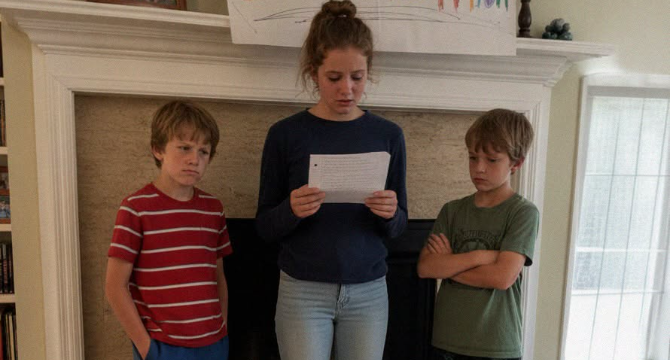
Then one afternoon, I walked into my living room and found all four of them waiting for me beneath a hand-drawn sign that said, “INTERVENTION.”
For years, I believed I was doing motherhood right.
I sacrificed everything to raise my four children.
I wanted to be there for every living moment.
To pack their lunches in the morning, find the things they somehow couldn’t find in their own rooms, brush their hair, watch cartoons beside them, drive them to soccer practice, and sit there through every single minute while they tried their best.
I exhausted myself to the very last nerve.
But whenever I felt like I couldn’t keep going, I told myself the same thing: “At least I’m a good mother.” “At least they know I’m always here.”
My oldest daughter, Sophie, was 13.
Then came 11-year-old Ben, six-year-old Lucy, and Noah, who was ten months old and hadn’t even learned to walk yet.
Their father, David, had left 18 months earlier.
I won’t pretend our marriage had been good before that.
It hadn’t.
But after he left, something changed in me.
I became obsessed with making sure the children never felt his absence.
If David forgot Ben’s soccer game, I cheered twice as loudly.
If he canceled a weekend, I planned pancakes and movies.
If Sophie cried after another unanswered call, I sat beside her until midnight even if Noah had me awake again at three.
I became two parents.
Then three.
Then four.
Whatever they needed, I would provide.
Whatever they lost, I would find.
Whatever hurt, I would fix.
And I was proud of that.
Which is why the intervention blindsided me.
I’d been upstairs putting away laundry when Sophie called me.
“Mom? Can you come down?”
“Give me five minutes.”
“Now, please.”
Something in her voice made me stop folding.
I went downstairs.
All four children were in the living room.
Noah sat in his high chair chewing the ear of a stuffed elephant.
Lucy sat cross-legged on the rug.
Ben was on the couch.
Sophie stood beside him holding a sheet of paper.
Behind them was a huge poster covered in colorful marker.
“INTERVENTION.”
I stared at it.
“What is this?”
Ben looked at Sophie.
Sophie looked at Lucy.
Lucy announced, “We’re intervening.”
I almost laughed.
“Are you?”
“Yes.”
“On what?”
Nobody answered.
That was when I saw Sophie’s face.
Her eyes were already filling with tears.
And suddenly, I wasn’t laughing anymore.
My first thought was David.
At that point in our lives, he was the one subject nobody knew how to talk about.
The shadiest, most painful, most delicate part of our family.
So as I lowered myself onto the couch, my stomach tightening, I was almost certain they were finally going to ask me something about him.
I was wrong.
Sophie looked down at the paper.
Her hands were shaking so badly that I could see the page trembling.
Then, barely holding back tears, she began to read.
“Dear Mom, we’ve discussed this a lot, and we’ve been meaning to tell you. The way things are right now, they can’t go on for much longer.”
I stared at her.
Then she read the next sentence.
“We need you to stop doing everything for us.”
I blinked.
“What?”
Sophie lowered the letter.
“Please let me finish.”
“But what does that even mean?”
“Mom, please.”
“All right.”
She continued.
“You think we need you to do everything because Dad isn’t here. But we don’t. And sometimes we don’t tell you things because we know you’ll try to fix them even when you’re already tired.”
I looked at Ben.
He immediately looked at the floor.
“You don’t tell me things?”
“Sometimes,” he admitted.
“Like what?”
Sophie sighed.
“This is why we made a letter.”
She kept reading.
“You make our lunches. You clean our rooms even when we say we’ll do it. You wash everything. You drive us everywhere. You help with homework. You make dinner. You take care of Noah. You do all the shopping, and you barely sleep.”
“That’s called being a mother,” I said.
“No,” Sophie said.
She wasn’t reading anymore.
“That’s called doing everything.”
Something defensive rose in me.
“Who else is going to do it?”
“We can do some of it.”
“You’re children.”
“I’m 13.”
“Exactly.”
She looked hurt.
I immediately regretted my tone.
Then Ben spoke.
“I can make my own lunch.”
I turned toward him.
“You made a sandwich last month and somehow got mustard on the ceiling.”
“That was one time.”
“How does mustard even reach a ceiling?”
“I squeezed it.”
“Clearly.”
Lucy raised her hand.
“I can brush my own hair.”
“You scream when I brush it.”
“I also scream when you brush it.”
Ben snorted.
Even Sophie smiled.
For a second, the tension broke.
Then Sophie looked back at the letter.
“That’s not really what this is about.”
“What is it about?”
She swallowed.
“You don’t do anything anymore.”
“I do approximately nine thousand things a day.”
“For us.”
The room went quiet.
Sophie looked straight at me.
“What do you do for you?”
I opened my mouth.
Nothing came out.
“I read.”
“When?”
“At night.”
“You fall asleep with the book open.”
“I watch television.”
“You fold clothes while you watch television.”
“I have friends.”
“When did you last see one?”
“That isn’t the point.”
“It is.”
I felt cornered.
By my own children.
And, embarrassingly, I was getting angry.
“You have no idea what it takes to keep this family going.”
Sophie flinched.
Ben looked uncomfortable.
Immediately, I wanted the words back.
But Sophie surprised me.
“I know.”
Her voice was quiet.
“That’s why we’re doing this.”
She handed the letter to Ben.
Apparently, everyone had a section.
He stared at his paper.
“You don’t have to read it,” I said.
“Yes, I do.”
He cleared his throat.
And began reading.
“Last month, I didn’t tell you about the science project until two days before it was due.”
“I remember.”
“You stayed up until one in the morning helping me.”
“Yes.”
“I knew about it for three weeks.”
I stared at him.
“You what?”
“I didn’t tell you.”
“Why?”
“Because you looked tired.”
That made no sense.
“So you waited until the last minute?”
“I thought I could do it myself.”
“Then why didn’t you?”
“Because I messed it up.”
His eyes filled.
“And then you stayed up fixing it, and the next morning you forgot to eat breakfast because Noah was crying.”
I softened.
“Ben—”
“I felt bad.”
“You shouldn’t.”
“But I did.”
Sophie took the letter again.
“That’s what we’re trying to tell you.”
She turned toward Lucy.
“Your turn.”
Lucy climbed onto the couch beside me.
She didn’t have paper.
Apparently, six-year-olds were allowed to freestyle their interventions.
“You don’t eat dinner.”
“I eat dinner.”
“You eat standing.”
I frowned.
“Sometimes.”
“All the times.”
“That isn’t true.”
“Yesterday you ate my crust.”
Ben laughed.
“She did.”
“I wasn’t hungry.”
Lucy looked deeply skeptical.
“And you don’t color anymore.”
That one caught me off guard.
“What?”
“You said you like drawing.”
I hadn’t drawn anything in years.
Before children, before David, before the endless machinery of lunches and laundry and appointments, I’d drawn constantly.
Not professionally. Just because I loved it.
I used to keep sketchbooks everywhere.
I hadn’t thought about them in ages.
“Who told you that?”
“Sophie.”
I looked at my oldest.
She went very still.
“What?”
“I found something.”
There it was.
The first moment I realized this intervention had another layer.
“What did you find?”
She glanced at Ben.
“Can we finish first?”
“No. What did you find?”
“Mom, please.”
I could see she was nervous.
So I nodded.
Sophie continued.
“You always tell us that family means being there for people. But sometimes it feels like you think loving us means you aren’t allowed to be anything except our mom.”
My throat tightened.
“I chose this.”
“Did you?”
The question irritated me more than it should have.
“Yes.”
“You wanted to stop working?”
“When you were born, yes.”
“Forever?”
I didn’t answer.
Before Sophie, I’d worked as an illustrator for a small children’s publishing company.
I loved it.
I’d studied design.
I’d dreamed of illustrating books with my name on the cover.
Then Sophie arrived.
Childcare was expensive.
David’s career was taking off.
We decided I’d stay home temporarily.
Then Ben came.
Then life happened.
Years passed.
Every time I talked about going back, there was a reason not to.
Eventually, I stopped talking about it.
“You needed me,” I said.
Sophie wiped at her eyes.
“We still need you.”
“Then what are we arguing about?”
“We need you to be happy too.”
“I am happy.”
She looked at me.
Children can be cruel without meaning to be.
Not because they say terrible things.
Because sometimes they don’t believe your lies.
“You cry in the laundry room.”
My entire body went still.
“What?”
“I’ve heard you.”
“Sophie—”
“You think nobody knows.”
My face burned.
Those weren’t breakdowns.
At least, that’s what I’d told myself.
Sometimes everything simply became too much.
I’d close the laundry-room door, sit on the floor for five minutes, cry quietly, wash my face, and go back to being Mom.
Nobody was supposed to know.
“How many times?”
“A few.”
I looked at the others.
Ben was crying now.
“Is that why you’re doing this?”
Sophie nodded.
“Partly.”
“I am not falling apart.”
“We didn’t say you were.”
“Then what are you saying?”
She struggled for the words.
Finally, she said, “I don’t want to grow up thinking loving people means disappearing for them.”
That broke something open inside me.
For a moment, nobody moved.
Even Lucy seemed to understand that something important had happened.
I stared at Sophie.
“Where did you learn to say something like that?”
She looked toward the hallway.
“From Dad.”
Of all the answers, I hadn’t expected that one.
“What does your father have to do with this?”
“Not from him like he taught me.”
She hesitated.
“From what he used to say to you.”
My stomach tightened.
“What do you remember?”
“More than you think.”
Apparently she remembered the arguments.
David telling me returning to work would make things “harder for everybody.”
David asking why I needed a career when his salary covered our bills.
David telling me, whenever I complained that I was exhausted, that I’d chosen to stay home.
And one sentence I’d forgotten completely.
Sophie hadn’t.
“A good mother puts her children first.”
David used to say it whenever I talked about doing something for myself.
A weekend class.
Freelance work.
Dinner with friends.
Anything.
He’d smile while saying it, as if it were obvious.
And somewhere along the way, I’d absorbed it so completely that even after he left, his voice stayed.
A good mother puts her children first.
So I did.
Every minute. Every day.
Until there was almost nothing else.
Sophie disappeared upstairs.
When she returned, she carried an old black portfolio.
I recognized it immediately.
“Where did you get that?”
“From the closet.”
“You went through my things?”
“I was looking for poster board.”
She put it beside me.
Inside were drawings I hadn’t seen in more than a decade.
Animals.
Children.
Fairy-tale scenes.
Character sketches.
And beneath them was a letter.
I knew what it was before I touched it.
An offer from a children’s publisher.
Fourteen years old.
They’d wanted me for a six-book freelance project.
I had turned it down because Sophie was a baby.
“You kept this?” she asked.
“I forgot it existed.”
“I Googled the company.”
I looked up sharply.
“You what?”
“They still exist.”
“So?”
“And then I found her.”
“Found who?”
Sophie picked up her phone.
She opened an email.
The sender’s name made my breath catch.
Marianne.
My former art director.
The woman who’d hired me straight out of college.
The woman who’d once told me I’d illustrate my own book someday.
“You contacted Marianne?”
“I emailed her.”
I didn’t know whether to be furious or terrified.
“What did you say?”
“The truth.”
“Sophie!”
“I didn’t tell her everything.”
She spoke quickly now.
“I said I was your daughter. I said I found your old work and wanted to know if you could ever illustrate again after being away for a long time.”
“And?”
Sophie handed me the phone.
Marianne’s reply was short.
She remembered me.
More importantly, she remembered my work.
She said the industry had changed enormously, but if I was interested in returning, she’d be happy to look at a new portfolio.
There was more.
Her company ran a remote mentorship program for illustrators returning after career breaks.
Applications closed Friday.
My eyes blurred.
“Is this why you did all this?”
“Partly.”
“You emailed a stranger about me?”
“She isn’t a stranger to you.”
“She hasn’t spoken to me in 14 years.”
“Then maybe you should talk to her.”
I started crying.
Not delicate tears.
Ugly ones.
The kind where your face stops cooperating.
Lucy immediately climbed into my lap.
Ben moved beside me.
Sophie stood there looking terrified.
“I didn’t mean to make you cry.”
“No.”
I wiped my face.
“No, sweetheart.”
She sat beside me.
“I just don’t understand why you think you’re responsible for keeping me happy.”
“Because you’re our mom.”
“That isn’t your job.”
“Then it isn’t yours either.”
That shut me up.
For 13 years, I’d believed motherhood could be measured by subtraction.
How much sleep could I surrender?
How much work?
How many friendships?
How many ambitions?
How much of myself could I give away before there was nothing left anyone could accuse me of selfishly keeping?
And my children had been watching.
Worse, they’d been learning.
I looked at Sophie.
“What exactly are you asking me to do?”
Her answer came immediately.
“Apply.”
“For the mentorship?”
“Yes.”
“What if I’m not good enough anymore?”
Ben shrugged.
“Then they’ll say no.”
I stared at him.
“Very inspirational.”
“You tell us failure is okay.”
Apparently children keep receipts.
“And who’s going to do everything while I’m drawing?”
Sophie pointed at the poster.
I’d assumed it contained decorations.
It didn’t.
It contained a schedule.
“Ben: lunches three days a week.”
“Sophie: laundry.”
“Lucy: toys and setting the table.”
There was even a section labeled, “NOAH: LEARN TO WALK / STOP THROWING FOOD.”
I laughed through my tears.
“This is ridiculous.”
“Is that a yes?” Sophie asked.
I looked at Marianne’s email again.
Then at the portfolio.
Fourteen years disappeared beneath my fingertips.
I could remember exactly how charcoal felt against paper.
For once, I didn’t ask whether my children needed something first.
“Yes.”
Sophie started crying.
“So you’ll apply?”
“I’ll apply.”
That was the intervention.
Not my children telling me I’d failed them.
My children telling me they could see what I had done for them, and they didn’t want the price to be me.
I submitted the application Thursday night.
Sophie sat beside me when I pressed send.
She smiled.
Then she made her own lunch for the next morning.
It contained two granola bars, cheese, and something I’m fairly certain no nutritionist would recognize as food.
I said nothing.
That was harder than submitting the application.
Three weeks later, I was accepted.
I didn’t become a different woman overnight.
The laundry still multiplied.
Noah still woke up.
Lucy still occasionally screamed as though brushing her own hair violated international law.
And I still had to stop myself from automatically doing things the older children could do themselves.
But twice a week, I closed the spare-room door and drew.
The first afternoon, I sat in front of a blank page for 20 minutes.
Then I drew a little girl holding an umbrella.
It wasn’t my best work.
It didn’t matter.
I showed Sophie.
She studied it with exaggerated seriousness.
“She’s good.”
“She’s crooked.”
“So am I.”
I laughed.
Then she hugged me.
And that was enough.
For years, I’d measured good motherhood by how much of myself I could give away.
My children were the ones who finally taught me they didn’t need every piece.
They needed a mother who loved them.
But they also needed to see that loving someone doesn’t require erasing yourself.
And maybe the strangest part of raising children is discovering that the lessons occasionally travel in the opposite direction.