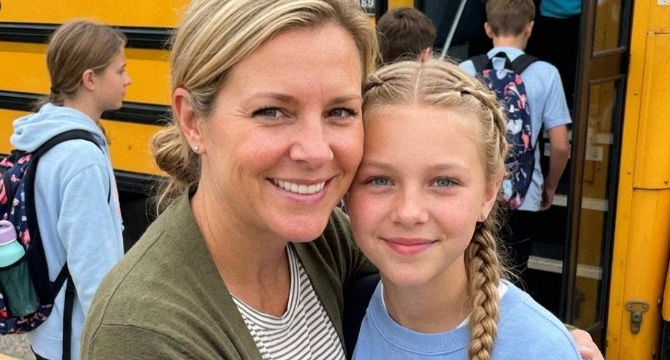
I expected my daughter to come home from summer camp with endless stories, new friendships, and a suitcase full of dirty clothes. Instead, she returned carrying a silence I couldn’t understand.
That summer, the laundry basket sat between me and the television. I was folding Kathleen’s clean camp clothes into three neat piles on the couch cushion. T-shirts, shorts, and the one hoodie she insisted on packing even though the forecast said 80° for two straight weeks.
At 35, I’d folded a lot of my daughter’s clothes. It never got old, actually. Every stack felt like proof that I was doing okay on my own.
“Mom, are you even listening?”
It never got old, actually.
My 13-year-old daughter was the kind of child who talked nonstop about school, made friends wherever she went, and told me every little detail about her day. She spent weeks talking about all the fun she and her friends were going to have and counting down the days until the bus left.
Kathleen was perched on the kitchen counter behind me, swinging her feet against the cabinet the way I’d asked her not to a thousand times. Her sketchbook, the beat-up hardcover she’d loved for years and carried everywhere, was open on her lap.
I’d asked her not to a thousand times.
“I am listening. You said archery, canoeing, and the night hike.”
“And the talent show. And Brenda says there’s a real campfire, not the fake gas kind.”
Brenda was one of Kathleen’s friends.
I glanced over my shoulder. She was glowing, the way teenagers do when something they’ve circled on the calendar is finally close enough to touch.
She was glowing.
“Two weeks is a long time, Kath.”
“Two weeks is nothing. You always say that when you go on work trips,” she challenged me.
“That’s different.”
“Well, I’ll be back in no time, just like you.” My daughter rolled her eyes at me with love. “Mom. It’s a camp. Everyone’s going.”
I set down a folded shirt. “Everyone, including Brenda?”
“Obviously. And Maya. I saved her a seat on the bus so she wouldn’t feel left out again. You know how she gets.”
“That’s different.”
I nodded because I did know.
For two months, Kathleen had been the one pulling a girl named Maya into group photos, lunch tables, and birthday plans. My daughter has a good heart. That was the part I never worried about.
“Brenda’s been kind of weird lately, though,” Kathleen added, almost to herself. She was flipping her pencil between her fingers. “About who sits where. But, whatever.”
That was the part I never worried about.
“Is that something I should be concerned about?”
“No, Mom, it’s nothing. Just girl stuff.”
I let it go. I told myself girls her age were their own weather system, and you couldn’t forecast every cloud.
The camp counselors were vetted. Her best friends were going. Kathleen was responsible.
I just couldn’t wait to hear all the stories she’d bring home.
“Is that something I should be concerned about?”
“You promise you’ll text me?” I asked.
“Every day.”
“Every other day is fine.”
“Mom,” Kathleen hopped off the counter and came to stand next to me, close enough that I could smell her strawberry shampoo. “I’ll be okay.”
“I know you will.”
“Then why are you refolding the same shirt?”
“I know you will.”
I looked down. I was, in fact, refolding the same shirt.
“Because I’m your mother, and that’s my job.”
She laughed, that big open laugh that used to fill the whole apartment when she was five, and leaned her head against my shoulder for one second before pulling away.
“That’s my job.”
“Can I bring the sketchbook?” my daughter asked.
“Of course you can.”
She grinned and disappeared down the hall to pack it.
I sat there with a hoodie in my lap, wondering how a person could grow from a whole baby into someone who thought about saving seats for lonely friends.
She grinned and disappeared down the hall.
The morning the bus left, I stood in the school parking lot with a paper cup of coffee I never drank.
Kathleen hugged me hard and ran off with Brenda before I could say anything embarrassing.
Through the bus window, I watched them settle in. My daughter laughed at something Brenda said. Then her friend leaned past her toward the quiet girl in the next seat, and my daughter’s smile flickered for just a second before she caught herself and waved at me.
Kathleen hugged me hard and ran off.
I waved back and whispered to no one in particular that two weeks would fly by.
I had no idea what my daughter was carrying onto that bus.
The first week of camp, my phone became a small altar.
I checked it between loads of laundry, between client emails, and between reheating the same cup of coffee three times.
I had no idea what my daughter was carrying onto that bus.
I sent Kathleen long messages every couple of days. Photos of the neighbor’s cat sitting on our porch. A funny story about the woman at the pharmacy who called me “sugar” four times in one transaction.
Her replies were always short.
“Everything’s great!”
“Having fun!”
“Love you, Mom!”
I sent Kathleen long messages.
I told myself she was busy enjoying herself and didn’t have time to spend on her phone.
Teenagers at summer camp weren’t supposed to be texting their mothers paragraphs. If anything, the short answers were a good sign, right?
By the second week, I stopped sending long ones.
I didn’t want to look like the clingy mom.
I told myself she was busy.
Pickup day, the parking lot was chaos.
Duffel bags, sunburned faces, and kids screaming names across the asphalt.
Kathleen ran straight into me and hugged me tightly. Tighter than a two-week hug should be, I remember thinking, but I chalked it up to missing home.
“How was it, baby?”
“Amazing,” she said, smiling into my shoulder.
“How was it, baby?”
On the drive home, I asked about the rope course, the canoe race, and the campfire skits she’d been rehearsing in the living room for a month. Kathleen gave me the answers. They just didn’t have any substance.
“It was fine, Mom. I’m tired.”
I didn’t push.
She’d been away for two weeks. Of course, she was tired.
“I’m tired.”
The unraveling was quiet.
Monday, the sketchbook stayed on my daughter’s nightstand. Tuesday, it was in the same spot, open to the same page. I realized I hadn’t seen her open it once since she’d been home.
At dinner, Kathleen pushed her food around and answered my questions in single syllables. She’d stare at her phone with a face I didn’t recognize. Not scrolling, just looking.
The unraveling was quiet.
My daughter had stopped talking about her day and seemed sad almost all the time.
“Kath. Talk to me. Did something happen at camp?”
She shrugged.
“I got into an argument with a friend. Over a photo. It’s stupid.”
“A photo of what?”
“It doesn’t matter, Mom.”
“A photo of what?”
I assumed she meant Brenda.
I remember thinking, of course, 13-year-old best friends imploding over nothing. Classic.
“You want me to call Brenda’s mom? We could…”
“Mom!”
Her voice was sharp for half a second, then soft again.
“It’s fine. Really. I just need a couple of days.”
I assumed she meant Brenda.
Days turned into a week. The sketchbook didn’t move.
I watched Kathleen from the doorway one night, curled on her side, with her phone facedown on the pillow beside her. She wasn’t crying. My kid, my chatterbox, had gone somewhere I couldn’t follow, and every time I tried, she smiled tightly and closed the door.
I kept telling myself to give her space. She’s a teenager. She’s allowed to have friend drama without her mother orchestrating a peace summit.
But something kept whispering that wasn’t the whole story.
Days turned into a week.
My phone rang on a Wednesday afternoon.
I almost didn’t answer. I was too busy with work.
“Hello?”
“Candice? This is Mr. Paulson, vice principal at Kathleen’s school.”
My hand tightened on the phone.
I was working from home to be around for my daughter because school wasn’t in session yet.
I almost didn’t answer.
“Yes, it’s me.”
“I’d like you to come in and speak with me, if you’re able.”
“Did she leave something at camp? I can just…”
“Candice, please come to the school. Alone.”
His voice was calm but serious, as if he were choosing every word.
“I’d like you to come in.”
I sat straight in my chair without meaning to.
Before I could ask why, he quietly added, “Your daughter didn’t tell you everything about camp. And I think you and I should talk before we bring her into the conversation.”
I don’t remember saying goodbye or standing up.
I don’t remember saying goodbye.
I looked toward the hallway.
Kathleen’s door was closed. It had been closed for eight straight days.
“Sweetheart, I need to go out for a few minutes! I’ll alert Mandy, and she’ll come over and watch you,” I called out.
“Okay, Mom!”
I grabbed my purse and headed for the neighbor’s house.
Kathleen’s door was closed.
Mandy worked from home full-time and didn’t mind watching Kathleen.
By the time I walked to my car, Mandy was already standing on my front porch, holding her laptop.
The school building felt too quiet when I pulled into the parking lot. My sandals slapped against the tile as I hurried down the empty hallway.
The school building felt too quiet.
Mr. Paulson met me at his office door with a soft nod.
He gestured to the chair across from his desk and slid a printed page toward me before I even sat down.
I looked at it, and my hand flew over my mouth!
It was Kathleen’s face. Someone had pasted it onto an embarrassing image, complete with a cruel caption mocking her sketching and her clothes. Little heart emojis lined the bottom, as if it were a joke everyone was in on.
My hand flew over my mouth!
“This was circulated in a private group chat the girls at camp made,” Mr. Paulson said quietly. “A counselor confiscated a phone after a separate incident, and we recently found the original file.”
“I knew it,” I breathed. “Brenda! She’s been off with Kathleen for weeks. Kathleen even told me.”
The vice principal let me finish. Then he folded his hands on the desk.
“Candice, it wasn’t Brenda.”
I blinked at him.
“A counselor confiscated a phone.”
“The edit history was intact. The file was created and sent by the new girl, Maya.”
I actually laughed.
“Maya? Kathleen has been saving that girl a seat since she arrived. She invited her into the group when nobody else would. That doesn’t make sense.”
“I know,” Mr. Paulson said gently. “But it’s what happened. And from what the counselors pieced together, Brenda was actually the one who told Maya to delete it. When Maya refused, Brenda stopped speaking to her. That’s the argument the girls had.”
I actually laughed.
I sat back. The chair suddenly felt too small.
Every conversation I’d had with my daughter over the last week rearranged itself in my head.
The “argued with a friend over one photo.”
The tight little smile.
The sketchbook laying untouched on her nightstand.
I had painted the loud girl as the villain and completely missed the quiet one.
The chair suddenly felt too small.
“She’s been carrying this alone,” I said, more to myself than to him.
Mr. Paulson nodded. “I’d like to set up a meeting tomorrow morning. Maya, her mother, Kathleen, you, and I. If your daughter’s willing.”
I drove home with my hands shaking on the wheel.
The printout sat folded on the passenger seat as if it were breathing.
“She’s been carrying this alone.”
Kathleen was on her bed when I got home, her phone beside her, staring at the ceiling.
I thanked Mandy, and she went home.
I sat on the edge of the mattress and set the paper down between us.
My daughter looked at it, then her whole face crumpled.
“Mom…”
“Come here, baby.”
She went home.
She fell into me and cried the way she used to as a small child, all of it at once. I stroked her hair and waited.
When she could finally speak, my daughter pulled back and wiped her cheeks with the heel of her hand.
“It wasn’t Brenda, Mom.”
“I know. Mr. Paulson told me.”
“Brenda tried to make her delete it. That’s why they were fighting.” She swallowed hard. “I didn’t know how to tell you it was Maya. I didn’t know how to tell you any of it.”
My daughter pulled back.
“Why, baby?”
Kathleen was quiet for a long moment. Then she said what I wasn’t ready for.
“Because I knew what you’d do.”
I felt my stomach fold in on itself.
“Kathleen…”
“Do you remember fourth grade? Mrs. Halston? When she marked my project down? You went to the school.”
“I remember. I marched in there without asking you.”
“I knew what you’d do.”
“Yeah.” Kathleen looked at her hands. “And after you left the office that day, kids called me ‘the girl whose mom fights her battles’ for the whole rest of the year. A whole year, Mom. Nobody wanted to be in a group with me because they thought you’d show up.”
I couldn’t breathe.
“I never told you,” she whispered. “I didn’t want you to feel bad. But when Maya sent that photo, all I could think was, if I tell Mom, she’s going to march in there, and it’s going to get so much worse. And I’d rather feel bad by myself than have it happen again.”
“I never told you.”
My eyes burned.
I stared at the sketchbook on her nightstand, and I finally understood what it actually meant.
My daughter hadn’t hidden this from me to protect Maya. She hadn’t hidden it to protect Brenda.
She’d hidden it to protect herself from me.
I took her hand and held it, and for the first time in a long time, I didn’t say a single word.
I finally understood what it actually meant.
The following morning, I sat in Mr. Paulson’s office with Kathleen beside me.
Maya sat across the table, next to her mother, staring at the floor. Every instinct in me wanted to speak first, loudest, and longest.
I didn’t.
I squeezed Kathleen’s hand once and let go.
My daughter’s voice shook as she spoke.
I squeezed Kathleen’s hand once.
“That photo hurt,” Kathleen said. “I sat next to you at lunch for months, Maya. I saved you a seat every single time. You didn’t have to do that to me. You could’ve just talked to me.”
Maya’s chin trembled.
“I felt invisible,” she whispered. “You and Brenda have this whole thing, and I thought if you were smaller, I’d finally be somebody. I know that’s awful. I know.”
Maya’s chin trembled.
“It is awful,” Kathleen said quietly. “But I hear you.”
Maya’s mother covered her face.
“She’ll delete every account for the summer,” she said. “She’ll write an apology to the group. Whatever the school decides, we’ll support it.”
Mr. Paulson nodded and outlined what fall would look like.
I didn’t say a word.
“But I hear you.”
Out in the parking lot, I finally turned to Kathleen and pulled her into a hug that wasn’t rushed.
“I owe you an apology,” I said. “Fourth grade. And every time after that. I made your problems mine and made them worse. I’m so sorry, sweetheart.”
My daughter laughed, wet and small.
“Mom, I just needed you to listen first. Fix second. That’s it.”
“I’m learning,” I said.
“I owe you an apology.”
Weeks later, the sketchbook was open on the kitchen table again.
Kathleen was three minutes into a rambling story about a movie I hadn’t seen, and I was still nodding, still quiet, still there.
I didn’t interrupt once.
She looked up, surprised, and grinned.
And I realized the bravest thing I could do was let her take the lead sometimes.