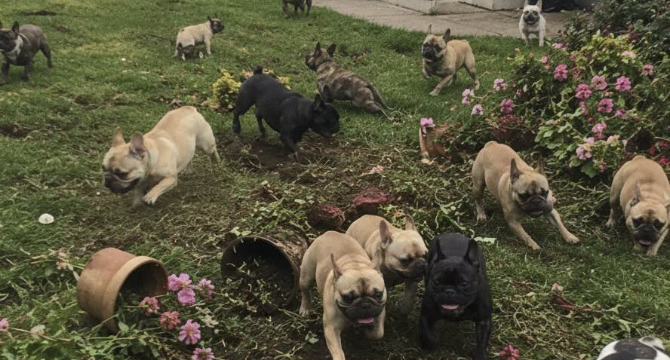
For weeks, she convinced herself the mess on her lawn was just a series of accidents. Then one morning, she realized her neighbor wasn’t being careless at all. Why would someone go out of their way to make another person’s life miserable?
Every morning, before I opened my laptop for work, I stepped onto the porch with a mug of coffee and looked over our front lawn.
My husband and I had spent 11 years turning patchy dirt into something we were proud to come home to.
I worked from home most days, which meant I saw the street wake up piece by piece.
The mail truck at ten. The Nguyens jogging at seven.
And every morning at eight sharp, Linda and her 13 French bulldogs.
“There she goes,” my husband muttered, glancing through the window.
“She waved this time,” I offered.
“Half a wave. With her phone still up.”
I laughed a little, because that was Linda. Half-friendly, half-somewhere-else, always in expensive sneakers, always trailing that ridiculous, wonderful parade of small snorting dogs behind her.
“Thirteen dogs,” he said. “Who needs thirteen dogs?”
“She loves them.”
“She loves the attention.”
I didn’t answer that. I liked keeping the peace in the mornings, and Linda hadn’t done anything worth losing peace over. Not yet.
The first pile showed up on a Tuesday.
I found it near the hydrangeas, right where the sprinkler hits the grass hardest.
I stared at it for a long moment, coffee cooling in my hand.
“Honey?” I called through the screen door. “Did a raccoon come through last night?”
He stepped out, squinted, and shook his head.
“That’s not a raccoon.”
“It could be.”
“It’s not.”
“It might be a stray.”
He looked at me the way he always did when I was reaching for a kinder version of a story.
“Or it might be one of those thirteen little snoring gremlins that come by here every morning.”
“She would have picked it up,” I said.
“Would she?”
I didn’t answer that either.
I got the bag and the scoop and cleaned it up myself, and I told myself it was a one-time thing, the way you tell yourself the leak under the sink will stop on its own if you just believe hard enough.
The second pile came on Thursday.
The third came Saturday, tucked right behind the little wooden sign my husband had carved for me that read, “Welcome, friends.”
“That’s it,” he said. “I’m ordering a camera.”
“Please don’t.”
“Why not?”
“Because then it becomes a thing. Right now it’s just… an accident. Maybe a couple of accidents.”
“It’s a pattern.”
“It’s a misunderstanding.”
He set down his mug and looked at me for a long time.
“You know they posted a new HOA rule last week, right? Pet waste. Fines and everything.”
“I saw it.”
“So we could just report it.”
“I don’t want to be that neighbor.”
“You mean the one with a clean yard?”
I smiled, but it felt tight. I hated that I felt tight. I hated even more that some small part of me already knew he was right, and that the polite little voice inside me had been overruled a long time ago by someone who never once considered being polite back.
That evening I stood at the window with my second cup of coffee and watched Linda’s silhouette pass by under the streetlamp, phone glowing, 13 small shadows padding along behind her.
She paused. Right in front of our lawn.
And for the first time, I let myself really wonder if any of this had ever been an accident at all.
By the third week, I had stopped pretending the piles were accidents.
Some mornings there were two. Some mornings there were four, scattered across the grass like Linda’s dogs had held a small convention on my lawn.
I started keeping count in my head while I made coffee.
It became a grim little ritual.
Pour the mug, glance out the window, sigh.
“She did it again,” I told my husband one Tuesday.
He didn’t even look up from the stove.
“Of course she did.”
“Maybe she didn’t notice.”
“She noticed.”
I hated how sure he sounded. Mostly because I knew he was right.
That morning, I walked out in my slippers and waited for her on the sidewalk. Thirteen French bulldogs bobbed around her ankles like a small, wheezing parade.
“Linda, hey,” I called, keeping my voice light. “Can I ask you something?”
She looked up from her phone with that half-smile she wore like lipstick.
“What’s up, hon?”
“Would you mind cleaning up after the dogs when they go on my lawn? It’s happening pretty often.”
She laughed.
“Oh, relax. It’s just fertilizer.”
“It’s not really fertilizer, though,” I corrected her.
“Grass loves it.”
“My grass doesn’t.”
She tilted her head like I’d said something adorable and mildly stupid.
“You know, some people just love to find something to be upset about.”
Then she clicked her tongue at the dogs and kept walking like the conversation was a mosquito she’d already swatted.
I stood there in my slippers, mug going cold in my hand, feeling like I was 12 years old again and the loudest girl at the lunch table had just decided I wasn’t worth listening to.
That was the wound she kept pressing without knowing it. Or maybe knowing it exactly.
I went back inside.
“Well?” my husband asked.
“She called it fertilizer.”
He set down the spatula.
“That’s it. I’m putting up the camera.”
“Not yet.”
“Why not?”
“Because if I put up a camera, I become the crazy lawn lady. That’s the story she’ll tell.”
“You’re already the crazy lawn lady in her head, sweetheart. She’s just the only one saying it out loud.”
I didn’t answer. I sipped my cold coffee and stared at the window.
Part of me still believed she’d correct herself. That some morning she’d bend down with a little green bag and the whole thing would end quietly.
That was the version of the world I preferred.
The version where I didn’t have to make a scene.
Days blurred. The lawn kept getting hit. My husband kept quietly suggesting the camera. I kept quietly saying no.
Then Saturday came.
There was a small cluster of neighbors at the end of the driveway, the way people gathered when the weather turned soft, and everyone wanted an excuse to stand outside.
Linda was in the middle of it, of course, dogs milling around her legs, holding court about something.
I walked out to check the mail. That was all.
I felt her eyes land on me the way you feel a spotlight.
“Oh, look who’s out,” Linda said loudly.
Two of the neighbors turned. One smiled uncertainly.
“Hey, Linda,” I said.
“You know,” she went on, addressing the little group but aiming it at me, “some people care more about their lawn than real life. It’s kind of sad, really.”
I heard a soft chuckle, and it was just enough to sting.
“I mean, it’s grass,” she continued. “Not the Sistine Chapel.”
Another laugh, louder this time. Marlene, two doors down, wasn’t laughing. She was looking at the pavement.
Linda turned to me fully.
“So, are you gonna go grab your little clipboard? Take some notes on my dogs?”
“Linda…”
“I’m just teasing.”
“You’re not.”
She blinked, just for a second. Then the smile came back, wider.
“Wow. Okay. Someone’s sensitive today.”
I could feel every eye. My throat did that thing where the words backed up behind my teeth and refused to line up. I couldn’t speak for a few seconds.
“It’s fine,” I said finally.
And that was the worst possible thing.
“See?” Linda said brightly, turning back to the group. “Fine.”
I walked back up my driveway with the mail crumpled in my hand and my ears burning.
I didn’t look back. I couldn’t.
Inside, my husband was in the kitchen with a dish towel over his shoulder. He took one look at my face and set the towel down.
“What happened?” he asked.
“She did it in front of everybody.”
“What did she say?”
“That I care more about my lawn than real life. That I’m sensitive. She got Marlene’s husband to laugh.”
He waited.
I set the mail on the counter. My hand was shaking a little, which annoyed me more than anything Linda had said.
“I kept smiling,” I whispered. “I kept smiling like an idiot because I didn’t want to be the mean one.”
“Honey—”
“She thinks I’m quiet because I don’t mind.”
I looked up at him. Something inside me had gone very still and very clear.
“Put up the camera.”
The next morning, I made coffee, sat at my kitchen table, and did something I should have done weeks earlier.
I opened my laptop, pulled up the HOA website, and started reading every line of the pet covenant.
Section 4.2 was crystal clear.
Owners were required to remove waste immediately from any private or common property. Violations carried warnings, then escalating fines.
I printed two copies—one for my husband and one for me.
“You’re actually doing it,” he said, watching me highlight lines in yellow.
“I’m doing it quietly,” I answered.
He kissed the top of my head.
“Camera goes up tonight,” he said with a smile.
A few hours later, the small doorbell camera was mounted above the porch, angled straight at the strip of lawn Linda favored.
I also started a notebook where I wrote dates, times, number of dogs off-leash, and number of piles left behind.
I felt ridiculous for the first two entries.
By the fifth, I felt confident and steady.
Then I did the part that scared me most.
I walked two doors down and knocked on Marlene’s screen door.
“Marlene, can I ask you something strange?”
She squinted at me through the mesh.
“Depends how strange.”
“Has Linda ever let her dogs on your property?”
Marlene’s whole face changed.
She stepped out onto her stoop and lowered her voice.
“Every Tuesday and Thursday. Right by my mailbox. I stopped putting mulch down because of it.”
“Why didn’t you say anything?”
She looked past me toward Linda’s house.
“Because she runs half the block book club, and my daughter’s kids play with her granddaughter, and she has a way of making you feel small if you cross her.”
I nodded slowly.
“I know exactly what you mean,” I said.
I told her about my notebook. About the camera. About Section 4.2. Her hands tightened around her coffee mug.
“If you’re really doing this,” she said, “I want in.”
I visited the Hendersons that same afternoon. Same story. Same fear. Same relief when they realized they weren’t alone.
Two days later, Linda noticed the camera.
I heard her before I saw her. She was at the community mailboxes, voice pitched loud enough to carry.
“So now she’s filming children walking by. That’s what we’ve come to on this street.”
Three neighbors stood in a loose half circle around her, uncertain, polite.
“She’s watching innocent dogs,” Linda continued. “It’s obsessive. It’s sad, really. My heart goes out to her husband.”
I froze on my walkway with the mail in my hand.
My face burned.
For one long second, I almost turned around, unmounted the camera, and burned the notebook.
Then I heard my own voice, small and old, whispering the same tired script it had whispered my whole life.
Don’t make a scene. Don’t be the difficult one. Let it go.
I looked down at the envelopes in my hand.
One of them was from the HOA.
A confirmation email had triggered a mailed notice. My complaint had been received.
I walked past Linda’s little circle without speaking, without flinching, and without smiling.
That night I sat on the couch beside my husband, laptop balanced on my knees, scrubbing through five days of footage.
“You okay?” he asked.
“I don’t know yet.”
I watched Monday’s clip. Then Tuesday’s. Then Wednesday’s. And somewhere around the fourth walk-through, I froze the frame with my finger.
Linda was standing at the edge of my grass, 13 leashes bunched in one hand, phone in the other. But she wasn’t looking at the phone.
She was looking at my front window.
I scrubbed back then played it again. Scrolled to Tuesday. Same glance. Wednesday. Same glance. Thursday. Same glance, held two full seconds before she loosened her grip and let the dogs wander.
“Honey,” I said quietly. “Come look at this.”
He leaned in. I played four clips in a row.
“She’s checking to see if you’re watching,” he said.
“She’s checking to make sure I am.”
We sat with that for a long minute.
“Why would she want you to see it?” he asked.
“I’ve been asking myself the wrong question this whole time,” I said. “I’ve been asking why she doesn’t care. I should have been asking why she cares this much.”
I thought about the last few months.
The HOA notice board. The rumor that had rippled through the block back in the spring about an unlicensed breeding operation being reported anonymously. Thirteen French bulldogs. Thirteen.
Months earlier, I’d mentioned it in passing to the HOA president at a summer barbecue.
It hadn’t been a complaint, just a concerned question.
I never imagined he’d repeat it, but he wasn’t known for keeping things to himself.
Later, I heard he’d told his wife, and his wife sat two chairs down from Linda at book club every second Thursday.
Apparently that was all it took.
“She knows,” I whispered. “She thinks it was me. It was me, but I didn’t even realize.”
My husband exhaled slowly.
“So this isn’t laziness.”
“No,” I said. “This is revenge. On a schedule.”
I opened a new email, attached the four flagged clips, copied Marlene and the Hendersons, and addressed it to Rachel on the HOA board. I typed two sentences in the body.
“Attaching documented violations under Section 4.2 from three affected households. Full log and additional footage available on request.”
I hit send before I could second-guess myself.
Then I closed the laptop, set it on the coffee table, and finally let my shoulders drop.
“Saturday morning,” I said, “she’ll be out there again.”
“And?”
I looked at him.
“And this time I won’t be the only one ready.”
Saturday arrived right on schedule.
At eight sharp, I carried my coffee onto the porch and watched Linda round the corner with her 13 French bulldogs.
Only this time, she wasn’t the only one waiting for what came next.
“So,” Linda pressed, arms folded, her smirk widening for the crowd. “Are you cleaning up today too?”
I smiled and let her have her moment.
“You know what, Linda? You’re absolutely right. I’ve been thinking about this all wrong.”
Her grin bloomed. “I knew you’d come around.”
I reached into my back pocket and pulled out a folded packet.
“Before you and the dogs head home, there’s something everyone here should probably see.”
I handed the top page to the neighbor closest to me.
“HOA covenant, section four. Pet waste. Seventeen documented incidents in the past ten days — plus weeks of piles I cleaned up before I started logging dates in my phone.”
Linda’s smile flickered.
“What is that?” she asked.
“Evidence,” I said. “The board already has the video. I sent it last night.”
A voice cut in from behind the mailbox cluster. Marlene stepped forward, clutching her cardigan.
“It’s not just her yard, Linda. It’s mine too. I have pictures.”
Another neighbor nodded slowly. “Mine as well.”
The little audience Linda had built to laugh at me was now looking at her.
“You people are unbelievable,” she muttered, tugging at the leashes.
The bulldogs scrambled after her as she walked off, phone forgotten at her side.
I didn’t chase. I didn’t gloat.
By Wednesday, Rachel from the HOA board called to let me know formal warnings had been issued, fines had been imposed, and Linda had been given a written route restriction.
Linda stopped walking past my house.
When our paths crossed at the mailboxes, she looked at the ground.
That Saturday, my husband brought two coffees onto the porch and sat beside me.
“How does it feel?” he asked.
“Quiet,” I said. “In a good way.”
The grass was already coming back in patches of soft new green. A neighbor across the street waved first for the first time in years.
I waved back, and understood something I wished I’d learned sooner.