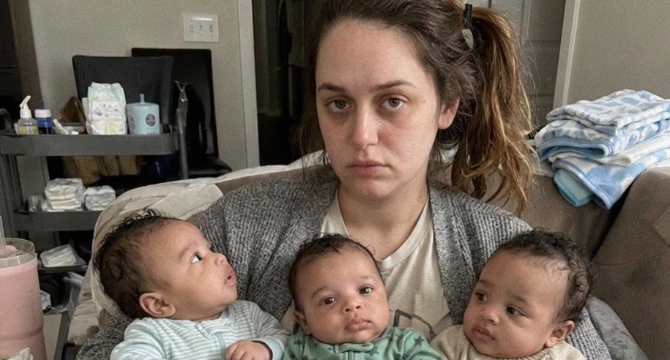
Three months after giving birth to triplets, I was running on broken sleep and pretending I could cope. When my husband dismissed my diagnosis and blocked the help I needed, I stopped waiting for him to understand. With one quiet plan, I made sure he finally heard the truth.
At the family dinner, my husband’s chair stood alone at the end of the table.
Every other place had been set in pairs.
Ryan stopped in the doorway with Noah’s carrier in one hand and stared at his mother.
“What is this?”
Kate folded her napkin beside her plate.
“Sit down.”
Ryan stopped in the doorway.
Ryan looked at me. Eli slept against my chest, Owen sat beside me, and my hand rested on a folder.
“You knew about this?”
My heart hammered beneath Eli’s cheek.
“I planned it.”
That was when Ryan finally looked afraid.
“You knew about this?”
Three months earlier, I’d given birth to triplets.
Noah, Owen, and Eli were healthy, beautiful, and loud enough to make our walls feel thin.
Everyone called me lucky.
I was lucky.
But I was also disappearing.
Before the boys, I worked in an elementary school office, fixing broken schedules and forgotten lunches before noon.
But I was also disappearing.
After the triplets came home, noon felt like the end of a full day.
By then, I’d fed three babies, washed bottles, pumped milk, started laundry, and cried where no one could hear me.
By midnight, I still wasn’t done.
One morning at 3:14, I stood in our kitchen holding an empty bottle.
The refrigerator door was open.
I’d fed three babies.
I couldn’t remember why.
Then Noah began crying in the nursery. His reflux usually hit after feedings.
Owen joined him seconds later.
Eli kicked beneath his blanket on the monitor.
I went into our bedroom.
“Ryan.”
He rolled away from me.
I went into our bedroom.
“Ryan, wake up.”
He pulled the blanket over his shoulder.
“Mona. Go away.”
“I need help. Please, Ry.”
“I have to be up in three hours.”
“So do I.”
“You’re already up.”
“Mona. Go away.”
I stared at the back of his head.
“Noah needs to be held upright. Owen won’t settle. Eli’s waking up.”
“You’ve got this.”
“No, I don’t.”
He sighed.
“If I don’t sleep, I can’t work tomorrow.”
“I haven’t slept more than two hours in a row since they were born.”
“You’ve got this.”
“I bring home the paycheck.”
“And I take care of three infants.”
Ryan turned and opened one eye.
“What exactly do you want?”
“Take Noah for 20 minutes.”
“You know his routine better.”
“I bring home the paycheck.”
“I know it because you won’t learn it.”
“Keep your voice down.”
“I’m asking you to help me.”
“You’re exhausted.”
“I’m drowning.”
“Our mothers raised babies without turning every hard week into a medical problem.”
“You’re exhausted.”
“Our mothers didn’t have triplets.”
“Babies cry, Mona.”
“I know.”
“Then go calm them.”
My hands shook around the monitor.
“I think something’s wrong with me.”
“You’re tired.”
“Babies cry, Mona.”
“It’s more than that.”
“You say that every night.”
“Because every night, I realize I have to do all of it again tomorrow.”
He looked at me for a moment.
Then he rolled away.
“You always fix things,” he muttered. “You’ll figure it out.”
I stood beside the bed until I understood he wasn’t getting up.
“It’s more than that.”
Two days later, Eli developed a fever.
I checked the thermometer twice, then called Ryan while fastening Noah into his carrier.
“I’m in the middle of something, Mona,” he said.
“Eli has a fever. I need help taking all three boys to Dr. Patel.”
“How high is it?”
I told him.
Eli developed a fever.
“That barely counts.”
“He’s three months old, Ryan. Everything counts.”
“Then call the doctor.”
“I already did. She wants to see him.”
“Mona, I’m at work.”
“And I’m trying to carry three babies out the door.”
“I can’t leave.”
“That barely counts.”
At the appointment, Owen was strapped to my chest while I pushed Noah and Eli in their carriers.
Dr. Patel examined Eli first.
“His temperature is mild,” she said. “He looks stable, but I’ll tell you what to watch for.”
“You’re sure?”
“I’m sure he looks well right now, Mona. I promise.”
Noah cried.
“He looks stable.”
I reached into the diaper bag, but my hand shook. The bottle slipped, struck the floor, and spilled milk across the room.
I froze.
“Look what I did.”
Dr. Patel crouched beside me.
“You dropped a bottle.”
“I can’t even feed them properly.”
“You dropped a bottle.”
“When did you last sleep?”
“Last night.”
“For how long?”
I stared at her.
“Maybe 40 minutes.”
“And when did you last eat?”
“When did you last sleep?”
“I had toast.”
“Today?”
I couldn’t answer.
She moved the bag aside and sat near me.
“Mona, are you feeling hopeless?”
“Sometimes they cry, and I feel like I’m not even in the room.”
“Have you thought about hurting yourself or the babies?”
I couldn’t answer.
“No. Never.”
“I believe you, but I am concerned about postpartum depression.”
My throat tightened.
“Does that mean I’m a bad mother?”
“No. It means you need care too.”
She handed me Dr. Martin’s card and helped me book an appointment.
“Does that mean I’m a bad mother?”
For the first time in weeks, I had a plan. I felt hope.
Then I told Ryan.
The boys had finally fallen asleep when I found Ryan on the couch, phone in hand.
“Dr. Patel thinks I have postpartum depression.”
He kept scrolling. “She’s a pediatrician. She’s not qualified.”
Then I told Ryan.
“She screened me and referred me to Dr. Martin. My appointment’s Thursday.”
“How much?”
“Two hundred dollars.”
That made him look up.
“For one hour of talking?”
“It’s treatment, Ryan.”
“How much?”
“It’s a trend, Mona. People get tired, read a few posts, and suddenly they need therapy.”
“I didn’t diagnose myself.”
“We have three babies. We can’t throw money at every hard week.”
I stepped closer. “This isn’t a hard week. I dropped a bottle because my hands wouldn’t stop shaking. I couldn’t remember when I’d eaten.”
Ryan opened the banking app.
“This isn’t a hard week.”
“What are you doing?”
“Stopping the payment.”
“Don’t.”
“It’s already done.”
My chest tightened. “You canceled medical care after a doctor told me I needed it.”
“I canceled an expense we can’t justify.”
“What are you doing?”
“You bought new golf clubs last month.”
“That was different.”
“Why?”
“Because I work for that money.”
The room went still.
I looked toward the monitor, then back at him. “So I have to get worse before you’ll believe me?”
Ryan set down his phone. “I think you’re lying about handling everything. You’re fine, Mona. Take a nap.”
“That was different.”
The next morning, I found an envelope in the back of my dresser.
It held birthday money I’d saved for years.
I sat on the floor and called Dr. Martin.
My voice shook when I explained that my husband had canceled the payment.
She arranged a video session.
It held birthday money.
“My husband thinks this is a trend,” I said.
“What do you think?”
“I don’t know anymore.”
“What are you afraid will happen if you stop pretending you can manage?”
“He’ll say he was right about me.”
“And what happens if you keep pretending?”
“What do you think?”
I looked toward the monitor.
“I think I’ll disappear.”
Dr. Martin didn’t tell me to leave Ryan.
She helped me name what I needed.
Sleep.
Food.
Treatment.
Practical help.
Someone safe who believed me.
“I think I’ll disappear.”
The next afternoon, Kate knocked on my door with two grocery bags.
Eli began crying before she set them down.
“I’ve got him, honey,” she said.
“He needs a bottle in 12 minutes.”
“Then I’ll give him one in 12 minutes.”
“The nipples are labeled. Noah needs the slower one, and Owen…”
“I’ve got him, honey.”
“Mona.”
I stopped.
“I believe you.”
Those words almost broke me.
Kate noticed Dr. Martin’s torn, taped card in the trash.
“Did Ryan do that?”
“No. I did. I thought maybe he was right.”
“I believe you.”
“Do you still?”
I looked at Eli.
“No.”
Kate sat beside me.
“Ryan called me this morning.”
“To ask about the boys?”
“No.”
“Do you still?”
Something in her voice made my stomach tighten.
“He told me you were unstable. He said you were trying to spend money on appointments you didn’t need. He made it sound like massages and nail appointments. I pushed until he told me the truth.”
I stared at her.
“He said not to encourage you.”
Kate’s jaw tightened.
I stared at her.
“I’ll speak to him.”
“No.”
“You shouldn’t have to carry this.”
“I don’t want you to rescue me.”
She studied my face.
“Then tell me what you need, Mona. Anything.”
“I don’t want you to rescue me.”
Dr. Martin had asked me the same thing.
This time, I had an answer.
“I need him to hear me without interrupting.”
“What else?”
“I need somewhere to go if he still refuses.”
“My home is open.”
I had an answer.
“And the boys?”
“All four of you, Mona. Always.”
I looked at the feeding charts beside the refrigerator.
Then I looked at the folders I’d begun filling with medical notes, schedules, and account records.
“Invite the family to dinner.”
Kate raised an eyebrow.
“All four of you, Mona.”
“What are we celebrating?”
“The boys turning three months old.”
“And what are we really doing?”
“Making sure Ryan hears the truth.”
I kept seeing Dr. Martin.
Kate prepared a room while I packed for the boys.
“Making sure Ryan hears the truth.”
I also got basic legal advice.
There were no magic papers or instant custody decisions, just facts about our money, our rights, and a safe care plan for the boys.
So I wrote one.
After the babies slept, I made three columns: what the boys needed, what I needed, and what had to change.
Kate watched my careful handwriting.
So I wrote one.
I looked up.
“I was always here.”
Ryan spent the next two days acting as though nothing had changed. I let him.
At dinner, Ryan stared at the chair waiting for him.
“I’m not sitting through some family ambush,” Ryan said.
I looked up.
He reached for Noah’s carrier.
I slid it closer to my chair.
“Then leave,” I said. “But I’m speaking tonight, whether you stay to hear me or not.”
Ryan’s hand dropped.
Kate pointed to the empty chair. “Sit down, Ryan. Now.”
He sat, but his eyes stayed on me.
I unfolded my page.
“Sit down, Ryan.”
“My hands didn’t shake before the boys,” I said. “I used to be the person everyone called when something went wrong.”
“Mona, we know you’re tired.”
“No. You decided I was tired because that was easier than hearing I was sick.”
Ryan leaned back. “I never said you were sick.”
“Exactly. Just because I don’t have a fever doesn’t mean I’m not sick.”
“I never said you were sick.”
I told them what Dr. Patel had seen.
Ryan’s sister frowned. “Why didn’t you call me, Mona?”
Ryan answered first. “She needed to learn a routine.”
I turned to him. “You told her not to come?”
“I said too many visitors would make things worse.”
“You left me alone with triplets and called help a distraction.”
“Why didn’t you call me, Mona?”
His sister stared at him. “You told me Mona wanted privacy.”
“I was protecting our home.”
“You were protecting your story,” I said.
I placed Dr. Martin’s card on the table.
“Our pediatrician referred me for postpartum depression. Ryan called it a trend and canceled the payment.”
Kate’s face tightened.
“Our pediatrician referred me.”
Ryan looked around. “We have three babies. I made a financial decision.”
“You made a medical decision for me.”
“I didn’t know it was serious.”
“I told you.”
His voice dropped. “You told me you were just overwhelmed.”
“I told you I was disappearing.”
“I told you.”
The room went quiet.
I slid my care plan across the table.
“What is that?” he asked.
“The boys and I are staying with Kate while I continue treatment.”
Ryan pushed back so hard that his chair scraped.
“You’re not taking my sons.”
“What is that?”
“I’m not cutting you out. Your time with them is written there.”
He grabbed the page.
“At Mom’s?”
“For now. You’ve never cared for all three alone.”
“I’m their father.”
“Then learn to be one without risking their routine or my recovery.”
“At Mom’s?”
His hands began to shake.
“You made this decision without me?”
“I asked you to make decisions with me. You canceled my care instead.”
“What about us?” Ryan asked.
“I’ll keep seeing Dr. Martin. You’ll keep paying your share of the boys’ expenses. Couples counseling can wait.”
“Wait for what?”
“What about us?”
“For me to decide whether this marriage is still safe for me.”
Ryan looked at Kate. “You’re letting her do this?”
Kate didn’t move. “Mona doesn’t need permission from either of us.”
I lifted Noah’s carrier.
Ryan stepped closer. “Tell me what to do.”
“Start by learning your sons without turning me into your instruction manual.”
“Tell me what to do.”
That night, Kate carried Owen. Ryan’s sister took Eli. I held Noah.
No one saved me.
They helped me leave.
At Kate’s house, I lined up the bottles and wrote the next feeding times.
“You can stop now,” Kate said.
“I know.”
They helped me leave.
When Owen cried later, I sat up.
Kate appeared in the doorway. “I’ve got him.”
I believed her.
Four weeks later, Ryan arrived with a diaper bag he’d packed himself.
“Noah needs to eat in 20 minutes. Owen’s pacifier and Eli’s spare clothes are packed.”
“Good.”
He swallowed. “I owe you an apology.”
“I’ve got him.”
“Then give me one.”
“You told me you were sick. I blocked your treatment, ignored your work, and lied to my family. I did all of that.”
“Yes.”
“I was wrong.”
“Yes.”
“Can I earn another chance?”
“Maybe. But you don’t earn me by behaving for a month.”
“Yes.”
He looked down.
“What do I do?”
“Keep changing when no one’s clapping.”
I handed him Eli.
Ryan took the next bottle.
I took my coat.
“Where are you going?”
“What do I do?”
“Therapy.”
He stared at me.
I opened the door.
“This time, you don’t get a vote.”
Then I stepped outside without waiting for his answer.
For the first time since the boys were born, I wasn’t waiting for Ryan to believe me.
I believed myself.