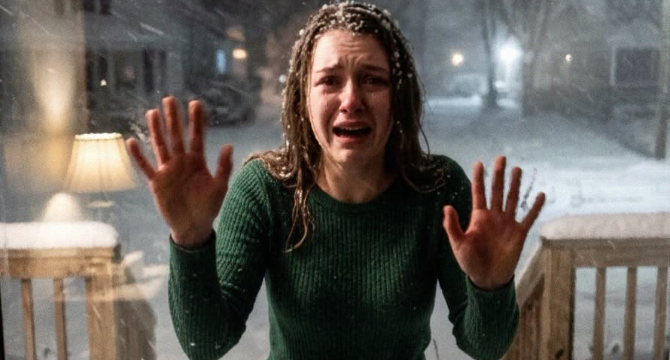
A young woman begged to stay in my house during a snowstorm. I thought I was saving a stranger from freezing. Then I heard her whisper on the phone, “Now I just need to wait until she falls asleep.”
I had been renting that little house for only two months.
It sat at the end of a narrow road outside Millhaven, the kind of place people drove past without noticing unless they were lost.
It had peeling blue shutters, a stubborn front door, and an attic that smelled like dust, cedar, and old secrets.
I moved there after my divorce because I wanted quiet.
That was what I told people.
The truth was, I wanted to live somewhere no one knew me well enough to ask why I still set two mugs beside the coffee maker some mornings.
I had no husband anymore.
No children.
No family nearby.
Just a job I could do from home, a house that creaked in the wind, and long evenings where the silence felt less peaceful than advertised.
One freezing winter evening, snow began falling before sunset.
By six, the road had nearly vanished beneath it.
Wind rattled the windows, and the old furnace coughed every few minutes, like it was personally offended by the temperature.
I was eating soup over the kitchen sink when someone knocked on my front door.
Not a polite knock.
A desperate one.
I froze with the spoon halfway to my mouth.
Nobody visited me there. I barely knew my neighbors, and the closest house was almost a mile away.
The knock came again.
I grabbed my phone, walked to the door, and looked through the peephole.
A young woman stood on the porch.
She looked about 20, maybe a little older, with dark wet hair plastered to her cheeks and snow clinging to her coat.
She was shivering so hard I could see it through the glass.
I opened the door a few inches with the chain still on.
“Can I help you?”
Her lips were pale.
“I’m sorry,” she whispered. “My car slid off the road, and my phone died. I… I saw the light.”
I looked past her into the storm.
There was no car visible, only white darkness.
“Are you hurt?”
She shook her head, then swayed slightly.
That was all it took.
I unlatched the chain and opened the door.
“Come in before you freeze.”
She stepped inside, and the wind followed her.
Up close, there was something strangely familiar about her face. Not in the way you recognize a neighbor or a cashier. More like a memory seen through dirty glass.
Her eyes.
The shape of her mouth.
The small dimple near her left cheek when she tried to thank me.
I knew that face.
But no matter how hard I tried, I couldn’t place it.
“My name is Rachel,” I said, helping her out of her wet coat.
“Lena,” she replied.
Her fingers shook so badly she could barely unzip her boots.
I gave her towels, dry socks, and an old sweatshirt from a drawer I had meant to clean out weeks earlier.
Then I heated soup and made her sit at the kitchen table with a blanket around her shoulders.
She ate like someone who had forgotten manners because survival had come first.
“Slow down,” I said gently. “You’re safe.”
At that word, her spoon stopped.
Safe.
For one second, her face changed.
Then she nodded and kept eating.
“What happened?” I asked. “Were you alone?”
She looked at me with tired eyes and quietly said, “I’m so exhausted… Could I tell you everything tomorrow morning? I just need to sleep.”
I hesitated.
The sensible part of me whispered that I had just let a stranger into my house.
The human part looked at her blue lips and trembling hands.
“Of course,” I said. “There’s a guest room upstairs.”
“Thank you,” she whispered.
I prepared the room at the end of the hall, the one I never used. I gave her extra blankets, a glass of water, and the charger from my nightstand.
“Bathroom is across the hall,” I said. “If you need anything, knock on my door.”
She stood beside the bed, looking around the room as if she had expected it to be different.
“Have you lived here long?” she asked.
“Two months.”
Her eyes flickered.
“Do you like it?”
“I’m trying to.”
She nodded.
“Good night, Lena.”
“Good night, Rachel.”
But I did not sleep.
That feeling that I somehow knew her face refused to leave my mind.
I lay in bed listening to the storm and the old house settling around us. At one point, I almost got up to check the road for her car, but the wind slammed hard against the window and convinced me to stay where I was.
Sometime after midnight, I woke needing the bathroom.
The hallway was dark except for a strip of light beneath the guest room door.
As I passed it, I heard Lena whispering.
At first, I thought she was crying.
Then I realized she was on the phone.
“I’m inside,” she said softly. “Everything’s fine.”
I stopped breathing.
A man’s voice murmured something I couldn’t make out.
Lena replied, “No. She doesn’t know.”
My hand tightened around the banister.
A few seconds later, I heard her say, “I’ve been waiting for this moment for two years.”
My blood turned cold.
Two years?
I had been in that house for two months.
Then came the words that made my heart skip a beat.
“Now I just need to wait until she falls asleep.”
I backed away from the door without making a sound.
In my room, I locked the door.
Then I stood there in the dark, phone in hand, heart hammering so loudly I was sure she would hear it through the wall.
“Call the police,” I told myself.
“But what would I say?” I thought. “A young woman I had invited into my house was whispering on the phone? That she said she was waiting for me to fall asleep?”
“Actually, yes,” I thought. “That was enough.”
My thumb hovered over the screen.
Then the memory hit me.
The attic.
A week earlier, I had been exploring up there because one of the ceiling vents rattled whenever the wind blew.
Behind a stack of cracked picture frames, I found a dusty cardboard box.
Inside were old curtains, a broken lamp, and a photograph.
Two girls sat on the back steps of this very house in summer sunlight.
One was younger, maybe 12.
The other looked about 20.
She had dark hair, a soft mouth, and a small dimple in her left cheek.
Lena.
No.
Not Lena.
The photograph had been old. Too old. The edges had yellowed, and the date stamped on the back read June 1998.
Lena could not have been in it.
But the face was the same.
Almost two hours later, I heard the guest room door slowly open.
I stood frozen beside my bed.
Footsteps moved down the hall. Toward the narrow door that led to the attic steps.
I waited until I heard it creak open.
Then I followed.
The attic was freezing.
A single bulb hung from a chain near the center. Lena had turned it on and was kneeling near the far wall, pulling boxes aside with quiet urgency.
In her hand was a small flashlight.
She knew where she was going.
That frightened me more than anything.
“Lena,” I said.
She spun around with a gasp.
The flashlight fell and rolled across the floorboards.
For a moment, neither of us moved.
Then I saw the tears on her face.
“How do you know this house?” I asked.
She swallowed.
“I can explain.”
“Start now.”
Her hands shook as she pointed toward the floorboards near the chimney.
“My mother said it was here.”
“What was here?”
“A box.”
I stepped closer, keeping several feet between us.
“You came here to steal something?”
“No.”
“You lied to get inside.”
“I didn’t lie about the car. It really slid off the road.”
“But you came to this road on purpose.”
She lowered her eyes.
“Yes.”
“Why?”
“Because my mother died six weeks ago,” she said, and her voice broke. “And before she died, she told me there was something hidden in this house.”
I said nothing.
Lena wiped her face with her sleeve.
“She worked here when she was young. Not for long. Just one summer. She said this was the only place she ever felt safe.”
“Your mother,” I said slowly. “Was her name Marisol?”
Lena stared at me.
“How do you know that?”
I turned and hurried to the stack of boxes where I had left the photograph. My hands shook as I pulled it out and held it toward her.
“Is this her?”
Lena took it as if it might vanish.
Then she sank onto the dusty floor.
“Mom,” she whispered.
For a long moment, she just stared at the picture.
“She never had photos of herself young,” Lena said. “She said she lost them all.”
“She didn’t lose this one.”
Lena touched the second girl in the photo.
“Who’s that?”
I sat slowly on an old trunk.
“Me.”
Her eyes lifted.
“You?”
“I was 12. My parents sent me here for three weeks one summer to stay with my aunt. She owned the house then.”
The memory came back in pieces.
Hot afternoons.
Lemonade.
A young woman in a yellow dress braiding my hair on the back steps.
Marisol. My aunt’s helper.
She had shown me how to make paper cranes. She had given me cookies when I cried from homesickness. She had told me, “Some houses listen better than people.”
Then one morning, she was gone.
I had asked my aunt where she went.
My aunt said only, “Some people don’t stay.”
I never saw her again.
Lena watched my face.
“You knew my mother?”
“Only for a summer,” I said.
“She remembered you,” Lena whispered. “She called you the lonely girl with the red sandals.”
I almost laughed.
Then I cried.
I had forgotten the sandals.
My throat tightened.
“What is hidden here, Lena?”
She crawled to the floorboards near the chimney and pressed along the edges.
“She said the board would lift if I pushed near the knot.”
“Lena…”
“I know how this looks. I know. I tried to find the owner first. Then I found out the house was being rented. I drove past three times before tonight.”
“For two years?”
She nodded.
“After Mom got sick, she started telling me pieces. She said there was a box in the attic of the blue house outside Millhaven. But she couldn’t remember the address at first. Chemo made everything foggy. I searched property records, old maps, rentals, anything I could find.”
“And tonight?”
“The storm got bad faster than I expected. My car slid into the ditch. I saw your light. I thought…” She looked ashamed. “I thought maybe this was my only chance.”
“And the phone call?”
“My boyfriend. He was worried. I told him I was inside and okay.”
“You said you were waiting for me to fall asleep.”
Fresh tears filled her eyes.
“Because I didn’t want to scare you by asking to search your attic in the middle of the night.”
“You did a great job avoiding that.”
A tiny, miserable laugh escaped her.
“I’m sorry.”
I looked at the loose board.
Then at the photograph.
Then at this young woman wearing her mother’s face.
“Lift it,” I said.
Lena pressed near the knot.
The board gave way with a soft groan.
Inside the gap was a metal tin wrapped in oilcloth.
Lena covered her mouth.
For a few seconds, she did not touch it.
Then she carefully lifted it out and placed it between us.
The tin was rusted at the edges but still sealed.
I found an old screwdriver in a nearby toolbox and pried it open.
Inside were letters tied with string, a small cassette tape, a pair of tiny knitted baby socks, and a sealed envelope.
On the front, in faded handwriting, were three words, “For my daughter.”
Lena made a sound I will never forget.
“She knew I’d make it here,” she whispered.
I looked at her.
“What do you mean?”
Lena pressed the envelope to her chest.
“She gave me up when I was born. I was adopted. I didn’t meet her until I was 18.”
I sat back.
“She never told you?”
“Only pieces. She said she was young, scared… and married to a man who hurt her. She said giving me up was the only brave thing she did.”
Lena stared at the tin.
“Then, near the end, she kept saying, ‘I left proof that I loved you before I ever held you.’ I didn’t understand.”
I looked down at the tiny socks.
Proof.
We took the tin downstairs because the attic was too cold for that much grief.
At the kitchen table, where only hours earlier Lena had eaten soup like a stranger, she opened the envelope.
Her hands trembled too badly to unfold the letter, so I asked, “Do you want me to read it?”
She nodded.
I read Marisol’s words aloud.
“My little girl,”
“If you are reading this, then I failed to be brave enough to tell you everything while I was alive. I am sorry for that. I was seventeen when I carried you. I was afraid of your father. Afraid of hunger. Afraid that love would not be enough to keep you safe.”
“So I chose the only safety I could give you. I chose a family who could raise you without looking over their shoulder.”
“But before I signed the papers, I knitted you these socks. I held them every night and imagined your feet inside them.”
“Never believe I forgot you.”
“Never believe you were unwanted.”
“You were wanted so much that I broke my own heart to protect you.”
Lena covered her face.
I kept reading, though my own voice shook.
“In the summer of 1998, I hid this box in the only house where I had ever felt peace. A little girl named Rachel lived there for a while. She was lonely too. I braided her hair and wished, foolishly, that someday someone would be gentle with you the way I tried to be gentle with her.”
“If she is grown now, I hope life was kind to her.”
I stopped.
Lena looked at me through tears.
“She wrote about you.”
I could not speak.
For years, I had thought I came to this house because I wanted to disappear from my old life.
But maybe houses remembered things people forgot.
We spent the rest of the night reading Marisol’s letters.
Some were addressed to Lena, some were journal pages, and some were just prayers.
The cassette tape was too old to play, but I promised we would find someone who could transfer it.
When morning came, the storm had stopped.
The world outside was white and quiet.
Lena’s car was still in the ditch, tilted but visible now down the road.
I made coffee.
She sat at the table, wrapped in the blanket, the baby socks beside her hand.
“I am sorry I scared you,” she said.
“You should have told me.”
“I know.”
“I might have believed you.”
She gave me a look.
“Maybe after calling the police.”
“Fair.”
For the first time, she smiled properly.
There it was.
Marisol’s dimple.
Before she left, we went back to the attic. Lena replaced the tin’s oilcloth and set the empty box back beneath the board.
“Why put it back?” I asked.
She ran her fingers over the floorboard.
“Because some houses deserve to keep their memories.”
I liked that answer.
A tow truck came by noon. Lena hugged me before she climbed into the passenger seat.
It should have felt strange.
It didn’t.
“Can I call you?” she asked.
“You’d better.”
She smiled. “I waited two years to get here. I don’t want to disappear after one night.”
Lena did call.
A week later, we found a shop that could transfer the cassette. Marisol’s voice came through soft and young, singing a lullaby to a baby she had not been allowed to keep.
Lena cried.
So did I.
The little blue house felt different after that.
It felt less empty and more like it had been waiting for both of us.
Sometimes, when the wind moved through the attic, I thought of Marisol in her yellow dress, hiding love beneath a floorboard because she had nowhere else to put it.