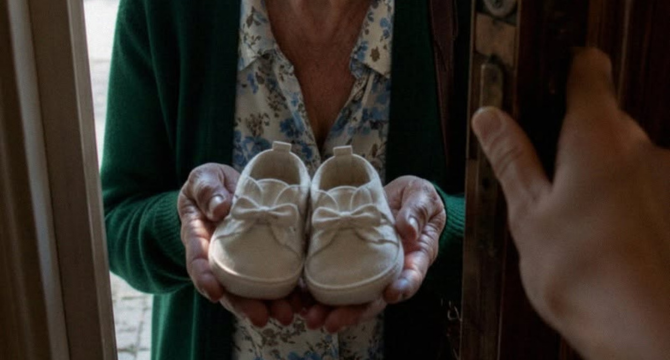
When I opened my front door, an elderly woman silently held out a tiny pair of baby shoes and said, “Are you Daniel’s mother?”
For a few seconds, I just stood there staring at her.
It was late afternoon, the kind of dull, gray hour when the whole house felt quieter than it should. I had been in the kitchen, wiping down the counter for the second time that day, more out of habit than necessity. The kettle had just begun to murmur on the stove when the doorbell rang.
I remember thinking it was probably a delivery. Maybe one of my neighbors had dropped off a misdirected package again. That happened often enough on our street.
But when I opened the door, there was no package on the step.
There was only this woman.
She looked to be in her 70s, maybe older. Her silver hair was tucked beneath a soft blue scarf, and her brown coat hung loosely from her narrow shoulders. Her hands trembled slightly as she held out the tiny shoes, almost as if they weighed far more than they should have.
They were cream-colored, with little laces and soft soles.
New, or nearly new.
Not the sort of thing a stranger carried to a person’s door without a reason.
“Yes…” I finally answered, completely confused. “Is something wrong? Is Daniel okay?”
The name left my mouth before I could stop it.
Daniel.
My son.
The boy who used to run through this very hallway with untied sneakers and a peanut butter stain on his shirt. The man who now lived across town and called me only when he remembered that mothers noticed silence.
The son I loved so fiercely that it sometimes made me angry, because love did not disappear just because people disappointed each other.
The woman did not respond right away.
Instead, she looked past me into the house, then back at my face, as if she were trying to find the right words.
That look made something cold move through me.
It was the look people wore in hospitals. In waiting rooms. Outside funeral homes. The look of someone standing at the edge of terrible news, unsure how to step forward without destroying whoever stood in front of them.
Finally, she spoke.
“My name is Margaret.”
Her voice was quiet.
“I’m your son’s mother-in-law.”
I actually laughed.
Not because it was funny…
But because it was impossible.
The sound came out sharp and breathless, almost rude. I covered my mouth with one hand, embarrassed, but I could not help it. The words had hit me so strangely that my mind refused to accept them.
“I’m sorry,” I said, shaking my head. “You must have the wrong house.”
She slowly shook her head, too.
“I don’t.”
The smile disappeared from my face.
For a moment, neither of us moved.
Behind me, the kettle began to whistle, thin and piercing. I ignored it. The sound grew louder, filling the hall, but I could not turn away from the woman on my porch.
That made absolutely no sense.
I’d spoken to Daniel just two days earlier. We’d talked about work, about the weather, and about whether he’d be coming over for Sunday dinner.
Not once had he mentioned getting married.
Not once had he mentioned a baby.
And Daniel was no longer a boy. He was 32, old enough to have his own life and his own secrets. I knew that.
Still, marriage? A child? A mother-in-law standing on my porch with baby shoes in her shaking hands?
No. That was not something a son forgot to mention.
Not even Daniel.
I looked down at the tiny shoes she was holding.
They looked almost brand new.
Small enough to fit into the palm of my hand.
My stomach tightened.
Suddenly, a hundred terrifying thoughts started racing through my mind.
Had Daniel been in an accident?
Had there been a woman in his life that he had hidden from me because of our old arguments?
Was there a baby somewhere, his baby, and had something gone wrong?
The thoughts came so fast I could barely separate them.
I gripped the edge of the door.
“Please…” I whispered. “Just tell me one thing.”
Margaret’s eyes lifted to mine.
“Is my son okay?”
She looked at me with tears in her eyes.
But instead of answering, she carefully placed the tiny shoes into my hands.
Their weight shocked me. They were so light, barely anything, yet the moment they touched my palms, I felt my knees weaken.
“He asked me to bring these to you if anything ever happened.”
For a second, I couldn’t even breathe.
The kettle screamed from the kitchen now, angry and forgotten. I wanted to tell her to wait there. I wanted to walk back inside, turn off the stove, and pretend this was a normal interruption to an ordinary day.
But I could not move.
I stared at the little shoes lying in my hands, trying to understand what I was hearing.
“What do you mean…” I whispered.
The words scraped out of me.
“…if anything happened?”
Margaret closed her eyes.
Took a long, shaky breath.
I noticed then how pale she was. How tightly she clutched the strap of her old leather handbag. How her lips trembled before she pressed them together.
Whatever she had come to say, she had rehearsed it. Maybe in the car. Maybe for days. Maybe while standing at the bottom of my steps, deciding whether to ring the bell at all.
“Please come inside,” I said, though my voice hardly sounded like mine.
Margaret opened her eyes.
“I don’t want to intrude.”
“You’re already here,” I replied.
I did not mean it cruelly. I meant that there was no going back now. She had brought my son’s name to my doorstep. She had placed baby shoes in my hands. She had cracked open a door I had not known existed.
She stepped carefully over the threshold.
I shut the front door behind her and led her into the living room.
My house suddenly felt too neat, too still. The folded blanket on the armchair. The framed school photo of Daniel at age eight, missing one front tooth. The graduation picture on the mantel, where he stood beside me with his stiff smile and one arm barely touching my shoulder.
Margaret noticed the photos.
Her gaze stopped on the graduation picture.
“He looks younger there,” she murmured.
My fingers tightened around the shoes.
“You know my son well?”
She looked away from the photo.
“Well enough.”
It was a strange answer. Not cold, exactly, but careful. Like she was stepping over broken glass.
I went to the kitchen and turned off the stove. The sudden silence rang in my ears. When I returned, Margaret was still standing, though I had motioned toward the sofa.
“Sit,” I said more gently. “Please.”
She sat on the edge of the cushion, knees close together, handbag in her lap.
I remained standing.
Maybe that was rude, but I could not sit.
I wanted it to be a mistake.
I wanted her to tell me Daniel had done something foolish but harmless. That he had hidden a relationship because he was embarrassed. That the shoes belonged to a baby shower gift, and the whole thing had been confused.
But Margaret’s face would not allow that hope.
“You said you’re his mother-in-law. That means he’s married?”
She swallowed.
“Yes.”
The room shifted around me.
“To whom?”
“My daughter,” she answered. “Her name is Elise.”
Elise.
The name meant nothing to me.
Daniel had mentioned coworkers, neighbors, and friends from his gym. He had once talked about a woman named Tina who liked old movies, but that had been years ago and had ended before I ever met her.
“Elise,” I repeated.
Margaret nodded.
“They were married quietly.”
“How quietly?” I asked, and the bitterness in my voice surprised even me. “Quietly enough that his own mother didn’t know?”
Her eyes filled again, but she did not defend him.
That hurt more than if she had.
I looked toward Daniel’s graduation photo and felt a familiar ache open in my chest.
We had not always been like this.
There was a time when he told me everything. When he would sit at the kitchen table after school and unload his entire day while eating cereal straight from the box.
Then his father died when Daniel was 19, and grief changed the shape of our home. I became too watchful. Too afraid. Too determined not to lose the only person I had left.
Daniel called it smothering.
I called it love.
Maybe we had both been right and both been wrong.
“Why didn’t he tell me?” I asked, softer now.
Margaret’s hands clenched over her handbag.
“That isn’t my story to explain.”
“But you came here.”
“Yes.”
“With baby shoes.”
Her face crumpled for one second before she steadied herself.
“Yes.”
I sat down then, not on the sofa, but in the armchair across from her. The baby shoes rested in my lap like evidence.
“Where is Daniel?”
Margaret stared at me.
“Before I answer that, you need to know something.”
“No,” I said, shaking my head. Panic rose in me, hot and wild. “No, I need to know where my son is.”
“I understand.”
“Do you?” My voice broke. “Because a stranger just came to my house and told me my son has a wife, maybe a child, and something might have happened to him. So please don’t ask me to be patient.”
Margaret flinched, but she did not leave.
“I’m not a stranger to him,” she said.
The words landed quietly, but they struck hard.
I stared at her.
Of course. That was the part I had been trying not to see. Whatever Daniel had hidden from me, he had not hidden from her. This woman had known him in ways I had not. She knew about Elise. She knew about the baby shoes. She knew why he had asked her to bring them.
And I, his mother, knew none of it.
The shame of that mixed with fear until I could barely tell one from the other.
I looked down at the shoes again. One lace had come loose. Without thinking, I tied it into a careful bow, the way I used to tie Daniel’s sneakers when he was small and impatient.
Margaret watched me do it.
“He kept them in a box,” she said.
I lifted my eyes.
“What box?”
“A wooden one. In the top drawer of his dresser.”
My breath caught.
“You’ve been in his home?”
She nodded.
I almost asked how often. I almost asked whether Elise lived there too. I almost asked if there was a crib, a bottle, a photograph, anything that proved the life my son had built without me.
But the questions crowded my throat.
Margaret reached into her handbag and took out a folded piece of paper. She held it for a moment, then placed it on the coffee table between us.
“I didn’t come here to hurt you, Sharon.”
Hearing my name from her mouth startled me.
Daniel had told her my name.
Of course he had.
Yet that small proof of being remembered nearly broke me.
“How do you know my name?” I asked.
She gave me a sad look.
“Because he talks about you.”
I let out a breath that was almost a sob.
“He talks about me?”
“Yes.”
“Then why didn’t he come to me?”
Margaret’s gaze fell to the paper on the table.
“I think he wanted to.”
“Wanted to?”
She nodded slowly.
“But wanting something and being able to do it are not always the same.”
A cold fear settled low in my stomach.
The house felt smaller now, as though the walls had moved closer. I could hear the clock ticking above the mantel, each second loud and final.
“Margaret,” I said, forcing myself to speak steadily. “Tell me what happened.”
She looked at me for a long moment. There was pity in her eyes, but also something else. Guilt, maybe. Or grief.
Then she told me something about my son that made every assumption I’d just made come crashing down… and suddenly those tiny baby shoes made perfect sense.
Margaret stared at the baby shoes in my lap as though they belonged to a ghost.
“Daniel has a son,” she said.
The room went silent around me.
For a moment, I heard nothing.
Not the clock. Not my own breathing. Not even the faint hum of the refrigerator in the kitchen.
“A son?” I repeated.
Margaret nodded, and tears slipped down the soft folds of her cheeks.
“His name is Noel. He is eight months old.”
Eight months.
My grandson was eight months old, and I had never held him. I had never smelled the top of his head or watched his fingers curl around mine. I had never known he existed.
I pressed one hand to my mouth.
“No,” I whispered. “No, Daniel would have told me.”
Margaret’s eyes lowered.
“He wanted to.”
“Then why didn’t he?”
She rubbed her thumb over the clasp of her handbag. “Because Elise begged him not to.”
The name struck me again. Elise. My son’s wife. The mother of his child. A woman I had never met.
“Why?” I asked. “What did I do to her?”
“It wasn’t you,” Margaret answered quietly. “It was fear.”
I shook my head, confused and angry and so hurt I could barely keep my voice steady.
“Fear of what? I’m his mother.”
Margaret looked straight at me then.
“Fear that you would hate her for what happened.”
My breath caught. “What happened?”
She reached for the folded paper on the coffee table but did not open it yet.
“Elise was driving the night Daniel lost his father’s watch.”
I stared at her.
For years, that watch had been the crack between Daniel and me. It had belonged to his father, Walter, the one thing Daniel had kept with him every day after the funeral.
Then, three years ago, Daniel came to my house pale and shaken, saying it was gone. He told me he had lost it. I had been cruel that day. I called him careless. I said his father deserved better.
Daniel left with wet eyes and did not come back for two months.
“What does a watch have to do with this?” I asked, though my voice had gone thin.
Margaret unfolded the paper. “It was never lost.”
She handed it to me.
My fingers trembled as I opened it.
Inside was a photograph.
Daniel stood beside a young woman with dark hair and tired, kind eyes. Elise. She held a newborn wrapped in a white blanket. Daniel’s face was softer than I had seen it in years.
Around his wrist was Walter’s watch.
I looked up sharply.
“I don’t understand.”
“They were in an accident that night,” Margaret said. “Nothing terrible, thank God. But Elise was badly frightened. She had just found out she was pregnant and panicked behind the wheel. Daniel told you the watch was lost because he had pawned it to pay for her car repairs and the first doctor’s visit.”
I stared at the photograph as the truth opened like a wound.
“He pawned his father’s watch?”
“He got it back,” Margaret said quickly. “Months later. He worked extra shifts and bought it back. But by then, he believed you would never forgive him.”
My throat burned.
I remembered Daniel standing in my doorway that day, trying to speak while I kept cutting him off. I remembered saying, “You always destroy what matters.” I remembered the way his face closed.
I had thought I was protecting Walter’s memory.
Instead, I had crushed our son.
The baby shoes blurred in my lap.
“Why did he not tell me about Elise after that?” I asked.
Margaret inhaled carefully. “Because Elise blamed herself. She thought she had already cost him his peace with you. Then, when they married at the courthouse, Daniel said he would tell you soon. But soon became next week, then after the baby, then after he found the right words.”
I closed my eyes.
The right words.
We had wasted years waiting for them.
“Where is he now?” I asked.
Margaret’s face crumpled. “In the hospital.”
I stood so fast that the shoes fell from my lap.
“He’s alive?”
“Yes,” she said, rising with me. “He is alive, Sharon.”
A sob burst from my chest.
Margaret reached for my hand, and this time, I let her take it.
“He collapsed at work this morning,” she explained. “A heart condition they had not caught. The doctors say he is stable now, but before they took him in, he asked for me.”
“Why you?” I asked and hated how small I sounded.
“Because Elise was already at the hospital with Noel,” Margaret replied. “And because he was scared he might not wake up. He told me, ‘If anything happens, take the shoes to my mom. Tell her I was trying to come home.'”
My knees weakened. I gripped the back of the chair.
“He said that?”
Margaret nodded. “Word for word.”
I bent to pick up the baby shoes. This time, I held them against my chest.
“Take me to him.”
Margaret did not hesitate. “Of course.”
The ride to the hospital passed in pieces. Rain on the windshield. Margaret’s hands tight on the steering wheel. My heart pounding so hard it hurt. When we reached the intensive care floor, a young woman stood near the nurses’ station with a baby against her shoulder.
Elise turned when she saw us.
She looked exactly like the photograph, only paler, thinner, and terrified.
“I’m Sharon,” I managed.
Her chin trembled. “I know.”
For one awful second, we just looked at each other.
Then Noel lifted his head from her shoulder and stared at me with Daniel’s eyes.
I made a sound I did not recognize.
Elise stepped forward. “Would you like to hold him?”
I nodded, unable to speak.
When she placed my grandson in my arms, his little body settled against me as if he had known me all along. I touched his soft hair and began to cry.
“I’m sorry,” Elise whispered.
I looked at her through my tears.
“No,” I said. “I’m the one who needs to say that.”
Daniel was awake when they let me in.
He looked pale beneath the hospital lights, with wires taped to his chest and Walter’s watch resting on the table beside his bed.
His eyes filled when he saw me.
“Mom,” he breathed.
I crossed the room and took his hand.
“I’m here.”
His fingers tightened around mine. “I should’ve told you.”
“And I should’ve listened,” I replied.
A tear rolled down his temple. “I was scared.”
“So was I,” I admitted. “But I let my fear become anger.”
He looked toward the door, where Elise stood with Noel in her arms and Margaret beside her.
“That’s my family,” he said softly.
I squeezed his hand.
“No,” I told him. “That’s OUR family.”
Daniel broke then, and so did I.
Later, when Noel fell asleep against my shoulder in the corner of that hospital room, I looked at the tiny shoes on the table and understood why they had come to my door first.
They were not a warning.
They were an invitation.
A small, trembling bridge back to the people I thought I had lost, and to one beautiful little boy I had never known I had.