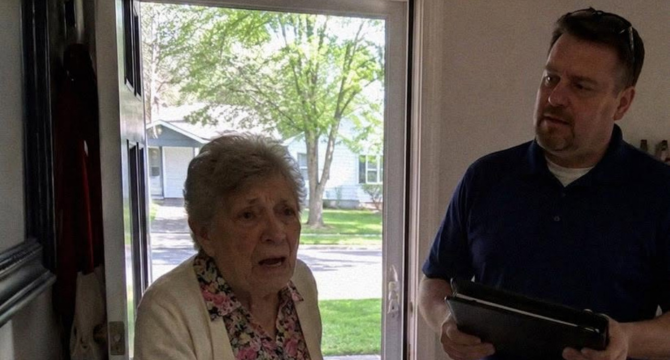
Mrs. Gilmore was 82-years-old and needed a cane to cross her own driveway, so when she burst through my front door like the house was on fire, I knew something was wrong.
Thomas, my realtor, nearly dropped his measuring tape.
I’d just signed the first listing form.
Mrs. Gilmore grabbed my wrist and said, “Tori, you can’t sell this house.”
I blinked at her. “Mrs. Gilmore, what are you doing?”
I knew something was wrong.
Her eyes were wet.
“Your mother made me promise to stop you.”
Mom had been dead for three weeks.
I looked down at the papers on the kitchen counter, then back at the woman who had lived next door to us for almost 40 years.
“Stop me from selling Mom’s house?”
Mrs. Gilmore’s fingers tightened around my wrist.
Mom had been dead for three weeks.
“Please,” she whispered. “Don’t let strangers buy it. If this house belongs to someone else, it’ll be too late.”
Thomas cleared his throat. “Ma’am, this is a private appointment.”
Mrs. Gilmore didn’t even look at him.
“Tori,” she said, “Natalie knew you would try to run.”
I pulled my hand back.
“Get out.”
Her face crumpled. “I promised her.”
“I said get out.”
“Ma’am, this is a private appointment.”
For a second, I thought she might argue. Instead, she turned and walked out, leaving Thomas and me with the listing papers, Mom’s chipped yellow mug, and a silence so thick I could barely breathe.
Three weeks after Mom’s funeral, I had made what I called a practical decision.
I was going to sell the house where I grew up.
The yard was too big. The rooms were too quiet. The memories were everywhere.
I thought she might argue.
But that wasn’t the whole truth.
I wanted to get away from the place where Mom’s silence still lived.
When my marriage fell apart, I’d sat at this same kitchen table and asked her for one thing.
“Just tell me you’re on my side.”
Mom had looked at me with tired eyes and said, “Tori, you need to stand on your own two feet.”
I’d never forgiven her for that.
“Just tell me you’re on my side.”
So that morning, before Thomas arrived, I stood in her kitchen with a donation box at my feet and yanked open drawers like grief was something I could sort.
My phone buzzed on the counter.
My ex-husband, Jared.
“Heard you’re selling your mom’s place. Probably best. You don’t need another emotional project right now.”
I stared at the screen until my jaw hurt.
My phone buzzed on the counter.
Then the doorbell rang.
Thomas was a local realtor with silver glasses, polished shoes, and the careful voice people used around fresh grief.
“Are you sure you want to do this today?” he asked.
“Yes.”
“We can wait a few weeks.”
“If I wait until I’m ready, this house will still be here when I’m 80.”
“Are you sure you want to do this today?”
He stepped inside and looked around. “The bones are great.”
“My mother kept it perfect.”
“Natalie was very particular.”
“That’s one word for it.”
He followed me to the kitchen and measured the window over the sink while I tried not to look at Mom’s yellow mug. It was still hanging from the same hook. Chipped rim. Ugly as sin.
“The bones are great.”
“I want it listed fast,” I said.
“Fast usually means a lower offer.”
“I don’t care.”
“No,” he said gently. “You’re grieving.”
I opened a cabinet too hard. “I’m efficient.”
“Sometimes those look the same.”
“Fast usually means a lower offer.”
“Not in my family.”
He wrote something on his pad, and before he could ask another careful question, Mrs. Gilmore burst in and blew a hole through the morning.
That night, I tried to pack. I only made it through one drawer.
Mom’s measuring spoons. Rubber bands around old mail. A pharmacy receipt from the week before she died.
I dropped the receipt like it had burned me and sat at the kitchen table.
He wrote something on his pad.
At 1:14 a.m., I wrote on the back of an envelope:
“Why can’t I sell the house?”
I crossed it out.
Then I wrote it again.
By eight the next morning, I was on Mrs. Gilmore’s porch.
Christine, Mrs. Gilmore’s daughter, opened the door before I could knock twice. She looked tired, but not surprised.
“Why can’t I sell the house?”
“I need to talk to your mother.”
“She didn’t sleep.”
Christine studied my face, then opened the door wider. “Come in.”
Mrs. Gilmore sat in the living room with a blanket over her knees. She looked smaller than she had the day before.
“Tori,” she said, eyes filling. “I’m sorry.”
“She didn’t sleep.”
“Don’t apologize. But please, explain.”
Christine sat beside her. “Natalie told us enough. Mom panicked yesterday.”
“She said my mother made her promise to stop me.”
“She did.”
My throat tightened. “Why?”
Mrs. Gilmore looked down at her hands. “Because Natalie knew grief would make you run before truth could catch up.”
“Mom panicked yesterday.”
Christine stood. “She left something for you.”
She returned with a white envelope.
My name was written on the front in Mom’s handwriting.
“What’s that?”
“Your mother left it with us years ago,” Christine said. “Only if you tried to sell.”
Mrs. Gilmore’s voice softened. “She knew you’d argue if she told you herself.”
“She left something for you.”
“That sounds like her.”
“She also knew she hurt you.”
That made me look up.
I took it.
Inside was one note.
“Before you sell this house, you deserve to know the truth I kept from you all these years.
I know you think I chose silence over you during your divorce.
Check the bottom drawer of my sewing table.”
“She also knew she hurt you.”
I folded the note with shaking hands.
Christine watched me. “What now?”
I stood. “Now we go open the drawer.”
Christine blinked. “Right now?”
“Yes.”
Mrs. Gilmore pushed her blanket aside.
“You don’t have to come,” I told her.
“I promised your mother,” she said, reaching for her cane. “And I already failed her once yesterday by being messy about it.”
“Now we go open the drawer.”
Back at Mom’s house, the three of us went straight to Mom’s sewing table.
I opened the bottom drawer.
“Under the blue cloth,” Mrs. Gilmore said.
I pulled it back.
There were condo brochures underneath.
Highlighted floor plans.
I opened the bottom drawer.
Notes in Mom’s handwriting.
Lakeview unit.
No stairs.
Morning sun.
Close to pharmacy.
“She wanted to move,” I said.
Christine nodded. “For years.”
“No. She loved this house.”
Mrs. Gilmore’s mouth tightened. “She loved what it could do for you.”
Under the brochures was a thick black binder.
“She loved this house.”
The label read:
For Tori.
I set it on the sewing table and opened it.
The first pages were mortgage records, insurance papers, trust documents, and a letter from an attorney explaining that the house would pass cleanly to me.
No delays. No shared claims. No strings.
“What is all this?”
The first pages were mortgage records.
“Your ground,” Mrs. Gilmore said.
I looked at her.
“Your mother cried the day you moved out after the divorce,” she said. “Not because she thought you failed. Because you would not let her help.”
“She told me to stand on my own.”
“She did,” Mrs. Gilmore said. “Then she made sure the ground under you would not move.”
“She told me to stand on my own.”
That should have comforted me.
Instead, it made me angry.
“No. Don’t make her noble. I begged her to say one sentence, and she couldn’t say it.”
Christine touched the binder.
“Keep reading.”
The next section was printed emails.
it made me angry.
All from Jared to Mom.
My skin went cold.
“What is this?”
“Read one,” Christine said.
“I don’t want to.”
“Then he’ll keep sounding reasonable in your head.”
I looked down.
“What is this?”
“Natalie,
I worry Tori is making emotional decisions. She struggles when things don’t go her way. I hope you won’t encourage her to turn this divorce into a fight.”
There were red notes in the margins.
Mom’s handwriting.
“He sounds polite when he wants control.”
“Don’t answer emotionally.”
“Save everything.”
I turned the page.
There were red notes in the margins.
“A smaller apartment would be better for Tori. Less pressure. Less upkeep. She needs to be realistic about what she can handle.”
In red ink, Mom had written:
“He wants her tired. He wants her desperate. Don’t help him.”
My hands started shaking.
I turned another page.
“Don’t help him.”
There was a note from Mom.
“Tori will hate my silence. Let her. Better that than giving him words to use against her.”
The page blurred.
“So she let me think I was alone because it was useful?”
Mrs. Gilmore leaned forward. “No, honey. She let you think she was cold because she was afraid he’d use her warmth against you.”
“Tori will hate my silence.”
“That doesn’t make it hurt less.”
I shut the binder.
“Love would’ve said, ‘I believe you.'”
She didn’t defend Mom past the truth.
“That doesn’t make it hurt less.”
Christine pulled one more envelope from the back pocket. “She said to give you this after you were angry enough to listen.”
I opened it.
“Tori,
I wanted to tell you I was on your side.
I was.
He wanted me angry. Easy to quote.
So I became careful. Hard to use.”
“I wanted to tell you I was on your side.”
“I’m sorry my silence hurt you. I thought I was building you a wall. I didn’t understand that it felt like a locked door.
I kept the house because I wanted you to have one place that was yours.
Not his. Not mine.
If you still want to sell it, sell it. But don’t sell it because you think being alone makes you strong.
You were never alone.
You just had a mother who loved badly out loud and better in paperwork.
Mom.”
I sat on the sewing room floor.
“You were never alone.”
Christine crouched beside me but didn’t touch me.
“I hated her,” I whispered.
Mrs. Gilmore’s cane tapped once. “No. You hated what you thought she did.”
The next morning, I called the attorney listed in the binder.
By noon, I sat in her office with the papers on my lap.
“Can I sell the house?” I asked.
“I hated her.”
“Yes,” she said. “It’s yours.”
“Would selling it hurt me?”
“That depends why you’re selling. If some financial issues are still being discussed, a rushed sale could let your ex call it a stress decision. He might not win, but you’d hand him a stick.”
The attorney slid a page toward me. “She fought in a way that made records.”
That afternoon, Thomas called.
“Would selling it hurt me?”
“I have a cash buyer who wants to see the house tomorrow.”
I looked at the binder.
“Come by,” I said. “Bring the paperwork.”
“You’re sure?”
“No,” I said. “But I’m paying attention.”
“Bring the paperwork.”
The next day, my aunt came by with sandwiches and opinions. Two cousins followed. Christine crossed the lawn with Mrs. Gilmore when she saw the cars.
Then Jared walked in behind my aunt like he had been invited, like he still belonged in Mom’s kitchen.
“I heard Thomas was coming,” he said.
“From whom?”
He smiled. “People talk.”
“They do when you call them first.”
“I heard Thomas was coming.”
His smile twitched.
My aunt sighed. “Please, not today.”
Jared lifted both hands. “I’m just trying to make sure Tori doesn’t rush into something she’ll regret.”
There it was.
That careful voice. That soft concern. The leash he used in public.
Thomas arrived five minutes later with his folder.
“Please, not today.”
Jared glanced at the binder on the table. “What’s that?”
“Something Mom left me.”
“More emotional weight?”
I opened the binder.
He stopped smiling.
I read one email aloud. “I worry Tori is making emotional decisions. If she keeps the house, she may use it to avoid making practical choices.”
“Something Mom left me.”
My aunt frowned. “You wrote that to Natalie?”
“I was concerned,” he said.
“No,” I said. “You wanted Mom to side with you so I’d have nowhere solid to stand. If she agreed I couldn’t handle the house, you could call every choice I made unstable.”
I read Mom’s red note beside it.
“He wants access to the house through fear. Don’t give him a door.”
“You wrote that to Natalie?”
The kitchen went silent.
Mrs. Gilmore stepped beside me. “Natalie wasn’t neutral. She was protecting Tori badly, but she was protecting her.”
Christine looked at my aunt. “She shut everyone out because she thought silence was safer than giving him words to twist.”
Jared pointed at Thomas’s folder. “This proves my point. She’s letting grief decide.”
I touched Mom’s handwriting.
“She was protecting Tori.”
Then I looked at Thomas.
“Cancel the sale.”
Thomas nodded once. “Done.”
Jared stepped forward. “Tori, don’t be impulsive.”
“No,” I said. “I’m being informed.”
Nobody moved.
“Cancel the sale.”
“I’m done selling pieces of my life to prove I don’t need anything. I’m done letting you call control concern. And I’m done mistaking being alone for being strong.”
Jared looked around and understood the room wasn’t his to manage.
He left without goodbye.
“I’m done letting you call control concern.”
The next morning, I opened every window, washed Mom’s yellow mug, and placed it beside mine. Then I found one last note in her recipe box.
“When you are ready, make this place yours. I only kept it safe until then.”
I thought selling the house would prove I was free.
Keeping it proved I finally was.