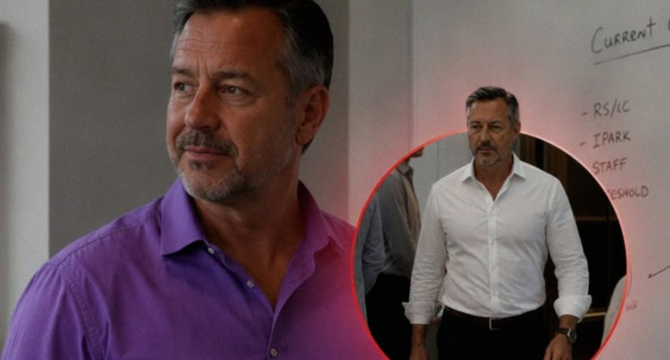
I worked for Mr. Carter for seven years before I ever saw him wear white.
That sounds ridiculous, I know. Out of all the things a person could notice about a CEO, I fixated on his shirts. But if you had worked in our office, you would have noticed it too.
The man dressed like a human highlighter.
Neon green on Monday. Violent orange on Tuesday. Purple so bright it made your eyes hurt. Coral pink. Canary yellow. Electric blue. He wore colors that made everyone else look like they were attending a funeral.
Clients remembered him. Investors joked about him. New hires whispered about him by the coffee machine. And every single person who stayed longer than a week learned the same strange fact:
Mr. Carter never wore white.
Not cream. Not ivory. Not light gray, trying to pass for white. I mean white-white. Printer paper white. Hospital hallway white.
Never once.
The first time I heard the reason was in my third month there.
A new sales rep named Dillon had just started, and he was one of those people who asked questions the rest of us had enough self-preservation to keep to ourselves.
We were in the break room. Mr. Carter walked in wearing a red shirt so bright it looked radioactive. Dillon laughed and said, “Sir, serious question. Do white shirts offend you on a spiritual level?”
The room went still for half a second because, again, you do not say things like that to your boss.
But Mr. Carter just smiled.
It was a strange smile, now that I think about it. Calm, polite, a little too practiced.
He stirred sugar into his coffee and said, “If you ever see me wearing white, call the police.”
Everyone burst out laughing.
Dillon grinned. “That bad, huh?”
Mr. Carter lifted his coffee. “That bad.”
Then he walked out.
We all treated it like one of his eccentric little lines. He had a few of those. Nothing dramatic, just enough oddness to make him memorable.
But over the years, he repeated it.
Not often. Just enough that everyone remembered.
Once at a holiday party, someone gave him a white dress shirt as a joke. Once, when Gina, the receptionist, asked whether he owned a tux. Once, a client joked that he’d probably show up to his own wedding in lime green. Each time, same smile. Same exact words.
“If you ever see me wearing white, call the police.”
And every time, he changed the subject.
That was Mr. Carter in general. Eccentric, private, respected. Early 50s, lean, silver at the temples, the kind of man who somehow looked expensive even with his sleeves rolled up. He wasn’t exactly warm, but he was fair.
He remembered details about your life. He sent flowers when your father died and expected your quarterly numbers by Friday. He could be funny when he wanted to be, and when he got quiet, the whole room listened.
People trusted him.
I trusted him.
So when I walked into the office last Tuesday morning and saw him standing by the reception in a plain white shirt, my whole body locked up.
I stopped walking.
Coffee sloshed over the lid and burned my hand, and I barely noticed. He was standing near Gina’s desk, one hand in his pocket, staring through the front windows toward the parking lot.
White shirt. No tie. Crisp collar. No color anywhere.
Gina laughed first, because she laughed when she was nervous.
“Well,” she said, “I hate this already.”
A few people chuckled.
“Did the rainbow finally reject you?” “Sir, are we supposed to evacuate?” “Please tell me laundry day went badly.”
Usually, Mr. Carter would have given something right back. He was quick that way. Dry, sharp, just amused enough to keep people relaxed.
Instead, he turned, and I saw his face.
He looked awful.
Not sick. Worse than sick. Drained. Like he hadn’t slept. His jaw was tight, his eyes were bloodshot, and there was sweat along his hairline even though the office was freezing. He gave us a smile that barely existed.
“Good morning,” he said.
Then he went to his office.
The floor buzzed all morning. People joked about it, but in that too-loud way people do when they’re trying to make themselves feel normal. At 10:00, I brought him updated numbers for a client review. He was sitting at his desk, but he wasn’t reading anything. He kept glancing at the glass wall of his office and then past it toward the elevators.
I set the folder down. “You okay?”
He looked up too fast.
“Fine,” he said.
I hesitated. “You’re wearing white.”
The second I said it, I knew I should have shut up. He looked at his sleeve like he’d forgotten what he had on. For one second, all the color left his face.
Then he let out something that might have been a laugh.
“So I am.”
I should have left then. Instead I said, “You used to tell people if we ever saw you in white, we should call the police.”
He stared at me.
Not annoyed. Not embarrassed. Just tired in a way that made me feel like I’d touched something raw.
“Did I,” he said quietly.
I waited for him to smile. He didn’t.
I tried once more. “Was that a joke?”
He looked past me, through the glass, out at the office floor where phones were ringing and people were pretending not to look into his office.
Finally, he said, “Some jokes last longer than others.”
That answer sat in my stomach like a stone.
By noon, I had convinced myself three different times that I was overreacting. By 2:00 p.m. I was worrying again. Twice, I saw him go completely still and look toward the parking lot. Once I caught him peering through the blinds like he expected someone to be watching from across the street.
Around 3:00 p.m., Gina came to my desk and whispered, “Does he seem off to you?”
“Very.”
She lowered her voice more. “Are we really not talking about the white shirt thing?”
“We’ve been talking about it all day.”
“You know what I mean.”
I did.
By 4:30 p.m., I felt stupid, paranoid, and weirdly sick. I sat with my phone in my hand, hearing his voice from years ago.
“If you ever see me wearing white, call the police.”
Maybe it had been a joke. Maybe he was just having a terrible day. Maybe I was about to become a permanent office story for all the wrong reasons.
Then I looked through the glass wall again and saw him standing at his window with one hand braced against the frame, staring toward the lot with the kind of fear a person can’t fake.
I picked up the phone and called.
I used the non-emergency number because I wasn’t completely insane. The dispatcher listened while I explained the colored shirts, the repeated warning, the white shirt, the way he was acting, and the fact that I knew how ridiculous it sounded out loud.
There was a pause.
Then she said, “What is the company address?”
That was the moment it stopped feeling ridiculous.
Two detectives showed up around 5:30 p.m., just as people were starting to pack up. One man, one woman. Suits, not uniforms. Both looked serious in a way that immediately made my pulse jump.
Gina saw them first and mouthed, “Oh my God.”
They asked for Mr. Carter by name. The male detective spotted the white shirt through the glass office wall, and his whole face changed.
Not confusion. Recognition.
He walked straight into the office and said, “Mr. Carter, where is your brother?”
The room went dead silent.
Mr. Carter stood so still he looked carved out of stone. His hand tightened around the back of his chair.
Then he whispered, “He’s already here.”
And right behind us, the elevator doors opened.
Everyone turned.
A man stepped out wearing the same white shirt. Same height. Same build. Same silver at the temples. Same face. For one terrible second, my brain refused to process what I was seeing. It felt like watching Mr. Carter step out of his own reflection.
Someone near accounting screamed.
The second man looked around the office, found Mr. Carter, and said, “Well. You finally did it.”
His voice was almost the same, too. Rougher, maybe. Like the same person after years of bad sleep and worse decisions.
The female detective moved between them. “Michael, keep your hands where I can see them.”
Michael.
His identical twin brother.
Panic went through the office in one ugly wave. People backed away. Chairs scraped. Nobody knew who to watch. Nobody knew which one of them was dangerous.
Michael slowly raised his hands. “Relax. If I wanted to hurt him, I wouldn’t have used the lobby.”
Mr. Carter’s voice came out sharp. “Stop acting like this is a game.”
Michael stared at him. “You think I came here for a game?”
The detective snapped, “Enough.”
But that only worked for about two seconds.
Mr. Carter looked at his brother like he was staring at a body that had climbed out of a grave. “You disappear for 20 years and show up now?”
Michael gave a short, bitter laugh. “I’ve been back for months. You just didn’t know it was me.”
Mr. Carter went pale. “What did you do?”
“What I should’ve done years ago,” Michael said. “I finished gathering the proof.”
The male detective looked at both of them. “We received the package yesterday.”
Nobody in that office understood a word of this, but the detectives clearly did.
The female detective turned to Mr. Carter. “The documents suggest long-term embezzlement inside this company. Shell vendors. Hidden transfers. Altered reporting. Millions missing over time.”
The room exploded.
“What?” “That’s impossible.” “Inside the company?” “Who the hell took it?”
Mr. Carter ignored all of us. He looked only at Michael. “You sent those records?”
Michael said, “I found them.”
“And you thought walking in here like this was smart?”
“I thought you wouldn’t listen any other way.”
That was when something in Mr. Carter’s face shifted.
Not fear. Pain.
Old pain.
“I wore white because I knew you were coming,” he said.
Michael blinked. “What?”
Mr. Carter’s voice was shaking now. “I wore white so the police would be here before you arrived.”
Michael’s expression hardened instantly. “Because you thought I was the threat.”
“No,” Mr. Carter said.
The room went quiet again.
He swallowed hard. For the first time since I’d known him, he didn’t look like a CEO at all. He looked like a man who was suddenly too tired to keep performing.
“I wore white because I didn’t trust either of us to do this alone,” he said. “If we met in private, we’d do what we’ve always done. We’d believe the worst.”
Michael stared at him.
Mr. Carter glanced around at the detectives, the staff, the entire ugly public scene. “I needed witnesses.”
Michael didn’t answer for a second. When he finally did, his voice was lower.
“So that’s what this was.”
“Yes.”
The detectives took both brothers into the main conference room. Then the whole office turned into a pressure cooker.
Nobody went home. Nobody worked. HR made one weak attempt to send people home, but by then, the finance team had already been pulled into interviews. IT got asked for system access. Legal showed up looking half-dressed and furious. It was chaos.
Around 7:00 p.m., they brought in our CFO, Richard.
Richard had been with the company forever. Mid-60s, perfectly groomed, perfectly calm, the kind of man who made every problem sound temporary. If Mr. Carter was the face of the company, Richard was the spine. He had worked beside him for 20 years. Everybody trusted him.
When he was led into the conference room, he actually smiled.
“What is all this?” he asked. “Somebody want to fill me in?”
No one answered.
He went in relaxed.
He came out 20 minutes later looking like somebody had drained his blood.
That was when the rumors really took off. By midnight, forensic accountants had access to half the system. Computers were seized. Department heads were interviewed. People were crying in the hallway. One of the detectives told us not to touch records, delete emails, or discuss financial files.
At around 12:30, as we were finally being released, I saw both brothers standing near the elevators.
Together, but not close.
Up close, the differences were clearer. Mr. Carter held himself like a man who had spent years controlling every expression. Michael looked like a man who had spent years paying for old mistakes. More lines. Rougher edges. Tired in a harder way.
Still, side by side, they were unmistakably brothers.
I don’t know what possessed me, but I walked over.
Mr. Carter looked at me first.
“I made the call,” I said.
He nodded once. “I know.”
“I wasn’t sure if I was being stupid.”
Michael gave a dry laugh. “Apparently you were the only person in the building paying attention.”
Mr. Carter looked down at his sleeve. “Thank you.”
That should have been the end of it, but it wasn’t.
Over the next week, the story came out in pieces.
Years before I worked there, the company had belonged to both brothers. Carter and Michael. Twins. Co-founders. Different personalities, same brain for business. One could walk into a room and make investors trust him in five minutes. The other could spot fraud in a spreadsheet like a bloodhound. Together, they had built the company fast.
Then Michael developed a gambling addiction.
That part was true.
He stole money. Investors got hurt. The company nearly collapsed. Michael disappeared before the full legal mess could bury him. Carter stayed, rebuilt the firm, and became the sole face of the business.
That was the version everyone knew.
What nobody knew was that Richard Hale had been poisoning them against each other long before everything fell apart.
Small things at first. Private comments. Carefully planted doubts.
“Your brother is asking strange questions about your decisions.” “He told investors you were unstable.” “He thinks you’re reckless.” “He says you’re hiding things.”
Michael’s addiction made him easier to distrust. Carter’s pride made him easier to isolate. By the time the first real scandal exploded, both brothers were already primed to believe the worst about each other.
Richard needed them divided.
Together, they checked everything. Apart, they were easier to manipulate.
Michael’s old crimes were real. That didn’t go away. But the missing millions in the current case? Those thefts started years later, after Michael vanished. Quietly. Systematically. Under Richard’s watch.
Michael found it first.
That was the bitterest part.
The disgraced brother nobody trusted had spent years trying to make himself useful enough to be believed. He had traced shell companies, false reimbursements, offshore transfers. He had gathered records, cross-checked dates, and eventually reached out to his brother in secret.
At first, Carter thought it was a scam. Then a trap. Then, slowly, painfully, he started to see patterns he had missed because the wrong man had been sitting closest to him for two decades.
So the brothers made contact.
And because neither of them really knew how to trust without some kind of shield, they fell back on the old signal.
White.
Not a distress call.
A surrender.
A white flag.
The public meaning of it had always been simple: danger. Call the police.
The real meaning was more vulnerable than that.
I cannot do this alone. I am putting down the costume. I am asking for witnesses because I want this to end without us destroying each other again.
Richard tried to flee two days later.
They arrested him at the airport.
That should have been the satisfying ending. Villain exposed. Company saved. Brothers reunited.
Real life doesn’t work that cleanly.
Because even after Richard was arrested, even after the missing money was tied to him, even after Michael’s evidence checked out, the damage between the brothers didn’t magically disappear.
A few days later, I was walking past Mr. Carter’s office when I heard voices and stopped.
Michael was inside.
Mr. Carter said, “You still stole from people.”
Michael answered, “I know.”
“You still left me to clean it up.”
“I know.”
“You let me believe every awful thing they said about you.”
There was a long silence.
Then Michael said quietly, “You made that easy.”
I should have walked away. I didn’t.
Mr. Carter laughed once, and it sounded broken. “You think I don’t know that?”
Michael didn’t answer.
Mr. Carter said, softer, “I built a whole life around not being surprised again.”
Michael looked at him. “No. You built a life where nobody could get close enough to matter.”
Mr. Carter’s face changed. He didn’t argue.
After a second, Michael glanced at the closet where a row of bright shirts still hung like stage costumes.
“The shirts,” he said.
Mr. Carter looked at them too. “Yeah.”
“You used to think people would see through you if you looked ordinary.”
Mr. Carter gave a tired smile. “I thought if I looked ridiculous enough, nobody would ask real questions.”
That was the truth of it.
The colorful shirts had never been eccentricity. They were armor. Noise. A way to make himself visible without being known.
A week later, the company held an all-staff meeting in the lobby.
Mr. Carter stood at the front in another white shirt.
No neon. No orange. No performance.
Michael stood beside him in a dark suit, no tie.
You could feel the room notice.
Mr. Carter looked out at all of us and said, “For years, many of you believed my shirts were a quirk. They were not. They were a wall. I built that wall because I was ashamed, and because I found it easier to become a character than a person.”
Nobody moved.
Then he looked at Michael, and his voice changed.
“The greatest mistake of my life was not just trusting the wrong man. It was how easily I accepted the worst story about the person who knew me best.”
Michael swallowed hard.
When he spoke, his voice was rough. “The greatest mistake of mine was giving everyone good reason to believe it.”
No polished corporate speech. No fake resolution. Just that.
And somehow that landed harder than anything else.
They weren’t asking us to admire them. They weren’t pretending the past had become noble just because the right villain had been caught. They were finally telling the truth.
After the meeting, people started clapping slowly, awkwardly. I didn’t.
I just stood there with tears in my eyes and felt stupid for it.
Maybe because I had spent years seeing only Mr. Carter’s costume. Maybe because the whole thing had turned out not to be about crime in the way I first thought.
It was about trust.
About how easy it is to lose someone when pride, shame, and the wrong whisper in the right ear get there first.
Yesterday, I passed both brothers in the hallway.
Mr. Carter was wearing white again, sleeves rolled up, coffee in hand. Michael was beside him arguing about a vendor contract like they’d stepped out of one long nightmare and straight back into being brothers.
Michael said, “You still have terrible taste.”
Mr. Carter snorted. “You committed fashion crimes with my face for years. I’d stay humble.”
Michael glanced at me. “Did he ever make you wear one of those nuclear orange shirts for team spirit?”
“Twice,” I said.
Mr. Carter looked offended. “It was one time.”
“It was twice.”
He gave me the first real smile I’d seen from him in weeks. Not the polished one. Not the public one. Just a tired, genuine smile.
And for the first time, white didn’t look like a warning.
It looked like what it had really been all along.
Not fear. Not surrender to danger. Just a man finally putting down his armor.