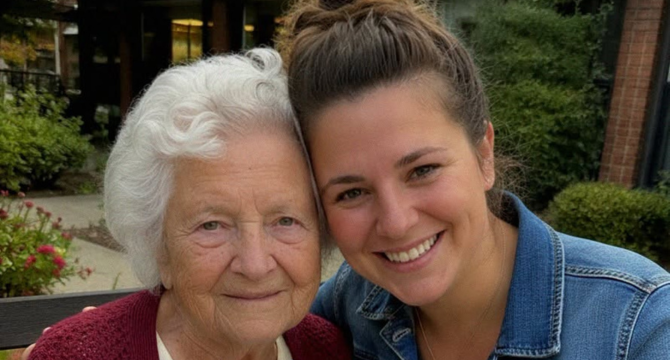
Some families have traditions. Holiday recipes passed down through generations. Sunday dinners that never get canceled. Inside jokes nobody outside the family understands.
My family had silence.
My mother and my grandmother had perfected that silence over decades. They could be in the same room for an entire Christmas afternoon and exchange maybe 30 words.
That’s it.
My family had silence.
My mother’s name is Daisy. My grandmother’s name is Clover. Two soft names for two women who carried harder things inside them than I ever knew.
I grew up treating their silence as background noise. Just the way things were.
Whenever I pushed — and I pushed plenty, especially as a teenager — my mother would give me the same answer every time.
“Some things can never be forgiven, Amber.”
No elaboration. No context. No opening for a follow-up question. The conversation would simply close, like a door pulled gently but firmly shut.
I grew up treating their silence as background noise.
I learned eventually to stop knocking.
What I never learned was what was behind it.
What made it stranger was how close I was to my grandmother despite all of it.
She was warm in a way that filled rooms. She remembered every small thing I’d ever told her, asked follow-up questions months later, and kept a tin of the exact shortbread I liked in the second drawer of her kitchen.
What I never learned was what was behind it.
When I was 11 and convinced I had no friends, she sat with me at that kitchen table for an entire Saturday afternoon without once telling me it would get better.
She just stayed. That was her gift. She simply stayed.
She helped raise my younger brother, Gabriel, and me in the years when my mother was working double shifts and barely keeping everything together.
She was at our school plays, our soccer games, and our bad report card conversations.
She simply stayed.
She showed up for everything.
Which, looking back, probably made things worse between Mom and her.
Every hour my grandmother spent with us seemed to pull something tighter in my mother. Not jealousy exactly. Something older and more complicated than jealousy.
I could see it in the way her jaw would set when my grandmother walked through the door, the way holiday dinners would start warmly enough and then curdle around something.
She showed up for everything.
A comment, a look, sometimes nothing at all. Until someone’s chair scraped back and a door closed somewhere in the house and the rest of us sat quietly pretending we hadn’t heard it.
I had built my own theories over the years.
Something terrible must have happened before I was born. Something my grandmother did that my mother decided was unforgivable.
I filled in the blank with various guesses depending on my age and mood.
I was wrong about all of them.
I had built my own theories over the years.
The stroke came on a Tuesday in February.
Mild, the doctors said, which is a word that means something different to doctors than it does to the people sitting in hospital waiting rooms at seven in the evening.
My grandmother survived. She was lucid, she was herself, she knew my name and squeezed my hand and asked immediately whether someone had fed her cat.
But she could no longer live alone safely, and everyone in the family understood that something had to change.
She could no longer live alone safely.
I assumed, without really thinking about it, that she would move in with us. It seemed obvious. We had the space. She had spent years inside our house anyway.
My mother’s answer came the same evening, while Gabriel and I were still in our coats in the entryway.
“She’s going into a nursing home.”
I stared at her. “She doesn’t need a nursing home, Mom. She just needs someone around…”
“She needs to be far away from this family, Amber.”
“She doesn’t need a nursing home, Mom.”
I waited for her to say something else. To soften it or explain it or at least acknowledge how cold it had sounded.
Mom didn’t. She turned back to the kitchen counter and the subject was closed. But the way she said it stayed with me all night.
Not cruel, exactly. Exhausted. Like someone who had been holding something at arm’s length for a very long time and was finally, quietly, desperately, setting it down.
A week later I drove to my grandmother’s house to help pack her things.
It’s a particular kind of sad, that task. Folding a person’s life into cardboard boxes, deciding what matters and what gets left behind.
The way she said it stayed with me all night.
I moved through the kitchen first, then the living room, wrapping photograph frames in newspaper and labeling boxes in marker. Then I worked through the bedroom closet, where decades of accumulated storage had piled up behind everything else.
I almost missed it entirely.
It was tucked behind two stacked storage containers in the far back corner. A small music box, wooden, with an ornate floral pattern worn thin at the edges.
I had spent half my childhood in that house. I had never once seen it before.
I almost missed it entirely.
I stood there for a moment just holding it.
Then I wound the key on the bottom. A soft, slow melody came out, something I didn’t recognize. It felt old, like a lullaby from before my time, the kind of song that exists only in the memories of people who heard it as children.
Inside, folded into a neat square, was a piece of paper.
A list of names and birthdays, handwritten in my grandmother’s careful cursive. All of us, I realized. All the grandchildren. Gabriel, me, and our cousins. Birthdays noted in order, small details penciled beside some of the names.
It felt old, like a lullaby from before my time.
I read slowly. Smiled a little at the note next to mine: She loves strawberry cake, not vanilla — remember this.
Then I reached the last line.
Gabriel’s birthday. His exact date, written precisely. But next to it, where his name should have been, was a different name entirely.
Michael.
I read it twice. Then a third time, slowly, in case I was misreading something obvious.
I wasn’t.
Where his name should have been, was a different name.
The name sat there in my grandmother’s handwriting, attached to my brother’s birthday, belonging to someone I had never heard of in my entire life.
Who is Michael?
I showed it to my mother that evening.
I have thought about that moment many times since. The way she was standing at the kitchen sink when I walked in, rinsing a glass, completely ordinary.
The way her eyes dropped to the paper in my outstretched hand and her whole body changed. Not with anger, the way I had half-expected, but with something that looked much more like fear.
I showed it to my mother that evening.
She took it from my hands so fast it almost tore.
“Your grandmother’s confused,” she snapped. “Throw this away.”
“Mom, she’s not confused. She’s never been confused, the doctors said her cognition is completely…”
“Throw it away, Amber.”
Her hands were shaking. I could see it clearly from where I stood. The paper trembled between her fingers before she folded it sharply and tossed it aside. I caught it before it even hit the floor.
She didn’t look at me again.
She folded it sharply and tossed it aside.
I didn’t sleep that night. I lay in the dark running the name through my head.
Michael. Said out loud it sounded almost familiar, the way a word sometimes does when you’ve heard it in a different context and can’t place where.
But I hadn’t heard it. I was certain I hadn’t.
The next morning, I drove to the nursing home.
When I set the music box on the table in front of my grandmother, she looked at it for a long moment without speaking. Her hand moved toward it slowly, the way you reach for something you thought you’d lost.
I hadn’t heard it.
Then her eyes filled. She placed her palm flat on top of it like it was something living.
“Now you’ll finally understand,” she said softly, “why your mother hates me.”
My chest tightened. The melody from the music box was still fading in my memory.
“Tell me who Michael is, Gran.”
She closed her eyes. Took a slow breath. When she opened them, she looked at me with an expression I had never seen on her face before.
“Now you’ll finally understand why your mother hates me.”
Not guilt, not quite. Something closer to relief. The expression of someone who has been carrying something alone for a very long time and has finally, against all expectation, been given permission to put it down.
“Michael was your mother’s first child,” she said.
For a second, I thought I’d misheard her.
“Before you. Before Gabriel. Before any of it,” Grandma added. “He was her little boy.”
“Tell me everything.”
And so she did.
I thought I’d misheard her.
My mother was only 19 when she married Dad. She was young, overwhelmed, and working whatever hours she could find, trying to build something solid out of very little.
My grandmother had stepped in the way she steps into everything. Completely, without asking permission, without keeping score.
For several years the four of them had been their own small world. My grandmother, Mom, Dad, and Michael. Navigating school and sickness and the ordinary chaos of raising a small child between four adults who loved him differently and equally.
Then Michael got sick.
The four of them had been their own small world.
I won’t pretend I handled the next part of the story with any composure. I sat across from my grandmother in that nursing home room and listened, and I felt something rearranging itself quietly behind my ribs.
The illness was serious. The kind that requires specialists and second opinions and decisions made at midnight with shaking hands and no clear right answer.
Every treatment choice became a battle. Mom, Dad, and Grandma were terrified, and fear in three people rarely pulls in the same direction.
They argued about doctors. About hospitals. About what to try next and when to try it and whether they were doing enough or too much or entirely the wrong thing.
The illness was serious.
Finally, Mom and Dad had agreed on a plan Grandma suggested, but things didn’t turn out the way they hoped for my brother.
Michael died before his fourth birthday.
The silence that followed that sentence was the loudest thing I had ever heard.
“She needed someone to blame,” my grandmother said. Her voice was steady but her hands weren’t, resting on top of the music box with a grip that had gone white at the knuckles. “I understood it. I understood it then, and I still do.”
“Did you ever blame yourself?” I asked.
Michael died before his fourth birthday.
Grandma thought about it the way she thinks about serious things. “For a while,” she admitted. “Then I realized it wasn’t helping either of us. So I let her have it.”
“You let her stay angry at you.”
“For 20 years,” she said plainly, without resentment. “Because what was the alternative? Tell her nobody was responsible? That we did everything possible and it still wasn’t enough?” She shook her head gently. “Grief doesn’t want to hear that, Amber. Grief wants somewhere to live. I just gave it somewhere to go. Then she had you and Gabriel, then your father passed away, and I became the sole recipient of your mother’s wrath.”
I sat with that for a long moment.
Then I drove home.
“I became the sole recipient of your mother’s wrath.”
My mother was in the kitchen when I got back. I said his name out loud — Michael — and watched her go completely still in a way I had never seen before.
What came out of her over the next hour came slowly. In pieces. Some of it matched what my grandmother had told me, but hearing it in my mother’s voice was different.
The guilt still so present after all this time, the second-guessing that had clearly never stopped, and the nights she had spent running through decisions that could no longer be changed.
What came out of her over the next hour came slowly.
At some point she stopped talking and just sat there. Her hands flat on the table. Her eyes somewhere else entirely.
Then, very quietly, she said: “I don’t even know if it was her fault anymore.”
She said it like a confession she had been keeping from herself.
“I’m not sure I ever really did.” A long pause. “But if I forgive her, if I actually let it go, then I have to accept that Michael is just gone. That there’s no reason. That we did everything we could and it still wasn’t enough and that’s simply the truth of it.”
Mom looked up at me.
“I couldn’t do that,” she whispered. “I couldn’t make myself do that.”
“I don’t even know if it was her fault anymore.”
I brought the music box to her a few days later.
We sat together at the kitchen table and she opened it herself, slowly, like she already knew what she would find inside.
She read the list of names in her mother’s handwriting — all of us, all the grandchildren, all the little notes and birthdays recorded with that same careful attention my grandmother brought to everything.
And at the top, in the same unhurried cursive as everything else, was Michael. Written in ink that had faded at the edges but never been crossed out. Never removed. Still there after everything.
She opened it herself.
My mother pressed two fingers over his name and didn’t speak for a long time.
I didn’t either.
Some things don’t need anything added to them. Some things just need to finally, quietly, be seen.
For most of my life, I thought my mother hated her mother.
The truth was far sadder.
They were both grieving the same little boy and had spent 20 years blaming each other for the fact that love hadn’t been enough to save him.