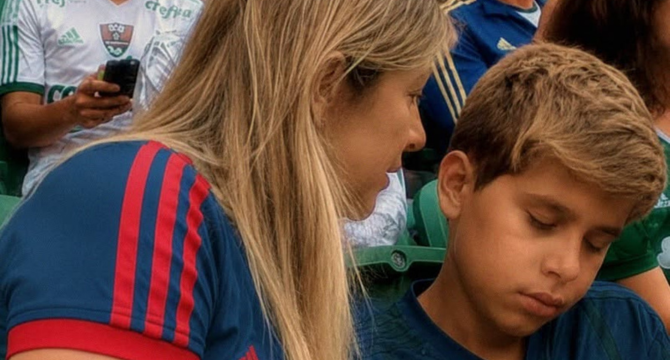
My husband and I have always taken our boys to football games. That is our thing.
Some families do beach trips and matching pajamas at Christmas.
We do stadium food, cold metal seats, overpriced foam fingers, and the kind of yelling that leaves your throat wrecked the next day.
Our sons grew up thinking a Saturday under stadium lights was as normal as dinner at the table.
So when we scored four seats for the championship game, my husband Dean acted like he’d won the lottery.
“Section 112,” he said, waving the tickets around in the kitchen.
“Good angle, close enough to feel the noise, not so close we get beer spilled on us, “He said that like it was an impossible dream.
By kickoff, the stadium was a living thing. Thirty thousand people packed into concrete and steel, all of them buzzing, stomping, and shouting.
The lights were so bright the field looked unreal, like something built just for television.
Music blasted between plays. Strangers high-fived like cousins. My younger son was vibrating in his seat from pure joy.
That was when I noticed the woman and the little boy a few rows down.
At first, it was just because they looked so still.
Everyone around them was standing, waving rally towels, and shouting at the field. But the boy sat motionless, hands folded in his lap, and his shoulders drawn in tight.
He looked about nine, maybe 10. He wore dark sunglasses even though the lights were already blazing overhead and the sky had gone fully black.
He didn’t look at the giant screen.
He didn’t react to the crowd.
He just sat there with his head slightly lowered, almost like he was listening to something the rest of us couldn’t hear.
His mother sat close beside him, leaning in every few seconds to whisper into his ear.
Not casually.
Constantly.
And with her other hand, she kept tracing quick patterns into his palm.
Over and over.
At first, I thought maybe he had sensory issues. Then maybe he was afraid of the noise. Then maybe she was calming him down through some kind of routine.
Whatever it was, I couldn’t stop watching.
Dean noticed me looking.
“What?” he asked, halfway through a hot dog.
I nodded toward them. “That little boy.”
Dean glanced down. “Hmm.”
“Do you see what she’s doing?”
He watched for maybe ten seconds. “I see, but I don’t understand what they are doing.”
I looked at him. “Likewise, I hope they are okay.”
The woman never once watched the game directly.
She would glance up at the field for a second, then immediately bend close and whisper to the boy while tracking quick patterns on his palm.
I looked around and realized that I wasn’t the only one who had noticed them.
A man two seats over from them had been drinking since we got there.
You could tell by the way he shouted half a beat too late at every play and clapped too hard and too long after anything exciting happened.
He was big, broad through the shoulders, red around the face, and getting more irritated by the minute.
At first, he was just muttering.
“Why even come if you’re not gonna watch?”
Then he got louder.
“Some people who actually wanted to watch the game could have taken those seats.”
His friends tried to quiet him once or twice, but he had already picked his target.
By the middle of the second quarter, he was openly staring at the woman every time she leaned toward her son.
The game was close and ugly and tense, the kind that makes people feel personally insulted by every missed catch.
Our whole section was on edge. So was he.
Then the woman started whispering again during a critical third down, and he snapped.
“Hey!” he barked.
A few heads turned.
The woman froze but didn’t look at him.
He stood up.
“Lady! Can you shut up?” he yelled. “Some of us are actually here to watch the game, not listen to you babble all night.”
The people around him stiffened.
A few pretended not to notice, which is what crowds do when they want conflict to disappear without getting involved in de-escalating things.
The woman flinched hard, like she’d been hit by the sound alone.
But she didn’t answer.
She just looked at the screen, took her son’s hand again, and kept tracing in his palm.
The man gave an ugly laugh. “Oh, so now you’re ignoring me, too?”
Dean was already rising beside me, keen to stop the confrontation.
I put a hand on his arm. “Go.”
He moved down the steps fast, but the drunk man moved faster.
He stepped into the row and loomed over the woman and her son.
“I’m talking to you,” he shouted. “If you can’t behave like everyone else, then leave.”
The boy jerked at that. Not dramatically. Just enough for me to see fear travel through him. His hand tightened around his mother’s fingers.
She stood up then.
She was not tall or threatening.
Just a tired-looking woman in a gray sweatshirt and jeans, putting herself between her child and a raging man who outweighed her by at least seventy pounds.
There were tears in her eyes.
And then she did something that silenced the entire section.
She turned fully toward him, one arm around her son, and said in a shaking voice, “My son cannot see the game.”
It wasn’t loud.
But in that sudden pocket of quiet, everyone heard it.
The man actually blinked.
She kept going before he could say anything.
“He lost most of his vision three months ago,” she said. “He is having surgery at six-thirty tomorrow morning. They don’t know if it will work.”
You could feel the whole section quietening down.
She continued, “They don’t know if this is his last night in darkness or the first night of the rest of his life.”
I could feel tears gathering in my eyes as she opened up.
She put a hand on her son’s shoulder, “His father loved this team more than anyone I have ever known, and he died last winter before he could bring him here.
The woman’s mouth trembled, but she lifted her chin anyway, “So I am describing the game to him the only way I know how, so he can feel close to his dad.”
“I am not deliberately trying to ruin your night,” she said. “I am trying to give my son one good memory of his father before the surgery tomorrow.”
A man who was sitting beside my boys suddenly stood up and said loudly, “She is not lying. My cousin’s daughter is deafblind. They do tactile signing. Not exactly like that, but similar.”
The woman’s words, combined with the man’s explanation, hit me hard.
Because suddenly what had looked strange looked intimate.
Necessary. Like a language made out of love and urgency.
And once I saw that, I couldn’t unsee it.
Unfortunately, not everyone in Section 112 had been as interested in understanding as some people were.
The big man who had confronted the woman just stared at her.
He had no anger left now. Just shock. Real shame arriving slowly and hard.
The little boy reached out, searching, and found the sleeve of her sweatshirt.
“Mom?” he whispered.
Her whole face changed instantly. Softer. She turned back to him and pressed his hand to her cheek.
“It’s okay, baby,” she said. “It’s okay.”
Dean had reached them by then, but he didn’t need to step in anymore.
Nobody did.
Because the man who’d been yelling suddenly looked like he wanted the ground to swallow him.
He sat down heavily on the empty seat beside the aisle.
He then dragged both hands over his face and said, quieter than I would’ve believed possible from him, “Oh my God.”
Then he looked up at her.
“Ma’am,” he said, voice cracking in a way that made the whole thing even sadder, “I am so sorry.”
She didn’t answer. I don’t think she had anything left in her.
But my older son, who had followed Dean halfway down the steps because 14-year-old boys think they are backup security, looked at me with tears already in his eyes.
His face was a reflection of everyone in the section. We were all emotional.
A woman behind me leaned forward and asked, “Do you want us to quiet down?”
The boy’s mother blinked. “No. No, please don’t. He liked to hear the cheers, groans, and celebrations.”
An older man in a team jacket called down, “What’s his name?”
She wiped under her eyes. “Eli.”
The whole section seemed to exhale around that name.
I stood up and moved down the row before I’d really thought it through.
“Hi,” I said softly when I reached her. “I’m Lana. Do you mind if I sit here for a second?”
She looked dazed, but she nodded.
Up close, she looked even more exhausted than I first thought. The kind of exhaustion that doesn’t come from one bad day.
Her son sat close against her side, his sunglasses reflecting the stadium lights like little black mirrors.
“I’m Paula,” she said.
“Eli,” I said gently, “I’m right here with your mom.”
He turned his face toward my voice.
“Are they winning?” he asked.
That about did me in.
I laughed through tears and said, “Not enough yet.”
That got the tiniest smile out of him.
The drunk man stood back up then, slower this time, as if he understood the intensity of his mistake now.
“Can I…” He swallowed. “Can I buy the boy whatever he wants? Food, jersey, anything? I know that doesn’t fix-“
Paula looked at him, and for a second, I thought she might tell him to go to hell.
Instead, she said, tired but honest, “He likes pretzels.”
The man nodded so hard it was almost painful to watch. “Pretzels. Got it.”
He practically ran.
Dean came down and crouched near Paula’s seat. “Need anything? Water? Space? Somebody to keep people back?”
She gave him a shaky smile. “No. Thank you.”
Then she looked at me and said the words that made this night even more emotional.
“I almost didn’t bring him.”
I said, “Why did you?”
She looked down at Eli’s hand in hers.
Her thumb moved over his knuckles as if she couldn’t stop touching him, like touch itself was the thread keeping her together.
“Because he wanted to feel closer to his dad on the eve of his big surgery,” she said.
For a second, I couldn’t speak.
Dean looked away and rubbed at his jaw.
Then Paula added, “My husband used to do play-by-plays in the living room for both of us. Like he thought he was on the radio.”
She gave a broken little laugh, “He’d yell at the TV and then explain every single thing Eli couldn’t quite follow. Tonight I just wanted to do it as well as his father would’ve.”
Just then, the man came back with a giant pretzel, two waters, and what looked like every candy option in the concession line.
Eli smiled when Paula pressed the warm pretzel into his hands.
“Is it salted?” he asked.
The man, still standing there like a scolded child, said, “Extra salted, buddy.”
Eli gave a solemn nod. “Good.”
That was the first laugh the section had shared since the shouting started.
From there, people started helping without making it a performance.
A college kid across the aisle pulled out his phone and turned the brightness up so Paula could better see her own hands while signing into Eli’s palm.
The older man in the jacket started quietly relaying formation changes to Paula whenever the field got too chaotic to follow from her angle.
My younger son took it upon himself to whisper, “Big run coming,” like he was part of an elite communication team.
And Paula, still leaning close to Eli, kept translating.
“Quarterback drops back.”
“Ball to the left.”
“Everybody is yelling because he almost got through.”
“Now they’re standing.”
Sometimes she whispered into his ear. Sometimes she signed quickly into his palm. Sometimes both.
At halftime, the big man returned again. This time sober.
He stood in the aisle and cleared his throat.
“My name’s Rick,” he said. “And I was out of line. Way out of line.”
No one interrupted.
He looked at Eli, then at Paula. “My son had surgery last year. To fix his leg. But I remember the night before.”
His voice cracked, “I remember thinking that if anyone so much as breathed wrong near him, I might lose my mind. And then I stood here and did exactly that to you. I’m ashamed of myself.”
Paula’s eyes filled again, but she nodded once.
Rick looked wrecked with relief just to have been acknowledged.
Then my husband, who has never met a problem he didn’t think could be fixed by logistics, asked the obvious question.
“What hospital?”
Paula hesitated. “St. Vincent’s.”
“What time?”
“Six-thirty check-in. Surgery at eight.”
The woman behind me asked, “Do you have family coming?”
Paula laughed without humor. “No. It’s just us”
“What about aftercare?” I asked.
That was the question that changed her face.
“It’ll be fine,” she said too fast.
Dean and I exchanged a look.
That is married-parent shorthand for: absolutely not, we are not letting “it’ll be fine” end this conversation.
So I asked gently, “What does ‘fine’ mean?”
Paula looked embarrassed now, which told me everything before she said it.
“It means I used the last of our savings to keep our insurance gap from pushing the surgery back another month.”
She sighed heavily, “It means I’m supposed to take unpaid leave for recovery month, and I haven’t figured out how bills and medicines will be paid for during that time.”
There it was.
The real weight under all of it.
Not just fear of the surgery. What came after.
Medication, follow-ups, missing work, rent, and food. The thousand ugly little expenses that gather around a crisis and wait until you’re weakest to strike.
Rick, of all people, was the one who moved first.
He turned to the section and said, loudly enough for everyone nearby to hear, “We can’t let her handle all that on her own. I’m sure we can help.”
Now, I am not saying Section 112 became saints in a minute.
But people are better than they look when something finally touches their heart.
The college kid already had his phone out. “I can set up a fundraiser.”
He added, “Then the funds can handle the after-surgery care. I’ll share the link for anyone who wants to contribute to do so.”
Someone else said, “I have cash. I can give my contributions right now.”
Dean said, “Do it.”
Rick dug his wallet out and slapped a hundred-dollar bill into my hand. “Start there.”
An older woman two rows back said, “I’ll match it.”
Then a man in a team beanie said, “I’m putting down fifty.”
Then somebody farther up shouted, “A hundred from us.”
Within five minutes, half the section was passing phones, cash, Venmo names, and email addresses around like we were organizing a bake sale in the middle of a championship game.
Paula kept saying, “You don’t have to do this.”
And everyone kept answering some version of, “We know.”
Then my son did something I’ll remember forever. He asked for a picture of Eli and his father at the game, and Paula sent it to him.
I wondered what he was up to, but I was too busy following up on the fundraiser.
I realized a few minutes later that he had taken the picture to the commentators with a special request.
When the giant screen flashed to a “fan memories” feature between plays, our section was in tears.
A photo came up of a man holding a little boy on his shoulders at an earlier game, both of them in team jerseys.
Paula made a sound beside me as she saw her husband and Eli.
The caption read: “For Mark, forever part of the crowd.”
The whole stadium cheered, not knowing what they were really cheering for.
But our section knew. Paula covered her mouth.
Eli turned toward the roar and asked, “Mom? What happened?”
She took his hand, pressing each word into his palm slowly this time, carefully, like she wanted him to feel every letter.
“They put Daddy on the screen,” she whispered.
Eli went still, and then he smiled.
A sweet, private smile that somehow broke every adult around him.
Rick actually started crying openly.
By the fourth quarter, the fundraiser had spread far beyond our section.
Somebody posted about it, and then one big social media account shared it.
One of those local sports accounts picked up the photo of Eli and his dad, and the caption read: “Section 112 showed what fandom really looks like tonight.”
Donations started pouring in faster than the college kid could refresh the page.
By the final whistle, they had enough to cover her missed work, the medication, transportation, follow-up appointments, and then some.
When I told Paula the number, she just stared at me.
“That can’t be real.”
Dean showed her the screen.
It was very real.
She sat down hard in her seat and cried while Eli held the pretzel in one hand and reached blindly for her with the other.
On our way out, Rick stopped them one last time.
“I know I don’t deserve this,” he said, voice shaking, “but if you need rides this week, meals, somebody to sit with you at the hospital, whatever, I’m local. Here’s my number.”
Paula took it. Not because everything was magically okay now.
But because maybe the world had turned once that night, and she could afford, for one minute, to believe in people again.
As we filed out with the rest of the crowd, my younger son tugged my sleeve and asked, “Do you think Eli will be okay?”
I looked back once.
Paula had crouched in front of him near the stairs, both hands around his face, saying something only he could hear.
I thought about her translating the game into his palm because she refused to let fear be the loudest thing he remembered the night before surgery.
Then I said, “I think whatever happens, he won’t be facing it alone.”
The next afternoon, Dean texted me from work with a screenshot.
Paula had posted from the hospital.
Surgery went well. He is resting. Thank you, Section 112.
I sat in my car outside the grocery store and cried all over my steering wheel.
A drunk man had almost ruined Paula and Eli’s night.
Instead, somehow, a whole section of strangers decided to become the kind of story a scared little boy could carry with him into the dark and out the other side.
And I still think about Paula’s hand moving across his palm.
She signed under those brutal white stadium lights, turning noise into meaning.
Her son couldn’t see, but she still ensured he enjoyed the game to connect with his late father.
The one last game before he could finally see the world again.
See what his father loved.
Remember his dad and reconnect through the game, even though he was gone.