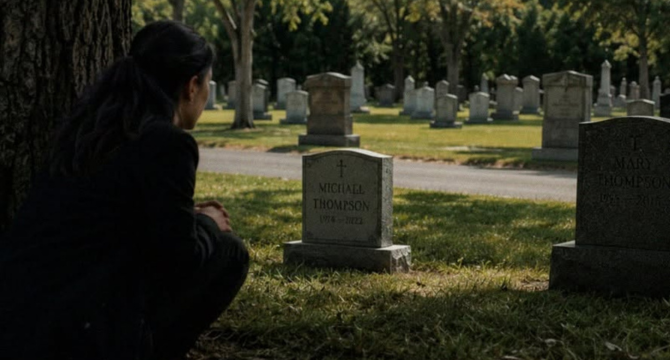
The kitchen clock kept time better than I did in those days. Six months had passed since Harry died on a stretch of wet highway outside the city, and most mornings, I still reached for his coffee mug before remembering.
Sunday was the only day that made sense. Because on Sundays, I had somewhere to be.
I drove the same route to the cemetery every week, with the same grocery-store carnations on the passenger seat.
The ritual was small, but it was mine.
Marlene called almost every day. She left casseroles on my porch and folded laundry I had not asked her to fold.
“You have to start living again, sweetheart,” she told me one Tuesday, smoothing a tea towel I had already smoothed twice.
“I am living, Marlene.”
“You’re surviving. There’s a difference.”
She meant well, I told myself. She had lost her son.
We were both carrying something neither of us could put down.
But Marlene’s grief moved like a project, and mine moved like weather.
The flowers had been there for weeks before I really noticed them. The first time I really saw them, I assumed the cemetery staff had placed them by mistake.
A small bunch of blue hydrangeas, fresh, was set neatly against Harry’s headstone.
The next Sunday, it was sunflowers.
The Sunday after, peonies wrapped in brown paper.
“Did you go see Harry this week?” I asked Marlene over the phone.
“No, dear. You know I prefer to remember him at home.”
“Someone is leaving flowers,” I told her.
There was a pause that felt longer than it should have. I heard her swallow.
“Probably one of his old college friends. Harry had a lot of people who loved him.”
“On the same day. Every week.”
“Betty.” Her voice tightened, the way it did when she wanted a conversation to end. “Don’t make a mystery out of kindness.”
I let it go that night.
But I noticed, after that, how her shoulders climbed toward her ears any time I mentioned the cemetery.
How she changed the subject when I described a new bouquet. How she suddenly remembered she had left something in the oven.
The next Sunday, I arrived at my usual time, just after 11. The sun was high, and the grass smelled of cut clover.
I walked up the small hill toward Harry’s section and stopped short. I saw white lilies. A full, careful bundle of them, laid against the headstone like something rehearsed.
They were Harry’s favorite. And that was a detail I had thought only he and I shared, traded in the dark of our bedroom one winter and never spoken of again.
I knelt and touched the stems.
The cut ends were still wet, pale, and clean, the brown paper damp where someone’s hand had gripped it. No petal had yet browned at the edge, which meant these had been set down hours ago at most, maybe less.
Whoever had left them had stood exactly where I was kneeling, and not long before.
I looked around the empty cemetery, at the long rows of stones and the distant gate, and felt the first cold thread of a question I did not yet know how to ask.
The damp lilies stayed with me all week.
I caught myself staring at the bouquet I had left beside them, comparing arrangements, noticing how carefully chosen theirs always was.
Whoever this person was, they knew Harry.
They knew the flowers he had picked for our wedding and the ones he kept on the kitchen table every spring.
By the fourth Sunday, I started writing it down. Same day. Same time, give or take 20 minutes. Always before me.
I told myself there was a simple explanation.
I told myself it was Marlene, or one of Harry’s old college friends, or a coworker who could not bear to come during visiting hours.
But none of that felt right.
None of that explained why my mother-in-law flinched every time I mentioned the cemetery.
And since the flowers had started appearing, the Sunday visits had shifted in me — what had been a quiet ritual, small enough to carry, was now the only fixed point in a week that otherwise blurred past me.
I lived from one Sunday to the next.
That Friday, Marlene invited me to dinner. She made Harry’s favorite pot roast, the way she always did when she wanted something from me.
I waited until dessert.
“Marlene,” I said, keeping my voice light, “I’ve been thinking about those flowers at Harry’s grave.”
She set down her fork. “Why are you asking?”
“Because they’re still showing up every week. Before I arrive. I keep wondering who could be leaving them.”
“Oh.” She picked up her fork again, too quickly. “No, sweetheart. It must be one of his old college friends. You remember the Bishop boys, how close they were. Or someone from the firm.”
“The Bishop boys live in Oregon.”
“Then a coworker. Honestly, Betty, half of Harry’s office adored him. It could be anyone.”
“Every Sunday? At the same time? Without ever signing a card?”
“People grieve in private ways.”
“You are not even looking at me,” I said.
She lifted her eyes then, and I watched the color pull back from her cheeks in real time, leaving her ten years older. She pressed her napkin flat against the table, smoothing it twice.
“I told her to stop,” she said, more to herself than to me. “I thought she had.”
Then, catching herself, she straightened. “Betty. I think you should stop going to the cemetery.”
I almost laughed. I thought I had misheard her.
“What?”
“Stop going there every Sunday like clockwork. It is not healthy. Harry would not want you living like this.”
“Harry is not here to want anything,” I said. “And visiting him is the only thing keeping me upright. You know that.”
She reached across the table for my hand. I pulled it back.
“Who is leaving the flowers, Marlene?”
“Some things are better left alone.”
“That is not an answer.”
“It is the only one I have for you.”
I stared at her. This woman, who had been calling me three times a day for six months, who had been folding my laundry and stocking my freezer, who had been telling me to move on, move on, move on, was now telling me to stop visiting my own husband.
“Why don’t you want me there?” I asked. My voice came out smaller than I wanted.
“Because you deserve peace, Betty. And you will not find it standing in the dirt every Sunday.”
“That is not what this is about, and we both know it.”
She looked away. She would not meet my eyes.
“Please,” she said. “Just trust me. Let it go.”
I stood up. I picked up my purse. I walked out without finishing dessert, without saying goodbye, without giving her the satisfaction of an argument she could control.
In the car, my hands were shaking so badly I could not get the key into the ignition.
She knew. Whatever this was, she knew. And she had been lying to my face for six months while pretending to be the only family I had left.
I drove home and sat at the kitchen table until midnight, watching the second hand on the clock above the stove.
Sunday morning, I set my alarm for 4 a.m.
I sat in the driver’s seat at dawn, my fingers white around the wheel, the cemetery gates 50 yards ahead through the windshield.
Whoever she was protecting, I was going to meet them in less than an hour.
The cemetery gates were still locked when I arrived, so I parked on the side road and slipped through the small pedestrian entrance.
The sky was a pale, bruised gray.
I crouched behind a tall headstone two rows from Harry’s, my coat pulled tight, and waited.
She came at 6:45 a.m.
A young woman, maybe 30, carrying yellow roses wrapped in brown paper.
She walked straight to Harry’s grave like she had done it a hundred times before. She knelt. She brushed dirt from the base of the headstone with her bare hand.
I stepped out from behind the stone.
“Who are you?” I asked.
She jumped to her feet, the roses scattering on the grass. Her face went white.
“I’m sorry. I’ll go.”
“No, you won’t.”
I moved to block the path. My hands were shaking, but my voice was steady in a way that surprised me.
“You’ve been here every Sunday for six months,” I said. “Who are you?”
“Please, just let me leave.”
“Tell me your name.”
She looked at the ground. Her shoulders folded inward. “Hannah.”
“Hannah what? How did you know my husband?”
The word husband made her flinch.
“You were sleeping with him, right?” I asked, looking at her with wide eyes.
“No.” Her head snapped up. “No, God, no.”
“Don’t lie to me. Six months of flowers. His favorite lilies. A detail I thought only he and I had ever shared.”
“I’m his daughter.” She bent and started gathering the roses with trembling hands. “That’s all. Please let me go.”
“His daughter?”
“Yes.”
“Harry didn’t have a daughter.”
“Please.” She would not look at me. “I shouldn’t have come. I won’t come back. I promise.”
She tried to step around me. I moved with her.
“No. You don’t get to say that and walk away. Prove it.”
“I can’t — “
“Prove it. Or I call the police and tell them you’ve been harassing my husband’s grave.”
She stopped. The roses hung from her hand by their paper. “Betty…”
“How do you know my name?” I asked.
She did not answer. She only shook her head and tried again to slip past me, her eyes fixed on the gravel path.
“You knew my name. And someone knew you’d be here — last week, Marlene sat across from me at dinner and told me to stop visiting Harry’s grave on Sundays. She wouldn’t say why. It was her, wasn’t it?”
Her face collapsed at the name.
She sank down onto the low stone bench beside the path as if her legs had simply given up, the roses sliding from her hand into her lap.
She covered her face and started to cry, quiet and broken, the kind of crying that comes from somewhere very old.
I watched her for a long moment.
The anger in my chest did not leave, but something underneath it shifted.
“Hannah.” I made my voice quieter. “I’m not going to call anyone. I just need to understand.”
She did not look up. Her shoulders kept shaking.
“Please,” I said. “Tell me.”
“He was my father,” she whispered. “That’s all I can tell you. Please don’t ask me the rest. Ask her.”
“Ask who? Marlene?” I asked.
Hannah nodded without looking up, her hand already moving toward her coat pocket.
I do not remember walking back to my car. I remember the cold metal of the door handle and the way my fingers would not close around it the first time.
I remember sitting in the driver’s seat with the engine off, watching my breath fog the windshield, the keys lying in my lap.
The last glimpse of Hannah in my mirror was of her on the bench, phone pressed to her ear with shaking fingers, the roses still spilled across her knees.
I started the car.
I drove without knowing where I was going.
Houses I had passed for 15 years slid by like a town I had never seen.
Harry had a daughter.
Harry had a daughter, and Marlene had known, and the casseroles and the hand-holding at the funeral and the quiet conversations at the kitchen table had all been the same lie, told in a hundred small kindnesses.
I pulled into a parking lot somewhere off the highway and sat with both hands on the wheel.
The shaking started in my shoulders and traveled down.
I let it come.
When it passed, the sky had brightened to a flat white.
I looked at myself in the rearview mirror. My eyes were red, but my face was steady.
I thought of Marlene standing in her kitchen in her robe, phone in her hand, waiting to see what I would do.
I thought of Hannah already on the long drive back to whatever life she had been paid into, three states between us by nightfall.
I thought of Harry, who was not here to answer for any of it.
I knew, sitting there, what I needed to do and in what order.
Not the driveway first. Not yet.
There was someone I owed an answer to before I went looking for the woman who had bought her silence.
I put the car in gear and pulled back onto the road.
I drove toward the cemetery first, hoping she might still be there.
It had only been an hour, and I could not picture Hannah simply walking away from that grave, not after what she had told me.
For a long minute, I just sat with my hands on the wheel, trying to fit 20 years into a shape I could carry.
Harry had kept a daughter from me.
It wasn’t a mistake.
It was a daughter he had fed, visited, and bought lilies for, year after year, while I sat across from him at breakfast, believing I knew the whole of him.
Hannah had not lied to me.
Hannah had only been the secret.
She had been a child when the lying started, and a young woman when Marlene paid her to vanish.
Whatever I owed Harry’s memory, I did not owe it at her expense.
I started the car again.
Hannah was still there, sitting on the iron bench near the gate, the yellow roses wilting in her lap. I sat down beside her.
“Marlene knew about you,” I said.
Hannah lowered her eyes. “Yes.”
“How long?”
“Since the beginning.”
I looked at the roses in her lap.
“Then tell me what happened,” I said.
For a moment, she said nothing.
“After Harry died, I came to see her,” she said quietly. “I thought maybe she would help me figure out what to do.”
My stomach tightened. “And?”
Hannah swallowed. “She offered me money to leave. To stop visiting. To stay out of your life.”
I stared at her. “She paid you to disappear?”
Hannah nodded.
“I was 29, broke, and terrified. She offered, and I told myself it was easier for everyone. It wasn’t. I am so sorry.”
I let the words settle between us. They hurt, but they were honest, and honesty was something I could work with.
“I am sorry too,” I said. “For what I accused you of. For what she did to you.”
Hannah wiped her cheek. “I never wanted to hurt you. I just wanted to know him a little longer.”
“He loved you,” I said. “I can see it in every bouquet you picked. You knew his favorites.”
“He used to bring me lilies on my birthday.”
I took her hand. “Then we bring lilies together. Next Sunday. And every Sunday after.”
“You would do that?”
“He was your father, Hannah. Marlene does not get to decide who belongs at his grave.”
I left Hannah at the bench and drove straight to Marlene’s, my hands shaking on the wheel.
She opened the door like she had been waiting.
“You paid her to disappear,” I said. “His own daughter.”
“I was protecting you, Betty,” Marlene said. “Protecting Harry.”
“From what? From a grieving young woman who lost her father?”
Marlene pressed a tissue to her eyes. “People talk. The inheritance. His reputation. I did what any mother would do.”
“No,” I said. “You did what a frightened woman would do. Controlling someone else’s grief is not love. It is fear wearing a nice coat.”
She looked up, stunned.
“Harry chose to take care of her,” I continued. “Quietly, for years. And the second he was gone, you tried to erase her. That is not protecting him. That is rewriting him.”
“Betty, please,” she said.
“I needed the whole man, Marlene. Not the version you wanted me to mourn.”
I walked out before she could answer.
The following Sunday, Hannah and I walked through the cemetery gates side by side, our arms full of flowers.
I understood then that grief shared was grief survived, and that love, real love, was always bigger than the secrets built to contain it.