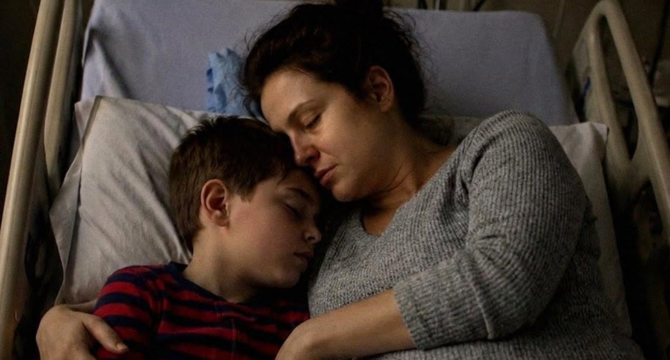
I never thought that at 41, I would have to choose between my unborn child’s life and my 8-year-old son’s.
Looking back now, I can still remember the exact moment everything changed.
Not the hospital room, the doctor’s words, or even the stack of consent forms waiting for my signature. It was a single word.
Her.
One small word that transformed the baby growing inside me from Micah’s last chance into my daughter. And suddenly, the impossible choice became even harder.
Two years earlier, our lives had looked completely different.
My son Micah was six when he was diagnosed with leukemia.
Before that, he was the kind of child who could never sit still. He built blanket forts in the living room, collected every interesting rock he found, and somehow managed to ask more questions in an hour than most adults did in a week.
“Why do woodpeckers never get headaches?”
“Can fish get thirsty?”
“If astronauts sneeze in space, where does it go?”
He was endlessly curious, the kind of child who made every room feel louder.
The diagnosis arrived on a rainy Tuesday afternoon. At first, we thought he had the flu. Then bruises began appearing on his arms and legs, followed by blood tests, scans, and an appointment with a specialist. Each step brought us closer to a truth I wasn’t ready to hear.
I still remember the doctor’s face when she sat across from my husband, Caleb, and me. The expression told us everything before she spoke.
Nothing prepares you for hearing the words:
“Your son has leukemia.”
The next two years became a blur of hospitals, treatments, and hope, followed by disappointment.
Chemotherapy came first.
Then stronger chemotherapy.
Then experimental options.
Every time a treatment showed promise, we allowed ourselves to believe, and every time it failed, we had to gather the pieces and try again.
Through it all, Micah remained remarkably brave.
One afternoon, while an IV dripped medication into his arm, he looked up at me and asked, “Do you think cancer gets tired of losing?”
I blinked.
“What do you mean?”
He shrugged.
“Because I keep fighting it every day.”
I had to turn away so he wouldn’t see me cry.
When he was eight, his doctors sat us down once again.
By then, I knew that particular conference room too well. It was the room where life-changing conversations happened, the room every parent learns to dread.
This time, they told us a bone marrow transplant offered Micah his best chance.
The relief lasted about five minutes.
Then came the problem.
Neither Caleb nor I matched.
No relatives matched.
No one in the donor registry matched.
Weeks turned into months. The search continued, but nothing came of it. One afternoon, Micah’s specialist carefully introduced another possibility.
The possibility was a future sibling. Sometimes, a sibling could be a suitable donor. I remember staring at the doctor in silence, then looking at Caleb.
Neither of us spoke during the drive home.
Because both of us understood what had just been suggested.
Months later, after countless difficult conversations and more guilt than I can describe, we decided to try. We genuinely wanted another child, and after everything we’d been through, it felt wrong to close that door forever.
And if that child could save their brother, how could we ignore that possibility?
I became pregnant shortly after my 40th birthday, and for the first time in years, hope returned to our house.
The pregnancy progressed smoothly. Each appointment brought cautious optimism, and every healthy scan felt like a small miracle. Meanwhile, Micah continued fighting.
By the seventh month, we had settled into a fragile rhythm: hospital visits, school when Micah felt strong enough, doctor appointments, pregnancy checkups, and the constant work of survival.
Then one night, everything fell apart.
I woke with a sharp pain twisting through my abdomen.
At first, I thought I had shifted awkwardly in bed.
Then another pain came.
Stronger.
By the time Caleb turned on the lamp, I was struggling to breathe through it.
Within an hour, we were in the hospital.
Doctors rushed through examinations while nurses moved quickly around me. Machines beeped, voices blurred together, and the atmosphere felt wrong.
Every glance exchanged among the medical staff seemed laden with concern, and with each passing minute, the tension in the room grew harder to ignore.
Finally, a maternal-fetal specialist pulled up a chair beside my bed.
Her expression reminded me of every difficult conversation I’d ever had with a doctor.
“You’ve developed severe complications,” she said gently.
My heart sank.
“What does that mean?”
“It means there’s a significant risk of premature labor.”
I placed a trembling hand over my stomach.
“And the baby?”
The hesitation before her answer terrified me.
“If labor starts now, survival will be very difficult.”
I closed my eyes.
Seven months.
So close, but still, not close enough.
Before I could process the news, the door burst open.
Micah’s oncologist entered the room, and I knew immediately something was wrong. Doctors do not run unless something is very wrong.
His face was pale.
“Micah’s condition has deteriorated rapidly.”
My pulse hammered.
“How bad?”
He exchanged a look with the specialist.
The silence answered before he did.
“Very bad.”
Caleb grabbed my hand.
“Tell us.”
The doctor swallowed.
“We’re seeing signs of organ involvement.”
The room spun as I whispered, “Then save him.”
Nobody spoke.
The silence stretched between us, heavy and terrible. Finally, the doctor said the words I will never forget.
“Not without the transplant.”
I stared at him, then at my husband, then at the ceiling. Anywhere except at the truth sitting in front of me.
“How long?” Caleb asked.
The doctor’s voice cracked.
“Maybe days.”
I couldn’t breathe.
Days? My little boy, my Micah, had fought for two years, and now the doctor was telling us we might only have days left.
The specialist leaned forward carefully.
“There is one possibility.”
I already knew.
Even before she said it.
“If we induce labor, we may be able to collect the stem cells Micah needs.”
My stomach clenched.
“And the baby?”
Nobody answered.
“TELL ME.”
The older doctor lowered his eyes.
“The baby might not survive.”
The room fell silent.
Then a nurse rushed in and hurried toward Micah’s doctor. She whispered something into his ear, and his expression changed immediately.
The monitor information she carried clearly wasn’t good.
He turned back toward us. “You have to choose now.”
“Her or him.”
I froze.
Her?
The word hit me so hard I almost forgot everything else.
“Her?”
The doctor blinked, then looked genuinely surprised.
“We… we thought you knew.”
“Knew what?”
During the emergency scans, they had determined the baby’s gender. Nobody had told us yet.
The doctor swallowed.
“You’re having a daughter.”
Not the baby, not the potential donor, not the hope we’d been carrying for seven months.
A daughter.
Suddenly, she became real, and somehow that made everything infinitely harder. I pressed both hands against my stomach and broke down crying.
For months, every conversation, every appointment, every fear, and every prayer had revolved around Micah. Even this pregnancy had been tied to him in some way.
Not because we didn’t love this child already, but because survival had taken over our lives.
Somewhere along the way, I’d stopped allowing myself to imagine who she might be: whether she’d have Caleb’s eyes, laugh as loudly as Micah, or spend her days hating vegetables, loving cartoons, and leaving crayons all over the house.
Now, in a single word, she became a person. And I was being asked to risk losing her.
Caleb buried his face in his hands.
I had only seen him cry a handful of times in our marriage: the day Micah was diagnosed, the day chemotherapy failed, and now.
Neither of us knew what to say. What words exist for a moment like that?
The doctors left us alone for several minutes.
The room felt unbearably quiet. I could hear the rhythmic beeping of monitors, the distant sounds of hospital staff moving through hallways, and the faint hum of air vents.
Ordinary sounds in an extraordinary nightmare.
Finally, Caleb looked at me.
His eyes were red.
“I can’t do this.”
Neither could I.
But the disease didn’t care. Time definitely didn’t care, and somewhere else in the hospital, our son was running out of it.
The door opened again.
This time, a different doctor stepped inside.
For a brief moment, I thought they had come back for our answer. Instead, he said something none of us expected.
“Wait.”
The room went still.
“What?” Micah’s doctor asked.
The specialist was breathing hard, as if he’d hurried from another part of the building.
“We just received a call from the national donor registry.”
Nobody moved. Nobody even seemed willing to hope yet.
“There may be a match.”
For a second, I genuinely thought I had imagined the words.
A match. After two years of searching, countless phone calls, and more dead ends than I could remember, someone had finally matched.
“Are you sure?” Caleb asked.
The doctor nodded.
“A preliminary match. We still need confirmation testing, but the markers look promising.”
Hope exploded inside me so suddenly it almost hurt.
The impossible choice that had been crushing us moments earlier suddenly seemed unnecessary. Maybe, if this worked, the impossible choice could disappear.
The doctor continued speaking.
“The donor is a 23-year-old male from Colorado.”
I laughed.
Then cried.
Then laughed again.
The emotional whiplash made me feel slightly insane.
For the first time that night, everyone in the room looked relieved.
Then the doctor’s expression changed.
The relief disappeared.
My stomach dropped.
“What?” I asked.
He hesitated. “We can’t reach him.”
The hope vanished as quickly as it had arrived.
“He isn’t answering calls,” the doctor said. Nobody spoke. He looked miserable as he added, “We believe he’s traveling overseas.”
I stared at him.
Surely not.
Not now.
Not after all this.
“We’re trying every number we have.”
The room fell silent again.
The specialist looked down at his notes.
“If we can reach him quickly, there’s still a chance.”
And if they couldn’t?
Nobody needed to say it. The answer hung over all of us.
Later that night, they wheeled me upstairs to see Micah.
He looked impossibly small in the hospital bed, and the machines surrounding him seemed far too large.
When he saw me, he smiled. “Did the baby kick today?”
My throat tightened. “A few times.”
He nodded thoughtfully.
“I think she’s excited to meet me.”
I looked away before he could see the tears gathering in my eyes. He was talking about a future neither of us could be sure we’d have.
The next 24 hours felt endless. Doctors monitored me constantly, then monitored Micah constantly.
Neither of us was doing well.
Every few hours, someone came into my room with updates. No contact. Still trying. No response. Still searching. The words became a painful refrain.
By the following afternoon, Micah’s condition worsened again.
His kidneys were beginning to struggle, and his blood counts continued dropping.
Every update seemed worse than the last.
That evening, the doctors gathered in my room once more.
I already knew.
You learn to recognize certain expressions.
The specialist placed a folder on the table beside my bed, and my chest tightened.
Inside were the consent forms.
I stared at them for a long time.
The pages looked ordinary: white paper, black ink, signatures. Nothing about them reflected the weight they carried.
Caleb sat beside me without speaking.
His hand never left mine.
“What are the chances?” I finally asked.
The doctor answered honestly.
“If we induce now, we may be able to collect what Micah needs.”
“And our daughter?”
The silence was answer enough.
I closed my eyes. For a moment, I imagined Micah, then I imagined the little girl I had never even met.
I thought about first birthdays, school pictures, bedtime stories, future Christmas mornings, all the moments neither child had experienced yet.
Then I picked up the pen.
My hand shook so badly I could barely hold it.
Tears blurred my vision.
Every instinct inside me screamed not to sign.
Every instinct inside me screamed to save my son. They were tearing me apart.
Caleb started crying beside me, and as far back as I could remember, I had never seen him look so helpless.
I signed.
The room blurred completely after that, and despite myself, I could make out the doctors quietly gathering the paperwork.
The procedure was scheduled for early the next morning.
For the first time since Micah’s diagnosis, I felt truly broken.
Not scared or hopeful.
Broken.
That night, I barely slept.
Every time I closed my eyes, I saw my children. One sleeping in a pediatric oncology ward, the other one kicking gently beneath my ribs.
I loved them both so much it physically hurt.
Just before sunrise, a loud knock echoed through the room.
At first, nobody reacted.
Hospitals were full of interruptions.
Then the door burst open.
Micah’s doctor was smiling.
Actually smiling.
For a second, I thought I was dreaming.
“We found him.”
I sat upright.
“What?”
“The donor.”
The room froze as the doctor continued. “He was at the airport.”
The doctor laughed breathlessly.
“He saw 27 missed calls and turned around right before boarding.”
I stared at him, unable to process the words.
“He agreed?”
“He agreed immediately.”
The tears came so fast I couldn’t stop them.
The doctor continued.
“He said if someone needed him, he wasn’t getting on that plane.”
Caleb covered his face. For several seconds, neither of us could speak. The impossible choice that had consumed us for two days suddenly disappeared.
Not because it hadn’t been real, but because we no longer had to make it.
I could finally let myself believe things might be okay.
The transplant took place a day later, followed by another terrifying stretch of uncertainty.
Because transplants are not miracles.
They’re chances. And chances can still fail.
But slowly, unbelievably, Micah began improving. His blood counts stabilized, his energy returned, and the doctors started using words we hadn’t heard in years.
Encouraging, promising, responding.
Meanwhile, my own condition stabilized.
The pregnancy continued.
The days turned into weeks.
The danger slowly eased.
I could finally allow myself to imagine bringing both of my children home.
Two months later, our daughter arrived screaming at the top of her lungs. It was the most beautiful sound I’d ever heard.
Caleb cried before the nurse even placed her in his arms.
Micah met her the next day. He sat carefully beside my hospital bed and stared at her for nearly a minute.
Then he smiled.
“She’s tiny.”
I laughed through my tears.
“She is.”
He smiled at her from a safe distance, and for the first time in months, I saw something other than exhaustion in his eyes.
Nobody in the room said anything.
Nobody needed to.
Years later, I still think about that moment, not because of what happened but because of what almost didn’t.
Years have passed since then.
Micah is healthy now.
Our daughter, Ava, is six.
They spend most of their time arguing over things that don’t matter, like whose turn it is to choose a movie, who ate the last cookie, and who gets the front seat. The kind of arguments that drive parents crazy and make them grateful at the same time.
One evening, I stood in the kitchen watching them bicker over a board game.
Suddenly, Micah looked at his sister and grinned.
“You know you saved my life before you were born, right?”
Ava scooted closer to him.
“Good. I like having you around.”
Everyone laughed.
Then both children looked at me.
I smiled and wiped away a tear.
“No,” I said softly.
“You saved each other.”
Neither of them understood why I was crying. I hope they never fully do because for two days, I believed I might lose one of my children to save the other.
Instead, I got to watch them grow up together.
And that will always feel like a miracle.