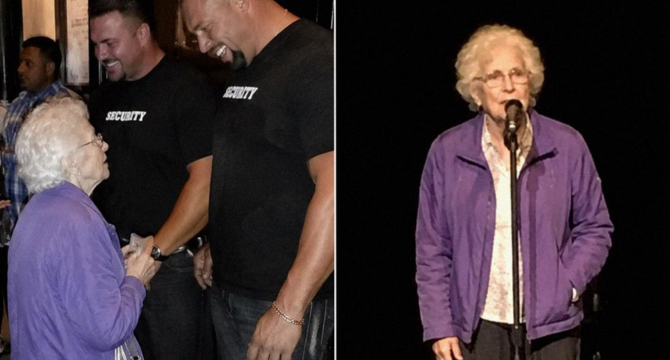
The October evening pressed cold against the sidewalk outside the concert hall, where neon light spilled over a line of young people wrapped in designer coats and excited chatter.
Somewhere near the end of the line stood a small figure in an old beige coat, holding a worn leather purse tight against her chest. Margaret watched the crowd the way one watches an old photograph come to life.
She had not stood outside this building in nearly 15 years.
Tonight, the air smelled the same. Cold concrete, perfume, and the faint metallic hum of stage lights warming up behind the walls.
A young couple ahead of her giggled at something on a phone screen. The boy turned, looked Margaret over, and grinned at his friends.
“Grandma got lost on the way to bingo,” he said loudly.
His friends laughed. Margaret offered a small, knowing smile and said nothing. She had heard sharper words in her 76 years, and most of them had not survived the test of time.
Her fingers tightened around the purse.
Inside, pressed between a folded handkerchief and a paper softened by countless readings, was a small photograph of her husband, Walter. He was smiling in it, the way he always smiled when he had a secret worth keeping.
“I promised him I would come,” she whispered to herself.
A flyer skittered across the pavement and settled near her shoe. She bent slowly and picked it up. Glossy ink, the headliner’s face filling most of the page, and at the very bottom in small print, “Damien, Director of the concert hall.”
Margaret read the name twice.
Then she folded the flyer neatly and slipped it into her pocket.
“Ma’am, are you sure you’re in the right place?” a girl behind her asked, not unkindly.
“I believe I am, dear,” Margaret answered.
“It’s a pretty wild crowd tonight.”
“I have stood in louder rooms,” Margaret said softly.
The line shuffled forward.
Somewhere inside, a sound check rolled through the walls, a low chord that vibrated under her shoes. Margaret closed her eyes for a moment and let it settle in her chest.
She thought of Walter sketching this building on a napkin in 1977.
She thought of the day they hung the first sign above the doors. She thought of a thin boy with a cracked voice who had once sung outside a diner for spare change.
A burst of laughter from the front of the line pulled her back. The bouncers were checking IDs, scanning faces, and waving people through with practiced indifference.
Margaret took a slow breath, lifted her chin, and shuffled one step closer. Whatever waited at the front of that line, she had come too far and promised too much to walk away now.
Margaret stepped forward as the line shortened, the cold air biting at her thin coat. The two bouncers at the door, Marcus and Rick, stopped talking when she reached them.
They looked her up and down.
Then they burst into laughter.
“There’s no way someone like you is on the guest list,” Marcus smirked, folding his arms across his chest. “We don’t even need to check.”
A ripple of laughter spread through the people behind her. Tyler, the young man who had joked earlier, leaned to his friends and snickered loud enough for everyone to hear.
Margaret pressed her purse closer to her chest. She lifted her chin slightly and spoke in a soft, polite voice.
“If you would just look at the list under the name H, I believe you will find…”
“Ma’am, please.”
Rick waved a hand dismissively. “You’re holding up the line.”
“I only need a moment,” Margaret said gently. “If you would just check.”
“There’s nothing to check,” Marcus said, rolling his eyes. “Step aside.”
The doors behind them swung open. A tall man in a sharp navy suit walked out, his polished shoes clicking against the pavement.
Damien, the concert hall’s director, surveyed the scene with the expression of a man who already disapproved.
“What is going on out here?” he asked, glancing at Margaret with thinly veiled distaste.
“She thinks she’s on the list,” Rick said, grinning.
Damien let out a short, sharp laugh that carried into the crowd. He gestured toward Margaret as though she were a curious exhibit.
“This isn’t a retirement home,” he said loudly. “Go home, ma’am.”
More laughter followed. A few people clapped. Someone whistled.
Margaret stood very still. The cold seemed to settle deeper into her bones, but it was not the wind that hurt.
It was the sound. That careless, easy laughter. She had heard it before, years ago, when Walter had grown frail and a young waiter at a fine restaurant had spoken to him as though he were a child.
She had stayed silent then, because Walter had squeezed her hand and asked her to.
She had regretted that silence for 20 years.
“Are you deaf as well?” Damien said, smiling at his own joke. “Move along.”
Margaret looked up at him. For just a second, her eyes were steady, almost studying him.
“You are certain you do not wish to check the list?” she asked quietly.
“I am certain,” he replied. “Have a lovely evening.”
The crowd laughed again. Marcus made a shooing motion with his hand.
Margaret gave a small nod. She did not argue.
She did not raise her voice.
She simply stepped away from the entrance and turned, the beige coat brushing softly against her ankles as she walked. Dozens of eyes watched her leave, and then the line moved on, the moment already forgotten.
But Margaret did not walk toward the street. She turned at the corner of the building, past the bright glow of the marquee, and slipped into the narrow shadow between the concert hall and the alley beside it.
Her steps were slower now, but they were certain.
She knew every crack in this pavement.
She passed a small wooden door marked “staff only”, then another. At the third door, half hidden behind an old service pipe, she stopped.
Her gloved hand reached for the brass handle, worn smooth by decades of use. She closed her eyes for a moment, feeling the cold metal against her palm.
“I kept my promise, Walter,” she whispered.
The door opened without a sound, as though it had been waiting for her all along.
Inside, the noise of the lobby faded behind heavy velvet curtains.
Margaret moved through the backstage hallways with the soft, sure steps of someone who had walked them many times before.
A young stagehand with a clipboard turned the corner and froze.
“Ms. Margaret,” Elena whispered, her eyes shining. “You actually came.”
Margaret offered a small smile and let the girl wrap her in a careful hug.
“I almost did not,” she admitted quietly. “But a promise is a promise.”
Elena pulled back and guided her gently by the elbow.
“Come with me. They have been asking about you all evening.”
Two security guards at the inner door stepped aside the moment they saw her. One of them nodded, almost bowed.
“Good to see you again, ma’am.”
Margaret nodded back, her purse still pressed tightly to her chest. Out front, on the other side of the building, a very different conversation was unfolding.
Damien leaned against the wall near the entrance, sipping sparkling water and chuckling to his assistant.
“Did you see her face?” he said. “Honestly, image is everything in this business. You let one beige coat through, and the whole brand looks tired.”
His assistant gave a thin, uncomfortable laugh.
“Sir, are you sure she was not someone’s guest?”
“Please,” Damien waved him off. “If she mattered, she would not be standing in a public line.”
Backstage, Margaret stepped into a small green room lit by warm lamps. Julian, the lead performer, was already there, dressed in stage black, his hands trembling slightly.
The moment he saw her, he crossed the room in three long strides and dropped to his knees.
“You came,” he breathed. He took both of her wrinkled hands in his. “I have been waiting all night.”
“I told you I would,” Margaret said softly.
“I keep my word, Julian. You know that.”
“Are you ready?” he asked. “One verse. The first one. Just like we used to sing it on your back porch.”
Margaret’s eyes glistened, but she did not let a tear fall.
“I am ready.”
The stage manager called Julian out. He kissed Margaret’s forehead and vanished into the bright corridor.
A roar erupted from the crowd as he stepped onto the stage. Margaret sat on a velvet stool by the wings, listening, her foot tapping gently to a melody she knew better than her own heartbeat.
Song after song passed.
Then the final note of his set rang out, and 20,000 voices screamed his name.
Julian raised a hand. The arena slowly hushed.
“Tonight,” he said into the microphone, “I want to introduce someone who changed my life. Someone without whom none of you would know my name.”
The lights dimmed. A single warm spotlight opened at the edge of the stage.
Margaret stepped into it.
Her old beige coat. Her small purse. A wireless microphone in her hand.
The audience fell silent in pure confusion.
Phones lowered. Whispers rippled through the seats.
Then a side door slammed open. Damien stormed onto the stage with Marcus pounding behind him.
He snatched a microphone from a tech and shouted into it.
“I am throwing her out right now,” his voice boomed through the speakers. “This is a private event, ladies and gentlemen. I apologize for the interruption.”
Marcus reached for Margaret’s arm. She did not flinch. She did not step back.
Julian moved between them in one smooth motion.
He raised a single hand toward Damien, palm open, calm as still water.
“Stop,” Julian said. His voice carried without effort. “Touch her, and you will regret it for the rest of your life.”
The arena held its breath. Margaret stood quietly in the spotlight, her purse still pressed to her chest, waiting for the moment that had been twenty years in the making.
Julian calmly took the microphone from Damien’s trembling hand and turned to the silent crowd.
“Twenty years ago,” he began, his voice softening, “a music teacher named Margaret found a homeless 12-year-old boy singing for coins outside a diner. She gave him food, then gave him something even greater. For six years, she taught him music without asking for a single cent. That boy was me.”
The arena did not breathe.
“She co-wrote the very first song I ever recorded. A song you all know.”
Thousands of eyes turned toward the old woman in the beige coat.
“And one more thing,” Julian said quietly. “Margaret and her late husband, Walter, founded this hall in 1978. Their family still owns 51 percent of the building you are standing in tonight.”
Damien’s face drained of color. Marcus took a slow step backward.
Margaret lifted the microphone with steady hands.
“I came tonight because Julian invited me to sing one verse of our song,” she said. “I stood in that line because I wanted to feel like a regular guest in the hall my husband built.”
She turned to Damien.
“I did not expect to be humiliated by the man I hired three years ago.”
A gasp rolled through the crowd.
“You are not fired for laughing at an old woman, Damien. You are fired for laughing at a paying guest. And then at every grandmother who ever stood in any line, anywhere.”
The arena erupted.
Security quietly escorted Damien off the stage as Julian wrapped an arm around Margaret’s shoulders.
Together they sang the first verse of their song, her voice trembling but true.
Backstage afterward, Margaret stood alone and opened her small purse. She touched Walter’s photograph gently with one finger.
“Dignity,” she whispered, “not noise, is what fills a hall.”
Then she walked toward the front door.