I’m 18, and for most of my life, I believed my parents had the kind of love people write stories about.
Not the loud, movie kind with flowers every Friday and dancing in the rain.
The quiet kind.
The kind where Dad always warmed Mom’s side of the bed with an extra blanket in winter. The kind where Mom packed his lunch even when she was running late.
They never argued in front of us, never raised their voices, and never made my 16-year-old brother, Drew, or me feel like our home could crack.
They seemed solid.
Then Mom got sick.
At first, it was little things.
She dropped cups more often. She held the wall when she walked down the hallway. She laughed it off and said, “I’m just clumsy, Jenny. Don’t make that face.”
But I saw the fear in her eyes when she thought no one was looking.
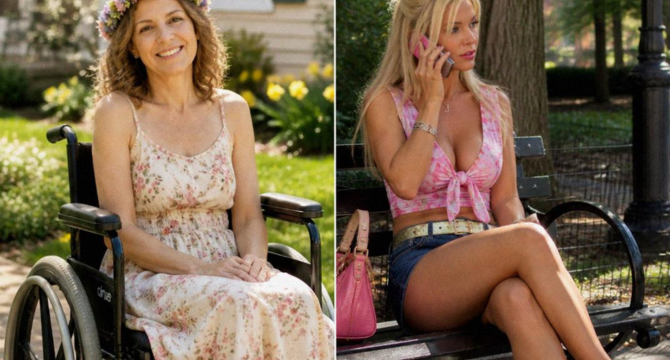
The illness moved through her slowly, then all at once. By the time I turned 18, my mother, who used to chase Drew around the yard with a garden hose, could barely stand without help. Now she’s in a wheelchair.
The doctors said there was a surgery that could help.
Could.
That word lived in our house like a candle in a storm.
The surgery was expensive, but we didn’t let that stop us. We all stepped up. I worked after school at a grocery store, standing for hours until my feet ached. Drew picked up weekend shifts washing cars and stocking shelves at a small hardware store near school.
Even Mom tried to help however she could, clipping coupons, selling old books online, and folding little paper envelopes where we stored cash before Dad deposited it.
Every dollar we earned went into that fund.
Dad was supposed to manage the money.
He said he knew how to keep things organized.
“We’ll get there,” I told Mom one night, holding her hand while Drew sat on the floor beside her wheelchair. “I promise.”
She smiled weakly. “I know you will.”
Drew looked away fast, pretending to check his phone. He hated crying in front of us.
Dad stood in the doorway, arms crossed. “Your mom’s lucky to have you two.”
At the time, I believed him.
Then one night, everything shattered.
I woke up thirsty and went downstairs, but stopped halfway when I heard voices in the kitchen. Dad was there with his best friend, Carl. Their voices were low, the way adults talk when they know they’re doing something wrong.
“I spent it all on Betty,” my dad said casually. “Even the money the kids earned.”
My hand tightened around the railing.
For a second, I thought I had misunderstood. Betty? Dad’s girlfriend? No. That didn’t make sense. Dad didn’t have a girlfriend. Dad had Mom.
Carl’s voice came next, quiet and stunned.
“What about your wife?”
Dad gave a soft laugh. Not nervous. Not guilty. A real laugh, as if Mom’s wheelchair, her pain, and the surgery we had built our hopes around were nothing more than an inconvenience he could deal with later.
“I’ll figure something out,” he shrugged. “She was worth it. You should see her in a swimsuit.”
I felt like I couldn’t breathe.
My chest burned, but I didn’t move. I stood there in the dark, listening to my father talk about destroying us as if he had bought the wrong brand of coffee.
I didn’t sleep that night.
By morning, I had dark circles under my eyes and a plan I barely understood. Mom was still asleep. Drew had already left for school. Dad came downstairs smelling like expensive cologne he never wore for Mom anymore.
“Morning, Jenny,” he said, grabbing his keys.
I forced myself to look normal. “Morning.”
He didn’t even notice my hands shaking.
The second he drove off, I followed him in Mom’s old car.
My heart pounded so hard I thought I might crash.
Dad drove across town, past the bank, past his office, and into the parking lot of an expensive restaurant with white tablecloths visible through the windows.
I parked two rows away and watched.
He walked inside like a man with nothing to hide.
A few minutes later, I saw her.
Betty couldn’t have been older than 25.
She had glossy hair, red nails, and a smile that looked practiced. Dad stood when she reached the table. He kissed her cheek. She laughed, tossing her head back like the world had never taken anything from anyone.
They laughed.
Like Mom wasn’t at home in a wheelchair.
Like Drew and I hadn’t worked until our bodies hurt.
Like the surgery fund had never existed.
My hands were shaking as I pushed the door open, ready to confront him right there.
But before I could even take a step toward their table, something happened.
And in that moment, I realized karma was already there.
And my father was about to learn a lesson he would never forget.
A woman in a navy suit walked straight to Dad’s table and stopped beside Betty.
Betty’s smile disappeared.
Dad looked up, annoyed at first. Then his face changed. The color drained from it so fast I thought he might faint.
“Betty?” the woman said, her voice calm but sharp. “Is this him?”
Betty shifted in her chair. “Mom, please. Not here.”
Mom?
I froze near the hostess stand.
The woman turned to my father. “So you’re the man who has been giving my daughter money?”
Dad swallowed. “I don’t know what she told you, but I care about her.”
The woman laughed once, but there was no humor in it. “You care about her? She is 24, and you are married. You have children. You told her your wife was dying and that you were only staying out of pity.”
My stomach twisted.
Betty stared down at the table. Dad’s mouth opened, but no words came out.
Then the woman placed a folder in front of him. “You also used money that was meant for your wife’s surgery. Betty found the bank slips in your car. She thought it was your savings until last night.”
Betty looked small suddenly. Not glamorous. Not powerful. Just young and ashamed.
“I didn’t know,” she whispered.
That was when Dad saw me.
“Jenny,” he said, pushing his chair back.
I walked toward him slowly. Every step felt heavy, but I kept going. “Is it true?”
His eyes flicked around the restaurant. “Please. This isn’t the place.”
“No,” I replied, my voice shaking. “The place was our kitchen last night, when you said, ‘I spent it all on Betty. Even the money the kids earned.'”
Betty covered her mouth.
Dad’s face hardened. “You were listening?”
“That’s what you care about?” I asked. “Mom can’t walk. Drew gave up his weekends. I worked after school until I could barely stand, and you spent it on lunch dates and swimsuits?”
He flinched at the last word.
Betty’s mother looked at me with pity. “Honey, I’m sorry.”
I nodded, but I couldn’t look away from Dad. “How much is left?”
He rubbed his forehead. “Jenny, I can fix this.”
“How much?”
Betty pushed the folder toward me. “Almost nothing,” she admitted. “But I brought what he gave me.”
She reached into her purse and pulled out an envelope.
Her hands trembled as she held it out.
“I sold the jewelry,” she said. “The bags too. It is not all of it, but it is a lot. I’m sorry. I know that doesn’t make it right.”
For the first time, I saw tears in her eyes.
Dad snapped, “Betty, don’t be stupid.”
Her mother turned on him. “Stupid was believing you were a decent man.”
People were staring now. Dad knew it. He stood quickly, trying to regain control of a room that no longer belonged to him.
“Jenny, we’re leaving,” he ordered.
I held the envelope to my chest. “No. You are.”
His face twisted. “I’m your father.”
“And she is your wife,” I said quietly. “You forgot that first.”
He looked at me as if I had slapped him.
I went home before he did. My hands shook on the steering wheel, but this time, it was not only fear. It was anger. It was grief. It was something stronger, too.
When I told Mom, she sat very still.
Drew came home halfway through and heard the rest from the hallway.
For a long moment, nobody spoke.
Then Mom whispered, “He said I was dying?”
I knelt beside her wheelchair. “Mom, he lied to everyone. But he doesn’t get to decide your story.”
Drew wiped his face with his sleeve. “We’ll build the fund again.”
I gave him the envelope. “We already started.”
Dad came home that evening.
He tried apologies first. Then excuses. Then anger.
Mom listened to all of it with a pale face and steady eyes.
Finally, she said, “Pack a bag.”
He stared at her. “You can’t be serious.”
“I have never been more serious in my life,” she answered.
A week later, Betty’s mother helped us contact a lawyer. Carl, Dad’s best friend, gave a statement about what he heard in the kitchen. Betty returned everything she could and apologized to Mom in person. Mom did not hug her, but she said, “Do better with your life.”
Months later, Mom had her surgery.
The recovery was hard, but the first time she stood with a walker, Drew burst into tears. I did too. Mom laughed through her own tears and said, “Look at that. I’m taller than both of you again.”
Dad lost his family, Betty, and the comfortable life he thought he could gamble with.
But Mom gained herself back.
And I learned something at 18 that I will never forget: Karma does not always arrive with thunder. Sometimes, it walks into a restaurant in a navy suit, carrying the truth in a folder.