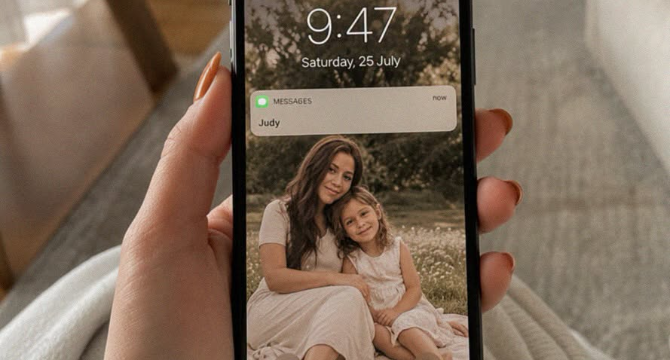
For nearly a year, an 8-year-old girl was never invited to a single classmate’s birthday party. Her mother blamed everyone, including herself, until one conversation uncovered a truth she never saw coming.
The kitchen clock ticked past four, and I already knew what Lily’s face would look like when she walked through the door.
That quiet, careful brightness she wore like a coat two sizes too big. It had become the rhythm of our year.
She dropped her backpack by the couch and climbed onto the stool at the counter, swinging her legs.
“Mom, guess what? Emma had a unicorn cake. A real one. With sparkles you can eat.”
“That sounds amazing, baby.”
“And Ben’s party is next weekend. At the trampoline place.”
I kept my hands moving through the dishwater so she wouldn’t see my face.
“Did they say anything to you about it at school?”
“No. But it’s okay.”
She reached for an apple slice.
“I’m fine, Mom.”
That line. She had been saying it since October, and every time it landed a little harder.
I dried my hands and sat down across from her, tucking a curl behind her ear.
“You know if something ever felt unfair, you could tell me.”
“I know.”
She smiled the way she smiled in school photos.
Practiced. Kind. Not quite hers.
By the time she went to do her homework, I was staring at the sink again, running through the same list I ran through every night.
Was it me? Was I too quiet at pickup, too awkward in the parking lot? Had I said the wrong thing to the wrong mother back in September?
I had been divorced barely two years.
I still felt like the new person at every gathering, the one people looked past. Maybe the other moms had decided we didn’t belong.
Maybe I had been the reason my daughter was invisible.
The doorbell rang before I could sink any deeper.
My mother let herself in with her own key a second later, the way she always did.
“I brought those little lemon cookies she likes,” she called from the hall.
“You didn’t have to.”
“Of course I did.”
She swept into the kitchen, set the box down, and hung her coat over the chair as if she lived there.
In some ways, she did.
She had been picking Lily up from school twice a week since the divorce, ferrying her to the library, folding into our evenings so gently I had stopped noticing where her presence began, and mine ended.
“Where’s my girl?”
“Homework.”
“I’ll go say hi.”
She was gone before I could answer. I heard Lily squeal, then laughter, then the soft rise and fall of a voice reading something out loud.
When my mother came back to the kitchen, she looked at me carefully.
“You’ve got that face again.”
“What face?”
“The one where you’re chewing on something.”
I hesitated. I didn’t want to say it out loud, because saying it made it real.
“Ben’s having a party next weekend. She wasn’t invited. Again.”
“Oh, sweetheart.”
“It’s been the whole year, Mom. Every single kid. Not one invitation.”
She sat down across from me and reached for my hand.
“Kids are cruel. Parents are worse. You know how those cliques get.”
“But she’s such a good kid.”
“She’s the best kid. This isn’t about her.”
Her thumb moved gently over my knuckles.
“You’re doing everything right. Don’t let this get in your head.”
I nodded, blinking too fast.
My phone buzzed on the counter between us, and she glanced at it, then slid it a little closer to her side of the table without picking it up.
“Let it go,” she said softly. “Focus on the birthday. Make it beautiful.”
That was the moment it clicked. If the world wasn’t going to invite my daughter anywhere, I would build the whole world for her, right here, for one afternoon.
I looked at her and made my decision.
“I’m inviting the entire class,” I said.
The backyard filled up faster than I expected. Kids poured through the gate in bright shirts and sticky sandals, arms full of wrapped boxes, voices climbing over each other.
Lily stood frozen for a second at the patio door, watching them arrive. Then she broke into a run.
I pressed a hand to my chest and just breathed.
For the first time in months, my daughter looked like a child who belonged somewhere. She chased a boy around the swing set, frosting already smeared on her cheek, laughing so hard she had to stop and bend over.
I lit the candles with shaking fingers.
Eight small flames, one for every year of her quiet, patient heart.
“Make a wish, baby,” I whispered.
She squeezed her eyes shut, and I felt tears sting mine.
After the cake, while the kids scattered back to the yard, I started slicing extra pieces onto paper plates.
That was when Judy walked over, her hands folded awkwardly in front of her.
She had a careful look on her face.
“This is such a beautiful party,” she said.
“Thank you. I’m just glad so many kids came.”
She hesitated, watching me cut another slice.
“Honestly, I wasn’t sure you’d be having one at all.”
I looked up.
“Why wouldn’t I?”
Judy shifted her weight.
“Well. After this whole year.”
I set the knife down.
“What do you mean, this whole year?”
Her forehead wrinkled.
She looked at me like I had said something wrong.
“After you declined every single invitation,” she said gently. “The other moms and I, we thought maybe Lily had allergies, or that weekends were hard for you. We stopped pushing.”
“What invitations?” I thought.
“Judy,” I said slowly, “I have never received a single birthday invitation this year. Not one.”
“That’s not possible,” she gasped.
“It’s true.”
“But you answered every time.”
I felt something cold spread down the back of my neck.
“Answered how?”
She dug into her pocket and pulled out her phone. Her thumb scrolled and scrolled, and then she turned the screen toward me.
There it was. A group chat titled with the class name and a little cake emoji. My name. My number.
My photo, the one Lily had taken of me last summer at the lake.
And underneath, message after message, going back months.
“So sorry, we can’t make it this weekend.”
“Thank you for thinking of Lily; she has a family thing.”
“Unfortunately she won’t be able to attend, but wishing your little one a wonderful day.”
But not one of them had been written by me.
I stared at the screen until the words started to blur.
Judy was still talking, softly, apologetically, but her voice sounded like it was coming from underwater.
“I never wrote any of these,” I said.
“I don’t understand.”
“Neither do I.”
She reached out and touched my arm.
“Are you okay?”
I nodded because I didn’t know what else to do.
Through the kitchen window I could see Lily on the grass, holding hands with a little girl in a yellow dress, spinning in a circle until they both fell laughing into the flowers.
A whole year.
A whole year of my daughter coming home and hearing about parties she was never told about.
A whole year of her shrugging and saying, “I’m fine, Mom.”
A whole year of me lying awake wondering what was wrong with us.
“Judy,” I said quietly, “I need you to send me screenshots of every message. All of them. From the beginning.”
She nodded quickly.
“Of course. I’ll do it tonight.”
“Please don’t say anything to the other moms yet.”
“I won’t. I promise.”
She squeezed my hand before she stepped back, and I saw pity in her eyes.
I hated that I understood why.
The party rolled on around me.
Presents got opened. Balloons drifted into corners of the yard. Somebody’s little brother cried over spilled juice, and I knelt to clean it up like a woman who was fully present, fully okay.
Inside, my mind kept circling one impossible question.
Who had my phone? Who could have taken it, over and over, without me noticing?
Who did I trust that much?
I ran through the list without meaning to.
Lily was too young. Her father lived three states away and hadn’t seen the phone in months. The babysitter had only started in April.
That left one person. The person who was always around. The person who picked Lily up from school when I ran late, who folded my laundry, who reminded me to eat, who scrolled her own social media on my couch while I cooked dinner.
The person I handed my phone to without a thought when my hands were full.
My mother.
I pressed the heels of my hands against my eyes.
“No,” I whispered. “No, please, no.”
Lily came bounding up the porch steps, cheeks flushed, hair wild.
“Mom, this is the best day of my whole life.”
I pulled her against me and kissed the top of her head.
“I’m so glad, baby.”
And over her shoulder, I stared at nothing, already knowing the truth I did not yet want to prove.
For three days, I couldn’t sleep properly.
The party was over. Lily was still glowing about the balloons and the friends who had finally come. But every time I closed my eyes, I saw Judy’s confused face and heard her voice saying, “You always answered.”
Judy’s screenshots had come through that first night, just like she promised, a long stack of them landing in a text at 11:04 p.m.
I had been rereading them ever since, scrolling with my thumb until the images blurred.
Every “so sorry, Lily can’t make it” in my own voice. Every polite little emoji I had never typed. On the fourth pass I started comparing her thread to my own phone, hunting for the other side of the conversation.
Nothing.
Not a single trace of Judy or the class parents’ group on my end.
Whoever had been answering had been careful. Whoever had been answering knew how to clean up after themselves.
“Maybe it was a mistake,” I told myself out loud in the kitchen. “Maybe the school had the wrong number.”
But I knew that wasn’t true.
Judy’s screenshots showed the very number I was holding in my hand.
For a moment, I let myself suspect Judy.
Maybe she was exaggerating. Maybe the other moms had quietly agreed to leave Lily out, and Judy was covering for them with a story about a chat that never existed.
It was a mean thought, and I hated myself for having it, but I needed somewhere for the anger to land.
That theory lasted about an hour.
Judy had no reason to lie.
She had shown up to the party.
She had watched her own child hand Lily a wrapped gift with a shy little smile. And the screenshots were too detailed, too consistent, to be a performance.
So I went back to the phone.
I sat on the edge of my bed and dug, properly this time, into folders I barely knew existed.
Settings I had never opened.
A hidden archive tucked three menus deep, the kind of place you only found if you already knew it was there.
And there were things in it.
Not the Judy thread — that was still gone — but other conversations. Old work emails I had never archived. A school reminder from October I remembered deleting. A message from my dentist I had definitely swiped away.
Someone had been moving things.
A stranger wouldn’t bother. A stranger would wipe and run. This was someone careful. Someone patient. Someone who knew my passcode and had time, over months, to sit with my phone in their hands.
I hung up on my own thoughts and stared at the phone.
On the fourth day, my mother came over for coffee, the way she always did.
She let herself in with her key, kissed the top of Lily’s head, and went straight to the cupboard where I kept the good mugs. She knew this house better than I did some days.
I couldn’t hold it in anymore.
“Mom,” I said, sitting across from her at the table, “something happened at Lily’s party. I need to tell you.”
She looked up, concerned. “What is it, sweetheart?”
I told her everything.
The invitations. Judy’s face. The declined messages sent from my number. The way I had spent nearly a year believing my own child had been quietly rejected by an entire classroom.
I told her how I had lain awake wondering what I had done wrong. Wondering what kind of mother produces a daughter no one wants at their birthday.
She reached across the table and took my hand.
“Oh, honey,” she said softly. “I can’t imagine how awful that must have felt.”
She smiled.
“You are a wonderful mother. Lily adores you. Anyone who couldn’t see how special she is doesn’t deserve her.”
I felt tears rise. This was why I always came back to her. She always knew what to say.
Lily wandered in a few minutes later with a drawing pressed against her chest.
“Grandma, look.”
My mother turned in her chair, and her whole face changed. “Come here, my love. Show me.”
She took the paper with both hands, the way she might handle something breakable.
“This is beautiful. Is this our house?”
Lily nodded, beaming.
“You are such a talented girl,” my mother whispered. “So talented. So loved.”
I watched them from across the kitchen and felt, for the first time in days, that maybe the world wasn’t as cracked as I had feared.
“I’ll make us another coffee,” I said.
I stood, kissed the top of Lily’s head, and walked to the counter. I heard Lily pad back down the hall to her room. I heard my mother shift in her chair.
The kettle took maybe 90 seconds.
When I turned around with the two mugs in my hands, she was holding my phone.
She was standing, actually. Not sitting. Standing near the edge of the table, my phone in both hands, her thumb moving fast across the screen.
She looked up.
For half a second, before her face rearranged itself, I saw something I had never seen on my mother before. Something cornered.
Then the screen went black under her thumb.
She smiled at me.
“I was just checking the time,” she said. “My watch battery is dying.”
There was a clock on my microwave. There was a clock on my oven. There was a clock, right behind her, on the wall.
“Oh,” I said. “Right.”
I set the mugs down carefully so my hands wouldn’t shake.
She stayed for another 20 minutes.
She talked about the neighbor’s new dog. She laughed at something Lily shouted from the other room. She kissed my cheek at the door.
“Love you, sweetheart. Get some rest.”
The moment her car pulled out of the driveway, I picked up the phone.
I opened the messages.
I scrolled and searched Judy’s name.
And there it was.
A whole thread I had never seen, buried in an archived folder I didn’t know existed.
The last message, sent that very morning, was still sitting there. Unread and undeleted.
She hadn’t had time.
I laid the printed messages on the kitchen table the next morning. My mother sat across from me, her coffee untouched.
“Explain these,” I demanded.
She looked at the pages. Her hands began to tremble.
“I was going to tell you.”
“When?”
“I don’t know.”
I pushed one page closer.
“Every invitation. For almost a year. You answered as me.”
Her eyes filled.
“I was scared, sweetheart.”
“Of what?”
“Of losing her.”
She pressed a napkin to her mouth.
“Since the divorce, I’ve been her whole world. The pickups, the snacks, the weekends. If she started going to parties, meeting other grandmothers, other families… she wouldn’t need me anymore.”
“So you made her lonely instead?”
“I told myself I was protecting her,” she said. “Those kids can be cruel. Weekends get so tiring.”
“She sat at this table every Monday listening to what she missed.”
My mother covered her face.
“I never meant to hurt her. You have to believe me.”
I did believe her. That was the worst part.
“Love that isolates a child isn’t love, Mom. It’s fear wearing love’s face.”
She reached for my hand.
I didn’t pull away, but I didn’t hold on either.
“No more phone. No more speaking for me. And your time with Lily is supervised until I can trust you again.”
“Please, I—”
“That’s the boundary,” I cut her off.
Weeks later, I sat on my porch watching Lily race through a sprinkler in the yard across the street, three classmates shrieking beside her at Emma’s birthday party.
Judy sat down next to me and passed me a glass of lemonade.
“She’s a different kid.”
“She was always this kid. She just wasn’t allowed to be.”
My mother was at home, alone, learning what it cost to be loved on someone else’s terms.
I felt the grief of that.
I also felt something steadier underneath it, something that had been waiting a long time to arrive.