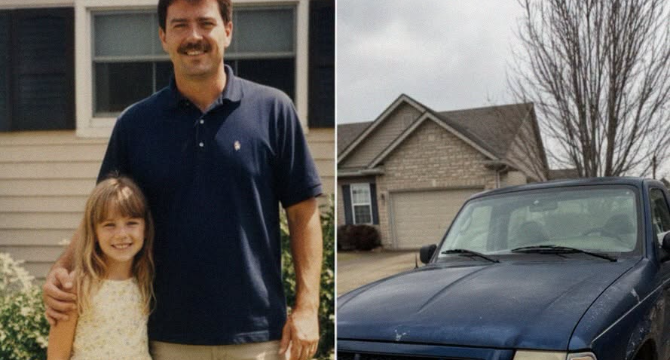
For fifteen years, I believed Dad had bought an old blue pickup because Mom’s death had freed him to choose practicality over love. Six months after his funeral, I finally tried to sell it. Instead, one hidden message forced me to question every cruel thing I thought I knew about him.
“If you’re reading this, then it’s finally time to tell you why I bought that truck two weeks after your mother died.”
I read the sentence twice.
Then I looked through the repair shop window at Dad’s old blue pickup.
For 15 years, I’d believed that truck proved he had stopped caring about Mom.
Now David was standing across from me with grease on his hands and guilt in his eyes.
“There’s more, Miley,” he said.
I read the sentence twice.
I turned the page over.
Dad had written one final instruction.
“Look beneath the passenger seat before you decide what kind of man I was.”
My fingers tightened around the paper.
“He had 15 years to tell me himself.”
David lowered his eyes. “I know.”
Dad had written one final instruction.
“Then why did he leave this with you?”
“Because he thought the truck would bring you back when you were ready.”
I almost laughed.
Six months after Dad’s funeral, I still wasn’t ready for anything he had left behind, especially that truck.
That morning, I’d opened Dad’s garage for the first time since he died.
I almost laughed.
The blue pickup sat beneath a layer of dust, exactly where he’d parked it after his last grocery run.
Dad had died of a heart attack at 68.
He hadn’t left a fortune, a business, or a collection worth fighting over.
He’d left a small house, stacks of tools, and the truck he’d driven almost every day for 15 years.
I hated it.
He hadn’t left a fortune.
Mom had spent years asking him to buy a reliable family car. Dad always said they needed to save longer.
Then Mom died.
Two weeks later, he came home in a faded blue pickup.
I was 23 and three hours away, training to become a physical therapist, when Dad brought the blue pickup home.
Mom had been dead for two weeks.
To me, the timing said everything.
Then Mom died.
She’d spent years asking for a safer family car. Dad always said they couldn’t afford one.
Then she was gone, and suddenly, he found money for a truck.
We fought about it until neither of us knew how to stop.
Now, six months after Dad’s funeral, I wanted it sold before the 15th anniversary of Mom’s death.
The buyer circled the pickup and pressed one thumb against a rusted wheel well.
We fought about it until neither of us knew how to stop.
“It looked cleaner in the photos.”
“The rust is cosmetic,” I said, trying to ease the awkwardness.
He glanced into the dusty cab. “Has it moved since your father died?”
“No, but Dad drove it every day.”
“That wasn’t my question, Miley.”
I held out the keys. “Start it.”
“That wasn’t my question, Miley.”
The engine coughed twice, then caught.
A bright orange light appeared on the dashboard.
The buyer pointed. “You didn’t mention that.”
“It wasn’t on before.”
He shut off the engine and climbed out.
“I’ll offer half.”
“You didn’t mention that.”
“Absolutely not.”
He shrugged and started toward his car.
“Fine,” I called. “Half.”
He turned back. “Not with that light.”
“You haven’t even opened the hood.”
“I don’t need to. Fix it, and then maybe we’ll renegotiate.”
“Not with that light.”
He drove away before I could answer.
I stood beside the truck with Dad’s keys biting into my palm.
“You couldn’t leave me one easy thing?”
His cracked work gloves sat above the steering wheel.
I reached for them, ready to toss them into a box, but my hand stopped.
I stood beside the truck.
Dad had worn those gloves through every winter, every repair, and every argument about that truck.
I climbed into the driver’s seat.
“I’ll fix the light,” I said, gripping the wheel. “Then you’re gone.”
David stepped out of the service bay before I’d shut off the engine.
He’d been Dad’s mechanic for nearly 20 years. He had silver hair, grease-darkened knuckles, and a calm expression.
“Then you’re gone.”
“I’d know that truck anywhere,” he said.
“Apparently, it doesn’t know itself. The check engine light came on.”
David leaned through the open window and checked the dashboard.
“You selling it, Miley?”
“Trying to, David.”
“The check engine light came on.”
His hand paused on the door.
I’d spent childhood afternoons in that shop, and I knew Dad trusted him.
“I’m sorry about Michael,” David said.
“Thank you.”
“He was a good man, honey.”
My shoulders tightened.
“I’m sorry about Michael.”
People had said that for six months. They called him dependable, generous, and always willing to help.
No one mentioned how Dad could turn silence into a locked door.
“I only need the warning light fixed.”
David opened the driver’s door. His eyes landed on Dad’s cracked work gloves above the wheel.
“Want me to clear those out?”
“No.”
People had said that for six months.
The answer came too quickly.
I looked away. “Leave them until it sells.”
David nodded, then reached for the hood release.
I started toward the waiting area but stopped.
“Check the brakes too.”
He glanced back. “The brakes?”
“Leave them until it sells.”
“And the tires, belts, and whatever else could fail.”
“A full repair might cost more than you’ll recover.”
“I don’t want someone driving away in an unsafe truck.”
“So you want it done properly.”
“Yes.”
“So you want it done properly.”
David studied me for a second, then walked into his office.
He stayed there long enough for me to hear drawers opening and closing.
When he returned, he wasn’t holding a service estimate.
He carried a dusty envelope.
My name was written across the front in Dad’s handwriting.
“What is that?”
He stayed there long enough.
“Something your dad left with me nine years ago.”
I stared at him. “Nine years?”
“He made me promise I’d wait.”
“Why didn’t you bring it after the funeral?”
“I nearly did.”
“But you didn’t.”
“He made me promise I’d wait.”
David rubbed his thumb across the sealed edge.
“He said I could only give it to you if you brought the truck here and asked me to make it safe. And today, you did.”
I didn’t take it.
“You’ve had six months to decide that?”
“I’ve felt guilty for all six.”
I didn’t take it.
“Then why wait?”
“Because your dad trusted me not to decide when you were ready.”
My eyes dropped to my name.
“And now?”
David extended the envelope again.
“Now you drove his truck back here yourself.”
“Then why wait?”
“Why didn’t he talk to me?”
David held it out. “Read it.”
I snatched it from him.
Inside was the single sentence that cracked open 15 years of anger.
Then Dad’s instruction sent me crawling beneath the passenger seat.
My fingers struck metal.
“Read it.”
I pulled out a small gray cash box.
“Do you have the key?” David asked.
“No.”
“I can cut the latch.”
“Do it.”
A few minutes later, the lock gave way.
“Do you have the key?”
Inside sat my old acceptance letter.
Beneath it were canceled checks, rent receipts, payment records, and one folded note in Mom’s handwriting.
The checks covered my rent, tuition, books, and equipment.
“I thought financial aid covered this.”
“It didn’t?”
“Not all of it.”
Inside sat my old acceptance letter.
I spread the records across David’s desk.
The dates were from the months before Mom died.
My chest tightened.
At 23, I’d planned to refuse my place in the training program.
Mom was sick, and I wanted to move home.
Dad wouldn’t allow it.
I’d planned to refuse my place in the training program.
“I want to stay with her,” I’d told him across the kitchen table.
“You’re going.”
“Mom needs help.”
“She has me.”
“You work all day.”
“I’ll manage.”
“You want me to leave her?”
“Mom needs help.”
Dad pushed my acceptance letter toward me.
“I want you to go.”
“That isn’t what I asked.”
“It’s the answer you’re getting, Miley.”
I remembered standing so fast that my chair scraped the floor.
“If I leave and something happens, I’ll never forgive you.”
“It’s the answer you’re getting, Miley.”
Dad’s face went pale.
“Then don’t forgive me, Miley. Just listen to me, sweetheart.”
I moved three weeks later.
Mom died before my first term ended.
For 15 years, I’d believed Dad had sent me away because he didn’t want the burden of caring for her while worrying about me.
“Just listen to me, sweetheart.”
Now his checks accounted for my first months of rent.
His money had paid the balance I thought a grant had erased.
My hands shook as I opened Mom’s note.
“Miley,
You have spent your whole life staying when other people need you.
I love that about you, but I won’t let your loyalty take your future.”
“You have spent your whole life staying when other people need you.”
“Your dad is going to make you angry because I asked him to.
Please live your life long enough to understand why.”
I pressed the paper flat against the desk.
“You both decided my life without me.”
David stayed quiet.
“Please live your life long enough to understand why.”
“They knew I’d blame him. That should’ve been my choice.”
I grabbed the bank statement beneath the note.
Mom and Dad had been saving for a new family car. I remembered Mom circling listings and telling Dad their old sedan wouldn’t last forever.
The account was almost empty.
“They knew I’d blame him.”
Then I found the receipt for the pickup.
Dad had bought it two weeks after Mom died for almost exactly what remained.
I looked through the window at the faded blue hood.
“He didn’t use their savings on the truck.”
David shook his head.
“They used them on me.”
David shook his head.
The room tilted.
The truck wasn’t what Dad chose instead of Mom.
It was what he settled for after they chose my future.
I folded Mom’s note and placed it back in the cash box.
“I need to know the rest.”
The room tilted.
David nodded toward the records. “Then don’t stop here.”
I didn’t.
For the next three days, I turned Dad’s house inside out.
I opened every file box.
I checked old bank statements.
“Then don’t stop here.”
I called the woman who had rented me my first apartment.
“Your dad paid three months in advance,” she told me.
“Why didn’t you tell me?”
“He asked me not to. He knew you’d try to give it back.”
I found a photograph of Mom sitting at the kitchen table with my acceptance letter beside her.
Dad stood behind her with one hand on her shoulder.
“He knew you’d try to give it back.”
On the back, he’d written the date.
It matched the first payment.
Then I called my aunt.
The silence after my question told me everything.
“You knew.”
“Your mom made me promise not to interfere.”
It matched the first payment.
“You helped them?”
“I drove her to the bank.”
Anger burned through me.
“Everyone decided I couldn’t handle the truth.”
“She was afraid you’d give up your place.”
“She was dying.”
“I drove her to the bank.”
“That’s why she was afraid.”
I gripped the phone.
“Did Dad want to push me away?”
“No.”
The answer came quickly.
“He told her you’d hate him.”
“Did Dad want to push me away?”
“What did Mom say?”
My aunt’s voice softened.
“She said, ‘Then she’ll be angry and alive somewhere beyond this house.'”
I shut my eyes.
“Did he regret it?”
“Every day, sweetheart. Every single day.”
“Did he regret it?”
She told me Dad had saved every article and printed page he could find about my work.
He’d attended one public talk I gave years earlier. He stood in the back and left before I saw him.
“He drove three hours?”
“He didn’t think you’d want him there.”
I hung up and searched until midnight.
“He drove three hours?”
At the bottom of a box, I found several birthday cards Dad had never mailed.
One read:
“I know you think I sent you away because caring for Mom was inconvenient. Letting you believe that was the hardest thing I’ve ever done.”
I sat on the floor with the card in my lap.
Dad had almost told me.
“I know you think I sent you away.”
Then he’d looked at the life Mom wanted for me and decided his silence was still protecting it.
“Why did you keep waiting?” I asked the empty room.
For once, anger wasn’t enough to hold me up.
I returned to David the next morning.
The truck was raised on a lift.
“I’m keeping it,” I said.
“Why did you keep waiting?”
David set down his wrench.
“You found everything?”
“I found enough.”
I placed Dad’s unsent card on the workbench.
“He knew I blamed him.”
“He knew you were angry.”
“You found everything?”
“That’s not the same as knowing I still loved him.”
David looked toward the truck.
“Your dad came here every year near your mom’s birthday.”
“For repairs?”
“Sometimes, nothing was wrong.”
“Then why?”
“Sometimes, nothing was wrong.”
“He just wanted it checked.”
David wiped his hands.
“One year, he said that truck was the reason his girl became who she was.”
I looked up at the faded frame.
“He meant the money behind it.”
“I think so.”
“He just wanted it checked.”
“How much will the repairs cost?”
“More than you’ll ever get back if you sell it.”
“I said I’m keeping it.”
David nodded once.
“Then we’ll do it right, Miley. Don’t worry about a thing.”
“How much will the repairs cost?”
A week later, my family gathered at my aunt’s house for what would’ve been Mom and Dad’s anniversary.
I arrived in the repaired blue pickup.
My cousin laughed when I stepped out.
“I thought you hated that thing, Miley.”
Everyone heard him.
For years, I’d told them Dad bought the truck because he was free of Mom’s requests.
“I thought you hated that thing, Miley.”
I’d damaged his name while he stayed silent.
I rested my hand on the door.
“I hated what I thought it meant.”
The yard went quiet.
“Mom and Dad used the money they’d saved for a reliable car to pay my tuition, rent, and training costs.”
My cousin stared at me.
“I hated what I thought it meant.”
“Why didn’t they tell you?”
“Because they knew I’d stay home if I knew the truth.”
My throat tightened.
“Mom made Dad promise to push me toward my future, even if I blamed him for it. He bought this truck with what they had left.”
My aunt wiped her eyes.
“Why didn’t they tell you?”
“I spent 15 years saying Dad didn’t care enough about Mom.”
I looked around at every person who had heard that story.
“I was wrong. I’m so sorry.”
Someone touched my arm.
“You didn’t know.”
“No, but he deserved to have the truth said out loud.”
“I was wrong. I’m so sorry.”
That afternoon, I drove to the cemetery.
I knelt between Mom’s and Dad’s headstones with her note and his unsent card.
“You got what you wanted,” I said. “I had a life.”
I rested my hand against Dad’s stone.
“I just wish you’d let me have you in it.”
“You got what you wanted.”
The next morning, I loaded the truck with boxes for a younger woman from work who was moving into her first apartment.
Before closing the glove compartment, I placed Mom’s note beside Dad’s card.
Then I pulled on his cracked leather gloves and started the engine.
For 15 years, I’d believed Dad bought that truck because Mom was gone.
He bought it because they had already given everything else to me.