Emily had barely survived becoming a widow while pregnant. But when someone vandalized her home and left a threat addressed to her newborn daughter, grief gave way to a fear rooted in a past she thought she had escaped.
I was seven months pregnant when my husband died.
One evening, David and I were arguing over baby names in our kitchen.
He liked Doris.
I liked Hannah.
“You only like Doris because it starts with the letter D, like your name,” I told him.
David pressed a hand to his chest. “That is a serious accusation.”
“You named your first dog Danilo.”
“It was a befitting name.”
“Again, you just wanted his name to start with D, like yours.”
David laughed, pulled me against him, and kissed my forehead.
“We still have time,” he said. “She’ll tell us her name when we meet her.”
The next morning, he left for work before sunrise.
That afternoon, a state trooper stood on my front porch.
There had been a single-car accident.
David seemed to have been speeding, lost control at a corner, and struck a concrete barrier.
He died before the ambulance arrived.
I remember staring at the trooper’s mouth while he spoke.
The words reached me, but they did not feel real.
“Emily?”
I looked down at my stomach.
My daughter kicked.
That was the moment I understood that David was gone.
I barely remember the funeral.
I remember people touching my shoulder. I remember them bringing over food and filling my refrigerator.
I remember David’s business partner telling me how talented he had been.
I remember standing beside his coffin and thinking he was supposed to be beside me when our daughter was born.
At night, I slept with one of his shirts pressed against my face.
During the day, I repeated the same sentence.
I have to stay strong for the baby.
It became a prayer. Then a command. Then the only thing holding me together.
My daughter was born six weeks later.
The labor lasted thirteen hours. My mother sat beside me, but when the pain grew unbearable, I still called for David.
The nurse squeezed my hand.
“I know,” she whispered.
When they placed my daughter against my chest, she opened her eyes and stared at me.
I started crying.
“Hi,” I said. “I’m your mom.”
Her fingers closed around mine.
I named her Doris.
It was the closest I could come to letting David have the last word.
The hospital discharged us three days later.
My mother offered to drive us home, but I refused.
“I need to do this myself.”
“Emily, you just gave birth.”
“I know.”
“You don’t have to prove anything.”
“I know that too.”
She studied my face, then kissed my cheek.
“Call me the second you get home.”
I promised I would.
Doris slept in the back seat as I drove through the city. I kept checking the mirror to make sure she was breathing.
When I turned onto my street, I knew something was wrong.
Three of my neighbors stood on the sidewalk.
Delgado from across the road had his phone in his hand. Susan stood beside her mailbox with both arms wrapped around herself.
Nobody waved or smiled.
They were all staring at my house.
I slowed the car.
Then I saw it.
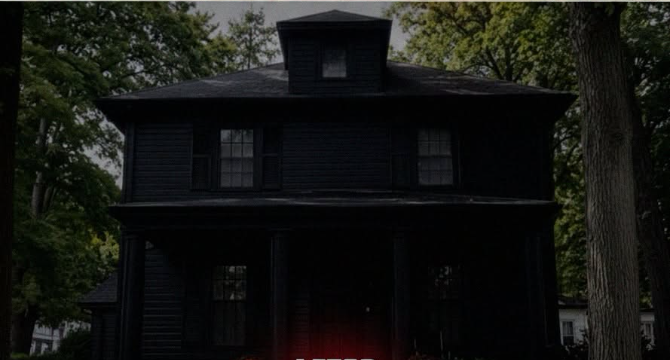
The entire front of my home had been painted black.
The porch, the door, and the trim.
Even the white columns David had spent an entire summer restoring.
Someone had covered everything in thick, uneven paint.
It ran down the steps in dark streams.
For a second, I could not breathe.
I pulled into the driveway and sat behind the wheel.
Doris made a small sound in the back seat.
That brought me back.
I got out, opened her door, and lifted the carrier with both hands.
Susan hurried toward me.
“Emily, don’t go inside.”
“What happened?”
“We don’t know. It was like this when I came outside at six.”
“Did anyone see anything?”
She shook her head.
Delgado said, “I called the police.”
I stared at the house.
David had designed the porch himself.
He had chosen the pale blue door because he said it made the house look hopeful.
Now it looked like someone had poured grief over it.
The police arrived within minutes.
One officer checked the doors and windows.
Another took my statement while I stood on the sidewalk holding Doris against my chest.
“Do you know anyone who might want to frighten you?” he asked.
“No.”
“Any recent disputes?”
“No.”
“Problems connected to your husband’s work?”
“Not that I know of.”
The first officer walked around the side of the house.
Then he stopped beside the mailbox.
“Ma’am?”
Something in his voice changed.
I carried Doris over.
Inside the mailbox was a white envelope with no stamp or address.
Only one word had been written across the front.
Doris, my daughter’s name.
The officer pulled on gloves and removed the envelope.
“I think you should open it,” he said.
My hands shook as I unfolded the paper.
There was one sentence.
“This house belongs to the child who was never supposed to be born.”
My vision blurred.
The officer took the note from me.
“Emily, do you know what this means?”
I did not answer.
Because suddenly, I remembered a man standing outside a courthouse eight years earlier.
His name was Victor.
Before I met David, I witnessed Victor attack a man outside a bar.
I had been walking to my car when I heard shouting in the alley. Victor had the other man on the ground and was kicking him in the ribs.
I called 911.
Then Victor saw me.
He ran, but the police caught him two blocks away.
The victim survived, though he spent weeks in the hospital.
I testified at the trial.
Victor stared at me the entire time.
He was sentenced to nine years in prison.
Afterward, his older brother approached me outside the courthouse.
He was tall, broad-shouldered, and calm in a way that frightened me more than shouting would have.
“You should have minded your own business,” he said.
I tried to walk past him.
He leaned close.
“You’ll regret this someday.”
I reported the threat, but nothing happened.
Years passed, and I moved.
I met David.
I convinced myself that I had outrun the past.
Standing beside my blackened house, I knew I had not.
I told the officer everything I suspected.
Victor and his family were the only people I knew who could threaten me.
The officer immediately called a detective.
My mother came to get Doris and me.
I spent that night at her house, sitting awake beside the bassinet.
Every sound made me jump.
The next afternoon, Detective Price called.
“We recovered fingerprints from the mailbox,” she said.
My stomach tightened.
“Whose?”
“Victor’s.”
I sat down.
“But he’s still in prison.”
“He was released last year for good behavior.”
I almost dropped the phone.
“What does he want from me?”
“We don’t know yet.”
“You know exactly what he wants. He wrote my baby’s name on an envelope.”
“We are taking this seriously.”
“Are you? He must have been stalking me at the hospital to even find out about my baby and her name.”
“Calm down, we are taking this seriously. We will check surveillance footage and do everything we can to find him.”
“Don’t tell me to calm down, because the last time one of those men threatened me, nothing happened.”
There was a pause.
Then she said, “This time, we have evidence.”
The police installed cameras around my mother’s house and assigned officers to watch my home discreetly.
They wanted me to return home.
I refused.
For five days, nothing happened.
On the sixth night, I was feeding Doris in my mother’s guest room when my phone rang with a call from Detective Price.
“We have him.”
My whole body went cold.
“Where?”
“At your house. He tried to climb the back fence.”
I looked down at Doris.
“Was he armed?”
“A knife and a can of black paint were found in his bag.”
My mother drove me to the station because the detective said they needed a formal statement.
Victor sat in an interview room behind thick glass.
He looked older than I remembered. His hair had gone gray at the temples, but his eyes were the same.
When he saw me, he smiled.
Detective Price stood beside me.
“You do not have to speak to him,” she said.
“I need to know why.”
She hesitated.
Then she opened the door.
Victor leaned back in his chair.
“Emily.”
The sound of my name in his mouth made me sick.
“You painted my house.”
“Yes.”
“You threatened my daughter.”
His smile widened.
“You ruined my life.”
“You nearly killed a man.”
“I lost nine years because of you.”
“You lost nine years because of what you did.”
His face hardened.
“My wife left me. My house was sold. Nobody would hire me after I got out.”
“That is not my fault.”
“Isn’t it? Because of you, I am treated like a worthless human being.”
“That is not my fault but a doing of your own.”
“I have not been successful this time, but you will regret testifying against me.”
“I never want to see you again. Leave me and my family alone.”
He stared at me for several seconds.
“You don’t know? Do you? You and I are family.”
I looked at him like he had gone crazy.
“What are you talking about?”
He laughed.
“What is funny?” I asked.
“You really don’t know.”
Detective Price stepped closer.
“Know what?”
Victor’s eyes stayed on mine.
“We’re closer than you think, Emily.”
I felt a chill move through me.
He leaned forward.
“The man you married was my younger brother.”
I stopped breathing.
“No. You’re trying to mess with my mind. Leave my husband out of your games.”
Victor smiled.
“David is my brother. Though I suppose he never brought that up. Did he?”
I looked at the detective.
“I’ll be back shortly,” she said quietly.
I grabbed the edge of the table.
David had told me his parents were dead.
He had told me he had no siblings.
Victor watched my face collapse.
“So, I’m right. He never told you about us, did he?”
“Shut up.”
I was still trying to process what Victor had said when Detective Price came back in five minutes later.
“His records show that he has two brothers. A David, the younger brother, and Rick, the older brother,” she said.
The name Rick rang a bell.
He was the one who had approached me after Victor was sentenced and had threatened me.
I had not set eyes on him since then. I didn’t even know that Victor had another brother.
My voice came out thin.
“He was really your brother.”
“Didn’t I just say so. However, David always thought he was better than the rest of us.”
“Why?”
“He left home at 22, just after I was jailed. He cut us off and said he was done cleaning up our messes.”
Victor’s mouth twisted.
“When I got out of prison and decided to look for you, imagine my surprise when I found out my own little brother had married the woman who sent me to prison.”
I thought of David, how open and honest I always thought he was.
“He loved me,” I said.
Victor laughed.
“Maybe who knows? But I had to punish him.”
“What do you mean, punish him?” I asked, my heart racing.
Victor looked at Detective Price and then back at me.
He smiled again, but this time there was pride in it.
“I loosened his car’s brake line.”
My knees almost gave out.
Detective Price caught my arm.
“No,” I whispered.
Victor shrugged.
“I wanted to scare him. Maybe teach him what happens when you betray your blood.”
“You killed him.”
“He chose you. How could he leave us and marry you? You who ruined my life.”
The words tore through me.
“He chose you over his family. Over me.”
“He chose not to be a monster.”
Victor slammed both hands against the table.
“You took everything from me!”
The detective shoved him back into the chair.
I was crying now.
“What did Doris have to do with any of this?”
His expression became calm again.
“She is his child.”
“She is a baby.”
“Our family’s blood and yours should have never mixed. She is the symbol of this contamination.”
“She is not your family. She will never be, and I will make sure of that. She is mine and Victor’s only.”
His eyes narrowed.
“I will ruin you. It may take years, but I will ruin you. For taking my brother and destroying my life.”
I stepped closer.
“You will never come near us again.”
Victor gave a soft laugh.
“You sound brave.”
“I am brave.”
My voice shook, but I did not look away.
“I will still stand between you and my daughter.”
Detective Price led me out.
Victor was charged with murder, stalking, criminal threats, vandalism, and attempted unlawful entry.
The investigation proved he had followed David for weeks.
Traffic cameras placed his car near our home on the morning of the crash.
Investigators also found tools and residue matching the damage to the brake line in his hideout.
My husband’s death had not been an accident but murder.
It took me months to accept that.
Later, David’s older brother, Rick, contacted me through my attorney.
He apologized for threatening me after Victor’s trial.
He claimed he had been angry and ashamed and had never intended to hurt me.
He begged me to please let him into our lives. To meet his niece.
I refused to meet him.
David’s mother wrote me a letter.
She said she had already lost one son and begged to meet Doris.
I said no.
For a long time, I was angry with David too.
I would sit in the nursery at night, rocking Doris, and whisper, “Why didn’t you tell me?”
He had known exactly who Victor was.
He had known the threat made outside that courthouse.
Maybe he believed changing his name and cutting ties would protect us.
But he had taken away my choice.
He had let me build a life beside a danger I could not see.
Grief is complicated when you are angry at the person you miss.
I hated him for lying.
I loved him for everything else.
Both feelings lived inside me at the same time.
A year after David died, I took Doris to his grave.
I was feeling safe just after I learned that Victor had been imprisoned for life with no possibility of parole.
I felt like I could finally face David.
Doris was learning to walk, though she still preferred holding my fingers.
I placed her on the grass.
“This is your daddy,” I told her.
She touched the stone with one small hand.
I sat beside her.
For a while, I said nothing.
Then I looked at David’s name.
“I wish you had trusted me with the truth,” I said. “I wish you had let me decide what risks I was willing to take.”
“I was so angry with you,” I continued. “Part of me still is.”
My voice broke.
“But I know why you left them. I know why you cut them off. You were trying to become someone better.”
I touched the cold stone.
“You did become someone better.”
Doris babbled and offered me a yellow leaf.
I smiled through my tears.
“I forgive you,” I whispered. “And I still love you.”
We sold the house.
I could never look at the porch without seeing black paint.
Doris and I moved into a smaller home near my mother’s neighborhood.
I returned to real estate work, first part-time and then full-time.
The first year was not easy.
Some mornings, getting dressed felt like a victory.
Some nights, I cried after Doris fell asleep.
But slowly, our life began to feel like a life again.
Doris is two now.
She has David’s eyes and his laugh.
Sometimes she points at his photograph and says, “Daddy.”
I tell her the truth in the only way she can understand.
“Your daddy loved you before he ever met you.”
One day, I will tell her the rest.
I will tell her that families are not defined by blood alone.
I will tell her that some people inherit cruelty and choose to continue it.
Others inherit the same cruelty and spend their whole lives trying to end it.
David ended it.
He walked away.
He built a home.
He loved us.
And though his silence nearly destroyed me, I no longer believe it came from betrayal.
It came from fear.
I understand fear now.
I also understand that love cannot survive on protection alone. It needs truth.
That is what I will give Doris.
The truth.
A safe home.