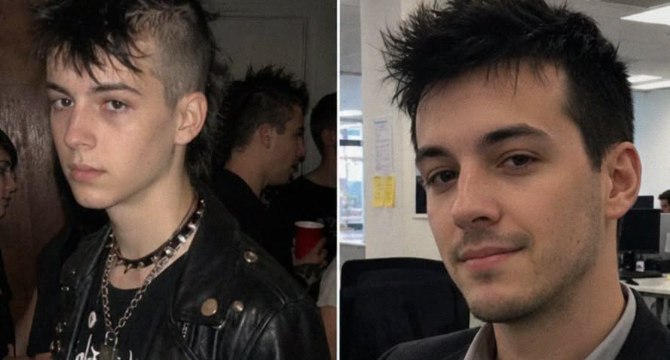
Years after leaving high school behind, Jessica walks into a new career opportunity and comes face-to-face with Jake, the boy she once quietly loved. But his shocking offer for her to quit hints at something that neither of them truly understands.
Back in high school, there was this boy I had the biggest crush on.
His name was Jake, and he was basically every teacher’s nightmare.
He skipped classes, never did homework, spent half his life in detention, and I honestly don’t even know how many times he had to retake the same courses.
At some point, I think even he lost count.
And of course, because teenage girls are not known for making smart emotional choices, I thought he was the most interesting person alive.
I was not the type of girl who usually liked boys like Jake.
I followed the rules.
I color-coded my notes. I knew the difference between studying hard and pretending to study while refreshing social media every five minutes.
Jake, on the other hand, treated school like an optional waiting room before real life began. He would stroll into class ten minutes late with his backpack hanging off one shoulder, hair messy, eyes tired, and a look on his face that said he had already decided the day was not worth his effort.
Teachers sighed when he walked in.
Girls whispered.
Boys either laughed with him or tried to act tougher than him.
And I sat there pretending not to notice him while noticing absolutely everything.
“Jessica, are you listening?” my chemistry teacher once snapped when I accidentally looked across the room instead of at the board.
“Yes,” I said too fast.
Jake, who had been half asleep with his cheek pressed to his fist, glanced over at me and smirked.
That stupid smirk stayed in my head for the rest of the day.
We were sort of friends, but nothing ever happened between us. I liked him from a distance; he barely noticed anything around him, and eventually we graduated and life moved on.
That is how I always explained it to myself, anyway.
It sounded cleaner that way. Simpler. Less embarrassing.
The truth was that Jake and I had existed in that strange space where we spoke enough for me to convince myself it meant something, but not enough for me to ever know where I stood.
He borrowed pencils from me and never gave them back. He copied my notes before tests that he had no chance of passing.
He once walked me to the parking lot in the rain because I had forgotten my umbrella, then acted like it was no big deal when I thanked him.
“Don’t make it weird,” he had muttered, shoving his hands into his hoodie pockets.
“I wasn’t making it weird,” I said, even though my face was burning.
“Good,” he replied. Then, after a pause, he added, “You always do your homework, right?”
I laughed before I could stop myself. “That is why you walked me out here?”
“Partly.”
That was Jake. A tiny moment of kindness wrapped in three layers of attitude.
By graduation, I had already understood he was not going to suddenly look at me and realize I had been there the whole time.
Life was not a movie, and boys like Jake did not magically become emotionally available because a quiet girl with neat handwriting liked them.
So I grew up.
I got a degree. I built a real career in finance. And to be honest, I hadn’t thought about Jake in years. I am not even sure I remembered his last name properly.
That surprised me sometimes, how easily people who once felt huge could shrink into old yearbook photos and half-blurred memories.
At 17, I thought my heart would always jump if I heard Jake’s name. At 29, I had deadlines, bills, performance reviews, and a favorite dry cleaner who knew not to crease my blouses too sharply.
My life became steady.
Maybe not perfect, but mine.
I worked hard to be taken seriously in rooms where people often assumed I was there to take notes instead of lead discussions. I learned how to speak clearly without apologizing first.
I learned how to defend my numbers. I learned how to sit across from men twice my age and explain why their projections were unrealistic without shrinking under their frowns.
So when I signed a contract with a new corporate firm and saw the CEO’s last name on the paperwork, it didn’t mean anything to me.
The company had a reputation for being intense but impressive. Strong growth. Smart leadership. Good benefits. The kind of place that looked beautiful on a resume and terrifying in person.
I had been approved by HR, passed the interviews with my team lead, signed everything, and was genuinely excited to start.
Advertisement
My mother cried when I told her.
“Jess, this is huge,” she said over the phone. “You worked so hard for this.”
“I know,” I said, smiling at the stack of onboarding documents on my kitchen table. “It feels unreal.”
“Promise me you will celebrate.”
“I ordered Thai food.”
“That is not celebrating.”
“It is when I add spring rolls.”
She laughed, and for the first time in months, I felt like I was standing at the edge of something good.
On my first day, I put on my best heels, chose a very “please take me seriously” office outfit, and walked into the building feeling proud of myself.
The lobby had high glass walls, polished floors, and a security desk where everyone looked like they had been trained not to blink. I gave my name, received my badge, and tried not to grin like a child on a field trip.
Jessica.
Finance Department.
I stared at those two words longer than necessary.
A woman from HR named Penelope met me near the elevators and gave me a warm smile.
“First day nerves?” she asked.
“A little,” I admitted.
“Good. That means you care.”
She took me upstairs, showed me my desk, introduced me to people whose names immediately began slipping out of my head, and handed me a schedule packed with orientation meetings.
My team lead, Alec, seemed brisk but fair. He shook my hand and said he had heard good things.
“We need someone who can catch problems before they become expensive,” he told me.
“I can do that.”
“I hope so.”
It should have intimidated me. Instead, it steadied me. This was my world. Numbers, reports, budgets, risk. I knew how to survive here.
Everything felt normal until I went to the company cafeteria to grab coffee.
The cafeteria was busier than I expected, filled with the low hum of conversation, clinking cups, and people pretending not to check emails while standing in line. I followed the smell of coffee like it was a lifeline.
That was when I saw him.
Jake.
Standing by the coffee machine in a suit, looking nothing like the boy who used to sleep through chemistry class.
For a second, I just froze.
The years had sharpened him. His shoulders were broader, his hair was neatly styled, and the careless slouch I remembered had been replaced by something controlled.
Expensive watch. Crisp white shirt. Navy suit that probably cost more than my first car.
But it was his face. Older, yes, but still Jake. The same dark eyes. The same mouth that looked like it was always holding back either a joke or a secret.
Then he looked up, locked eyes with me, and went completely pale.
Not surprised. Not pleased. Pale.
“Oh, my God. Jake?” I said, honestly happy to see a familiar face. “Hi! What are you doing here? Do you work here too?”
He blinked at me like he was hoping I was some kind of hallucination.
I smiled, trying to make it less awkward. “This is so funny. I guess we’re coworkers now.”
The silence that followed was awful.
He just stood there, holding his coffee like he had forgotten what hands were for.
People moved around us, reaching for sugar packets and lids, but it felt like someone had lowered a glass dome over the two of us. My smile began to feel stiff.
“Something wrong?” I asked. “You remember me, right?”
“Jessica,” he said quickly. “Yeah. Yeah, of course I remember you.”
His voice was lower than I remembered. Smoother, maybe. But there was something rough underneath it, something that made my stomach tighten.
Then he looked around like he wanted to make sure no one was listening.
“Funny thing, actually,” he said. “I don’t exactly work here.”
I laughed a little. “What does that mean?”
“It means I’m the CEO.”
I stared at him.
“The CEO?”
“Not the founder,” he added quickly, like that somehow made it less insane. “The founder is off somewhere in the Maldives now. But I run the company. I’m responsible for everything here.”
I didn’t know what to say.
This was the same Jake who once got detention for turning in a blank test with his name spelled wrong.
Images flashed through my mind before I could stop them.
Jake asleep in the back row. Jake leaning against a locker while the principal lectured him. Jake asking me if mitochondria was “the battery thing.” Jake laughing when I corrected him and saying, “Close enough.”
Now he was standing in front of me in a tailored suit, telling me he ran the company that had just hired me.
“Well,” I finally said, smiling, “I work in finance now. Who would’ve thought, right?”
He didn’t smile back.
Instead, his face changed. Completely.
The color that had drained from him did not return. His expression hardened, not with anger exactly, but with panic dressed up as authority. He set his coffee down on the counter with careful precision.
“Listen,” he said quietly. “Here’s the thing. I can’t have you work here.”
I actually thought I misheard him.
“Excuse me?”
“I know this is unfair,” he said, lowering his voice. “I know it’s hard to find a job right now, and I know you probably went through a bunch of interviews. I’m sorry for that. Really. But I’ll make it right.”
I just stared at him.
For a moment, my brain refused to connect the words into anything sensible. I had not even finished my first morning. My notebook was still blank on my desk.
My badge still felt stiff against my blouse.
I had smiled through introductions, memorized elevator routes, and promised myself I would not let imposter syndrome ruin the day.
And now Jake, of all people, was standing in front of me, calmly explaining that I needed to leave.
“What are you talking about?”
“I can give you a bonus,” he said. “A signing-off bonus. Whatever you need. One thousand, five thousand, ten thousand. Enough so you can take a few months and find something else.”
I hadn’t even taken my first sip of coffee at my new job, and this man was already trying to pay me to disappear.
The sound in the cafeteria seemed to fade. My cheeks warmed, but not from embarrassment anymore. Anger was rising slowly through me, steady and hot.
“Jake,” I said slowly, “whatever this is, we can figure it out. Just tell me what the problem is.”
His jaw tightened.
“You know what the problem is.”
I stared at Jake, waiting for him to explain himself.
The cafeteria noise kept moving around us, but all I could hear was my own heartbeat.
People poured coffee, checked phones, and laughed near the fruit stand while I stood there with my old high school crush, who had somehow become my boss and was now trying to buy me out of my job.
“Jessica, you know what it is,” he repeated, his voice low.
“No,” I said, placing my untouched cup on the counter. “I don’t. And if you think I’m going to accept ten thousand dollars and leave without an explanation, you have confused me with someone else.”
His eyes sharpened at that.
“That’s funny,” he muttered.
“What is?”
“You’re saying I confused you with someone else.”
I frowned. “Jake, what are you talking about?”
He looked around again, then nodded toward the hallway. “Not here.”
Part of me wanted to refuse. Another part, the part that still remembered him walking beside me in the rain in senior year, wanted to know why he looked like I had just dragged a ghost into the building.
“Fine,” I said. “But I’m not going anywhere with you unless there are windows.”
His mouth twitched, but it was not a smile. “Still cautious.”
“More cautious now.”
He led me into a small conference room with glass walls and a view of the city. Once inside, he closed the door but did not sit. Neither did I.
“Start talking,” I said.
Jake loosened his tie like it was strangling him. “Senior year.”
My stomach dipped, though I did not know why. “What about it?”
“The week before graduation.”
I searched my memory. Graduation week had been a blur of exams, yearbook signatures, and trying not to cry in front of people I claimed I did not care about.
“I don’t know what you mean,” I told him.
His expression hardened. “Don’t do that.”
“Do what?”
“Act innocent.”
That landed like a slap.
I took one step back. “Excuse me?”
“You heard me.”
I laughed once, short and disbelieving. “You are unbelievable. You drag me in here, offer me money to quit, and now you’re accusing me of something from high school? What exactly did I do, Jake?”
His jaw worked.
Then he said, “You told everyone I was cheating.”
The room went quiet.
I blinked at him. “What?”
“On the final economics project,” he continued, voice tight. “You told Mr. Bell I copied your work. You told people I stole from you. You told them I only passed because of you.”
I stared at him, waiting for the memory to click into place.
It did not.
“I never said that.”
His eyes flashed. “Jessica.”
“I never said that,” I repeated, firmer this time. “I remember the project. I remember we were in the same group. I remember you barely showed up for half of it, and I remember being annoyed. But I never accused you of cheating.”
He looked at me like he wanted to believe me and hated himself for wanting it.
“I got called into the office,” he said. “Mr. Bell had a written note. He said a student reported that I copied from you. He said the handwriting matched yours.”
A cold feeling spread through my chest.
“My handwriting?”
“That neat little handwriting everyone knew was yours,” he snapped, then immediately looked away. “Sorry.”
I ignored the apology because my mind was racing.
A note.
Handwriting like mine.
An accusation I never made.
“Jake, I swear to you, I didn’t write that.”
He let out a bitter breath. “Do you know what happened after that?”
“No,” I said softly.
“My scholarship interview got canceled. It was not a big scholarship, nothing fancy, but it was for a trade program. Business operations, accounting basics, stuff like that. Mr. Bell had recommended me because, for once, I had actually tried. Then that note came in, and suddenly I was the guy who cheated on the only decent thing I had done all year.”
His voice cracked on the last sentence, and it changed the shape of my anger. Not erased it. Changed it.
“I didn’t know,” I whispered.
“Of course you didn’t,” he said. “You graduated with honors. You went off to college. Everyone clapped for you. I left that building with people laughing behind my back.”
I swallowed hard.
Images from senior year returned in pieces.
Jake walking past me the last week of school, face closed off. Me thinking he was ignoring everyone because he was Jake. A girl near the lockers whispering, “Did you hear what he did?” and me assuming it was another detention story.
All these years, I had remembered him as the boy who barely noticed me.
Maybe he had remembered me as the girl who ruined him.
“Why didn’t you ask me?” I said.
He looked at me with exhausted disbelief. “Would you have asked me?”
That hurt because I did not know the answer.
At 17, I was shy and proud and terrified of looking foolish. If someone had told me Jake had betrayed me, I might have believed it because believing the worst of him would have been easier than admitting I cared.
“I don’t know,” I admitted. “Maybe not.”
His anger faltered.
“But I am asking now,” I continued. “Who else saw that note?”
He rubbed his forehead. “Mr. Bell. Principal Arden. Maybe the guidance office.”
“Did you see it yourself?”
“Briefly.”
“What did it say?”
He closed his eyes, as though the words were still there, burned behind them.
“It said, ‘Jake copied my section and turned it in as his own. I don’t want trouble, but it isn’t fair that he gets credit for my work.’ Then your name.”
I sat down slowly.
The wording felt strange. Too careful. Too polished. At 17, I would have written a paragraph, apologized three times, and probably included supporting evidence in bullet points.
“That doesn’t sound like me,” I said.
“No,” he murmured. “It sounds like someone pretending to be you.”
We looked at each other.
The same thought seemed to pass between us at once.
“Who hated you that much?” I asked.
He gave a humorless laugh. “Half the school?”
“Who hated both of us?”
Jake’s eyes shifted.
I knew the answer before he said it.
“Sabrina,” he muttered.
The name opened a door in my memory.
Sabrina had been in our economics group too. Perfect hair, perfect smile, and a talent for making insults sound like concern.
She had liked Jake, or at least liked the idea of him liking her. She also hated that he borrowed my notes and sometimes sat with me during group work.
One afternoon, she had seen him leaning over my desk, laughing at something I said.
“Careful, Jessica,” she had whispered later. “Boys like Jake only talk to girls like you when they need something.”
I had been embarrassed enough to say nothing.
“She had access to my notebook,” I said slowly. “During the project.”
Jake stared at me.
“And she used to copy my headings because Mr. Bell liked my format. She could have copied my handwriting.”
His face changed, not with relief, but with something heavier. Grief, maybe. Because if this were true, then he had spent years hating the wrong person.
“I believed it was you,” he said quietly.
“I can see that.”
“No, you don’t understand.” He sat across from me at last, looking older than he had in the cafeteria. “I used that anger for years. Every time someone underestimated me, I thought about you. I thought, ‘One day, I will be so far above people like her that she won’t be able to touch me.'”
The honesty in that confession made my throat tighten.
“People like me?” I asked.
He flinched. “I know.”
“No, say it. People like me. The careful girl. The good student. The one who got out.”
Jake’s face tightened. “The one who looked at me like I could be more,” he said, his voice low, “until I believed you had decided I wasn’t worth believing in anymore.”
For a moment, neither of us spoke.
That was the real wound. Not the note. Not even the accusation. It was the way two teenagers had been pushed into opposite corners by a lie and had grown up carrying versions of each other that were never true.
“I had a crush on you,” I said before I could stop myself.
Jake’s eyes lifted.
I looked down at my hands. “A ridiculous one. Painful, quiet, embarrassing. I thought you barely noticed me.”
He breathed out slowly. “I noticed.”
My heart gave an old, foolish twist, but I did not let it lead me.
“Then why were you so awful to me after that?”
“Because I thought you knew exactly how to hurt me,” he said. “And because I was too proud to ask if it was true.”
I nodded, blinking back the sting in my eyes. “And I was too scared to ask why you disappeared.”
Outside the conference room, someone walked by with a stack of folders. Life kept moving, indifferent to the fact that mine had just cracked open in a very expensive glass box.
Jake leaned forward. “Jessica, I was wrong today. Even if you had written that note, I had no right to do what I did. This job is yours. You earned it.”
“Yes,” I said. “I did.”
“I won’t interfere.”
“You won’t,” I agreed. “Because if you try, I will go straight to HR.”
A faint, sad smile touched his face. “Fair.”
“And we are going to find out the truth.”
His brows drew together. “How?”
“We start with records. Schools keep files longer than people think. Mr. Bell might still be around. Principal Arden might remember. And Sabrina is not a ghost.”
“You want to reopen high school drama?”
“No,” I said. “I want to stop letting it decide who we are.”
That silenced him.
Two weeks later, we had the answer.
Mr. Bell was retired but easy to find. He remembered the note because he had always regretted how the situation was handled. He still had a scanned copy in an old file, and when he sent it over, my stomach turned.
It looked like my handwriting at first glance.
But the J in Jessica was wrong.
Sabrina used to curl her J’s like a fishhook. I never did.
Mr. Bell also remembered something else. Sabrina had been the one who “found” the note tucked under his office door.
By the end of the month, Jake and I knew enough.
Sabrina had done it because she was angry at both of us. Angry that Jake had asked me for help instead of her. Angry that I had received praise for the project. Angry, in that small and poisonous way teenagers can be, that attention had landed anywhere but on her.
Jake apologized to me in writing.
Then he apologized in person.
Not in a conference room. Not as my CEO. As Jake.
“I’m sorry I made you pay for something you didn’t do,” he said one evening near the same coffee machine where everything had started. “And I’m sorry I let an old hurt turn me into someone unfair.”
I held my cup between both hands. “I’m sorry you went through that alone.”
His eyes softened. “You don’t have to be.”
“I know. But I am.”
I stayed at the company. I reported to Alec, not Jake. HR documented everything, just as I requested. Slowly, the office became less haunted. Jake became less like a warning and more like a person again.
We did not fall into some perfect romance.
Life is rarely that neat.
But we did have coffee sometimes, carefully, honestly, with all the old lies cleared from the table.
And when I thought back to the girl I had been in high school, the one who watched Jake from across classrooms and mistook distance for mystery, I wished I could tell her the truth.
Sometimes the people we think ignored us were fighting battles we never saw.
Sometimes the villain in our story is only someone holding the wrong version of the past.
And sometimes, walking into a new job can lead you straight back to the part of yourself that still needs to be believed.