Six years after Mom died, Dad’s house learned a new kind of quiet. It pressed against the windows from the inside and made the refrigerator hum sound like a stranger clearing his throat in the next room. I was forty-five, old enough to recognize loneliness and still young enough to pretend weekly visits could fix it.
After she was gone, even the walls sounded different.
Every Sunday I drove thirty minutes with groceries, sat at his kitchen table, and listened because one old man should not have to face that much silence alone. Before grief, Sundays had been noisy: Mom humming, Dad fixing imaginary wobbles just to stay near her at the stove.
After she was gone, even the walls sounded different. Dad still wore slippers to get the mail and still apologized to squirrels when he startled them off the porch.
“Sorry, fella,” he had told one the week before. “Didn’t mean to scare you.”
I tried to laugh, but my throat tightened.
That was the man I knew. So when the neighbor caught me by the mailbox one cool afternoon, cardigan pulled tight and eyes fixed on his garage, I almost smiled before she opened her mouth.
“I’ve been hoping to catch you,” she whispered. “Your father has changed, dear.”
“Changed how?” I asked, confused.
“He walks around the yard at night. Strange noises come from the garage.”
“Noises?”
I stood there while wind moved through the hedge, where Mom’s roses still came back every spring, stubborn as she had been.
“Scraping. Banging. Sometimes music, very late.”
I tried to laugh, but my throat tightened.
“Dad’s asleep by nine. He nods off during the weather.”
“I’m only telling you what I hear. Before something happens.”
“Before what happens?”
She gave a small, practiced smile and crossed her lawn. I stood there while wind moved through the hedge, where Mom’s roses still came back every spring, stubborn as she had been.
His hand was steady, his slippers unchanged, and a coffee ring sat beside his chair where it always did.
Inside, Dad worked the crossword with a pencil older than my marriage.
“Neighbor talk?” he asked quietly.
“Nothing much,” I said, though the lie felt clumsy.
He didn’t look up. His hand was steady, his slippers unchanged, and a coffee ring sat beside his chair where it always did.
“Dad, you feeling okay lately? Sleeping all right?”
“Sleep like a stone.”
The next Sunday, I unpacked groceries on his counter while watching him from the corner of my eye.
I kissed the top of his head before leaving and locked the door because he never remembered to do it. But as I backed out of the drive, I looked away from his front window and stared instead at the garage door, low, shut, and suddenly unfamiliar in the gray afternoon light behind me.
The next Sunday, I unpacked groceries on his counter while watching him from the corner of my eye. He moved as he always had: slow, careful, slippers shuffling against linoleum.
“The neighbor says you’ve been walking outside at night,” I tried, keeping my voice light.
He finally looked up. Mom’s stubbornness sat in his eyes.
“Did she.”
“And she hears noises from the garage.”
Dad opened soup as if the question weighed nothing.
“People hear things when they want a story. She wants a story.”
“If something is wrong, you’d tell me, right?”
He finally looked up. Mom’s stubbornness sat in his eyes.
But the neighbor kept finding me.
“Nothing is wrong. Stir this, would you.”
So I stirred, then drove home telling myself a daughter knew her father better than a woman three lawns down.
For months I held to that. I called more often, came on Saturdays as well as Sundays, and tried to catch him off guard. He was always the same: slippers, crosswords, and the kitchen radio turned to the station Mom had loved.
But the neighbor kept finding me.
“Lights at three in the morning,” she whispered once, gripping my arm.
I started losing sleep in my own house.
Another time it was a tarp he had dragged; then a moving shadow that was not his, she insisted, near midnight.
“He lives alone,” I said.
“I know what I saw.”
She always said ‘dear’ with a snark.
I started losing sleep in my own house. I lay awake picturing Dad in that garage with someone, with something, with a version of himself I did not know. Guilt sat on my chest like a cat refusing to move.
Then last Tuesday, Dad’s blood pressure dropped at the clinic.
I should have been there. I should have moved into the spare room. Under the guilt waited the worse thought: the small, ugly part of me wondering whether the neighbor might be right after all, despite every memory telling me otherwise.
Then last Tuesday, Dad’s blood pressure dropped at the clinic, and the nurse said he should not stay alone overnight. I packed a bag before he could argue.
“You don’t need to stay,” he said when I arrived.
“I’m staying.”
“I’m fine.”
Of course I heard nothing, I thought bitterly.
“I’m still staying.”
He didn’t fight longer. He made tea the way Mom had, with two sugars in mine without asking. I slept in my old room beneath the quilt she had sewn when I turned twelve. For hours I listened: sanders, footsteps, voices through the wall. I heard nothing except the house breathing softly around us.
Of course I heard nothing, I thought bitterly. Dad had known all day I would be in the next room. Shame warmed my face even in darkness. I had come to protect him, yet part of me had come to catch him.
I ran out in pajamas, concrete cold through my socks.
Sometime before dawn, I finally slept. Voices pulled me up later from a heavy dream. The dresser clock read 7:12. Red and blue light slid across the ceiling in slow sweeps, and someone outside was calling my father’s first name.
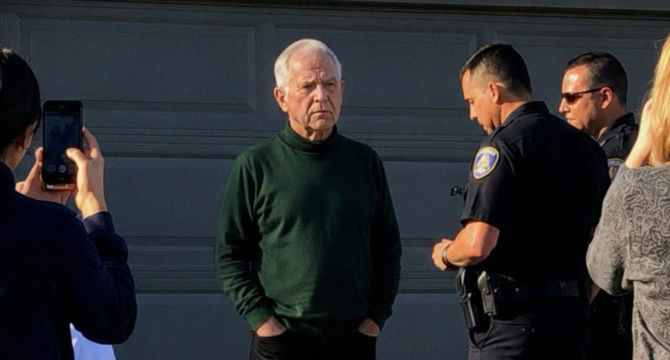
I ran out in pajamas, concrete cold through my socks. Neighbors clustered on the lawn, whispering over coffee. Two police cars blocked the driveway, lights spinning in the pale December morning. An officer met me on the porch steps.
“We’ve had repeated welfare calls from this street,” he said. “The caller reports a second voice, possible arguments, and someone living in your father’s garage without permission. We need to confirm he’s safe.”
Dad stood on the top step, hands hidden in his robe pockets, looking smaller than he had the night before.
“He’s seventy-three,” I said. “He wears slippers outside.”
“I understand. We still need to see inside.”
Dad stood on the top step, hands hidden in his robe pockets, looking smaller than he had the night before.
“There’s nothing in there,” he said, too quickly for comfort.
“Then open it,” I pleaded. “Let them look, and they’ll leave.”
He shook his head.
“I said there’s nothing.”
The crowd leaned forward as one body.
The officer kept his voice low.
“Sir, without consent, we can only enter if we reasonably believe someone inside is in danger. The repeated reports and your refusal put us close, but cooperation would be better for everyone.”
The crowd leaned forward as one body. At the front stood the neighbor, powder-blue coat buttoned to her throat, wearing concern like fresh paint.
“I told you,” she murmured. “There’s someone in there with him.”
He met my eyes, and for a moment I thought he might cry.
My stomach turned hard and cold inside me.
“Dad, please,” I said. “If there’s nothing, let them see nothing.”
He met my eyes, and for a moment I thought he might cry.
“You’ll think I lost my mind,” he whispered. “You’ll put me somewhere. You’ll sell the house.”
“I won’t.”
“You think you won’t.”
The officer stepped in first, flashlight sweeping across concrete, shelves, and covered shapes.
The officer stepped nearer, gentle but firm.
“Sir, we need an answer.”
Dad closed his eyes. He did not answer. He only stepped back.
The officers moved to the garage. One released the latch while the other stayed near Dad, speaking softly.
The door rose slowly, groaning on its old chain. The officer stepped in first, flashlight sweeping across concrete, shelves, and covered shapes. Then the beam steadied, and he stopped moving.
The far wall held dozens of hand-built wooden birdhouses.
“Sir,” he said, voice changed, “what is this?”
I moved behind him and looked past his shoulder.
The far wall held dozens of hand-built wooden birdhouses, each painted differently, each shaped like a place from my childhood: our porch, the lake cabin, the church picnic pavilion. In the corner, an old jukebox glowed softly, playing a song I had not heard in six years: Mom’s favorite song from Sundays together.
Behind me, the neighbor’s voice shrank.
And the center of the wall was her. Recipe cards in Mom’s looping handwriting; photographs of her at the lake, on the porch, holding me as a baby; the yellow kitchen clock that had ticked above her stove; dried petals from the roses she refused to abandon. Everything was arranged with the care of years, not madness. It was a memory wall, tender and aching, hidden because grief had frightened him into secrecy.
Behind me, the neighbor’s voice shrank.
“That doesn’t prove anything. I heard a woman.”
The officer noticed the papers too. He lowered his flashlight and asked dispatch to confirm where the previous calls had originated.
“Sanders,” Dad said from the doorway. “The jukebox. And me, talking to her.”
I stepped farther inside. My eyes caught on one recipe card pinned at eye level: banana bread, Mom’s hand, the little heart she always drew beside the sugar measurement. Beside it hung three handwritten offers from the neighbor, each asking to buy the narrow strip of yard where Mom’s roses grew. The latest was dated only two weeks earlier. Suddenly, the complaints had a shape sharper than concern.
The officer noticed the papers too. He lowered his flashlight and asked dispatch to confirm where the previous calls had originated. I didn’t look at the neighbor, but I heard her stop breathing for a second.
Outside, neighbors still lingered in damp clusters. The officer returned with his notepad folded in one hand.
Dad sat on an overturned crate, shoulders rounded under his robe.
“I didn’t tell you because I was afraid,” he said.
“Afraid of what?”
“That you would think I was gone too. Or that you would mean well and take everything away.”
My anger loosened into something sadder.
“You should have told me.”
“I know.”
I stepped onto the lawn, keeping my voice level because Dad had already endured enough spectacle.
Outside, neighbors still lingered in damp clusters. The officer returned with his notepad folded in one hand.
“All prior calls came from one address,” he said carefully.
The neighbor looked toward her porch, calculating distance and dignity at once.
I stepped onto the lawn, keeping my voice level because Dad had already endured enough spectacle.
“Would that address belong to the person trying to buy my father’s roses?”
The neighbor’s mouth opened, then closed.
One by one, they drifted away, embarrassed by the quiet they had helped make louder around him, and finally left us alone.
“Property values,” she muttered. “Someone had to say something.”
“You said plenty,” I replied. “Next time, try truth.”
A man in a winter coat cleared his throat.
“We should have come to him first,” he said.
“Yes,” I answered. “You should have.”
One by one, they drifted away, embarrassed by the quiet they had helped make louder around him, and finally left us alone.
I picked up a painted roof shaped like the church pavilion.
Inside the garage, the jukebox clicked and restarted Mom’s song. Dad wiped his eyes with the heel of his hand, pretending sawdust was the reason.
“I built the first birdhouse because the yard felt empty,” he said. “Then I remembered the porch one, and the lake one, and the little house you drew in kindergarten. After that, I couldn’t stop.”
I picked up a painted roof shaped like the church pavilion.
“This isn’t losing Mom,” I said. “It’s loving her where she can still reach us.”
That afternoon, after the cars left and the street forgot how to stare, Dad and I finished the wall.
He looked at me as if I had unlocked more than the door.
That afternoon, after the cars left and the street forgot how to stare, Dad and I finished the wall. I held nails; he hung Mom’s kitchen clock above her roasted chicken recipe.
“There,” he said. “She liked it where she could see it.”
I touched his shoulder.
“I’m staying two weekends a month.”
By evening, the house no longer sounded like it was holding its breath.
“You don’t have to.”
“I know. That’s why I want to.”
He held me in his gaze for a while, before letting the argument go. The clock ticked, the jukebox hummed, and a small wooden bird waited on the table, needing sanding, giving his hands somewhere gentle to rest.
The real danger had never been in the garage.
By evening, the house no longer sounded like it was holding its breath. It hummed with sawdust, old music, tea, and the stubborn sweetness of roses surviving winter. Dad sat beside me at the worktable, sanding the bird in slow circles.
I understood then that silence had not changed him; secrecy and fear had only taught grief to hide. The real danger had never been in the garage.
It had been outside it, in whispers that turned love into suspicion. When Mom’s song started over, Dad closed his eyes, smiled, and let the house sing with us at last.