I had only walked into the kitchen for a glass of water when I saw my neighbors’ house swallowed by flames.
A year later, my own daughter stood in my living room and told me everything I believed about that night was wrong.
I couldn’t bear the thought of her facing that loss alone.
I heard the girl scream before I understood what I was looking at.
“Mr. Harlan! Mr. Grover! Mrs. Stevens! Somebody help, please!”
By the time I got across the yard, firefighters were already fighting a blaze that had clearly been building for longer than any of us realized.
The heat reached me from thirty feet away, the kind that makes your skin sting before your mind even catches up.
Only Charlotte made it out.
“Somebody help, please!”
My neighbors’ 16-year-old daughter, soot streaked down one side of her face, stood in the grass shaking so hard her teeth clicked together.
I’d known her parents for ten years. Waved to them across the fence line most mornings, lent them a ladder once, and attended a graduation party or two.
We weren’t exactly close friends , but the kind of neighbors who become a quiet, dependable part of your daily landscape without you ever quite noticing it happening.
I’d known her parents for ten years.
Her parents didn’t make it.
The social worker found me a few days later, clipboard in hand, explaining in the careful tone of someone delivering bad news for a living that there were no emergency placements available that night.
“What happens to her?” I asked.
“A group facility,” she said. “Unless you know of any relatives.”
“She has none that I know of. Her mother’s parents passed years ago. Her father had a brother somewhere out west, but Charlotte says they haven’t spoken in years.”
Her parents didn’t make it.
The social worker studied me for a moment, the way people do when they’re trying to decide how seriously to take a stranger’s offer.
I’d buried my wife five years earlier.
My grown children lived states away and called mostly on holidays, the way grown children do once they’ve built their own lives far from the one they grew up in.
I had a spare room and a quiet house and absolutely no plan for either.
I had a spare room.
“She can come with me,” I said, surprising myself as much as the social worker.
“Are you sure, sir? You live alone. Raising a teenager, even temporarily, is hard work.”
“I have the room,” I replied. “And she knows me. I’m not a stranger walking through that door.”
Once the background checks came through and everything was finalized, Charlotte moved into the house.
“She can come with me.”
For the first two weeks, she barely left the guest room.
She flinched at the sound of the dishwasher. She ate almost nothing.
“You haven’t eaten today,” I said. “I made soup.”
“I’m not hungry. I just want to be alone.”
She barely left the guest room.
“I know. But grief is too heavy to carry alone.”
“I don’t know how to do this,” she whispered. “They’re just gone.”
I sat down in the doorway, not quite in the room, not quite out of it.
“It feels impossible right now,” I finally said. “But from now on, you carry one corner. And I’ll carry the other.”
“They’re just gone.”
Charlotte didn’t answer that night. But something in her shoulders loosened, just slightly, like a knot coming undone one thread at a time.
A few weeks later, I slipped on the back porch steps reaching for the hose and went down hard, twisting my ankle in a way that made the whole yard go white for a second.
Charlotte heard me from the kitchen window and was outside before I’d even finished swearing.
“Don’t move,” she said, already crouching beside me, checking my ankle with hands that were shaking but somehow still steady where it counted. “Can you put any weight on it?”
I slipped on the back porch steps.
“I’m fine,” I said, which was a lie we both recognized immediately.
She got me up and out to the car. Then she drove us to urgent care herself, even though she only had a learner’s permit and wasn’t supposed to be driving alone.
We sat in that waiting room for three hours.
Charlotte never once looked at her phone. She just sat beside me, asking the nurse the questions I was too embarrassed to ask, fetching me water, and finding me a magazine I never actually opened.
She just sat beside me.
None of my own children called that night. I hadn’t told them, and I didn’t feel the need to.
The person who mattered was already sitting beside me, asking if I wanted the chair closer to the window and worrying over my sprained ankle like it was far more serious than it was.
I didn’t say anything about it to her.
But I understood, somewhere in that waiting room, surrounded by fluorescent lights and the smell of antiseptic, that this wasn’t a girl I was rescuing anymore.
None of my own children called that night.
Somewhere along the way, without either of us announcing it, the direction of the rescue had quietly reversed itself.
Slowly, the house filled back up with sound.
Charlotte started joining me for breakfast, the two of us working through coffee and toast in the kind of comfortable quiet that takes most people years to build.
She took over the tomatoes when she noticed my knees bothering me, lecturing me cheerfully about overwatering while she did it.
Charlotte started joining me for breakfast.
In the evenings after she got home from school, she’d read to me when my eyes got tired.
She’d settle into the armchair across from mine with whatever paperback she had pulled from my shelves. Her voice would find a rhythm that filled the room in a way the television never had.
The first time Charlotte did it, I had to look away for a moment. My wife used to read to me exactly like that, same chair, same patient pace, working through a sentence twice if she thought I’d missed it.
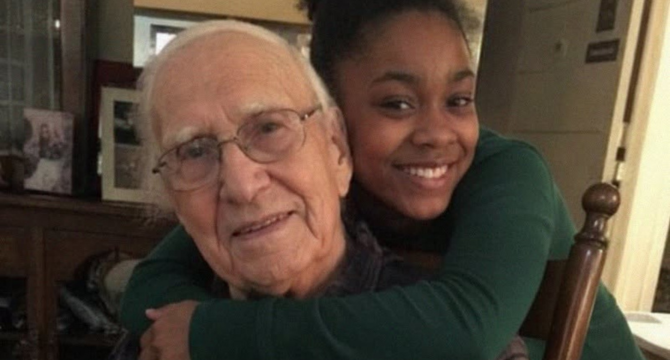
Without either of us planning it, Charlotte was slowly becoming my granddaughter, not by blood but by the quiet bond we had built together.
Charlotte was slowly becoming my granddaughter.
My children didn’t see it the same way.
“You’re too old to raise a teenager,” my son snapped on the phone once.
“Dad, I’m not saying she’s a bad person,” my daughter Brooke told me on the phone one evening, her voice careful in a way that told me she’d practiced this before dialing. “I’m saying you’ve known her for a year. You’re making life-changing decisions about someone I don’t know anything about. That scares me, Dad.”
“She helps me around this house, Brooke. She kept me company through a year I would’ve spent completely alone otherwise.”
“You’re too old to raise a teenager.”
“I just don’t want you trusting the wrong person,” Brooke insisted. “That’s all I’m asking you to hear me on.”
I told her Charlotte was part of this family now, and Brooke went quiet in a way that wasn’t agreement, just the sound of someone deciding not to push any further that particular night.
I should have recognized it for what it was.
Because Brooke didn’t know how else to protect a father three states away from a situation she couldn’t see for herself.
I should have recognized it.
My 77th birthday arrived with Charlotte covered in flour from sunrise, guarding a three-tier chocolate cake like a state secret.
“No peeking,” she warned, swatting my hand away when I tried to lift the towel covering it.
“Only the best for your birthday,” she said when she finally unveiled it, setting it down with the careful pride of someone who’d never made anything that complicated before and was determined not to let it show.
“It’s beautiful, Charlotte.”
The doorbell announced the rest of the family not long after.
My 77th birthday arrived.
My son came in first with a tight, polite smile, the kind people wear when they’ve decided in advance not to make a scene. Then Brooke, who didn’t say hello, didn’t look at the cake, and walked straight toward me with her phone already in her hand.
“Dad. I need you to see something. Everything you know about her is a huge lie.”
“Brooke, please. Not today.”
“This isn’t about today,” she hissed. “It’s about the last year.”
“Everything you know about her is a huge lie.”
She turned the phone toward me. Grainy black-and-white footage, the kind a gas station camera produces.
A timestamp glowed in the corner.
“October twelfth,” I read aloud. “Eleven-fifteen at night.”
“The night of the fire,” Brooke said quietly.
A timestamp glowed in the corner.
A girl walked across the screen, wiping her face, getting into a car and driving off.
“Is that Charlotte?” I asked, though some part of me already knew the answer.
The room had gone completely silent. Charlotte hadn’t moved from the doorway.
“That gas station is ten miles from your old street,” Brooke said. “She wasn’t home when the fire started.”
“Charlotte,” I said, and my voice came out smaller than I expected. “Is this true?”
“Is that Charlotte?”
She nodded, eyes already filling.
“You weren’t in the house?”
“No,” she whispered.
“Then why did you tell me you escaped?”
The silence stretched long enough that I could hear the cake candles still faintly hissing on the counter behind her. And somewhere in the kitchen a clock I’d never noticed before kept ticking through the quiet.
“Then why did you tell me you escaped?”
“Because if I’d stayed home,” Charlotte finally said, and stopped. Started again, quieter, like the words were costing her something physical to say. “Maybe they’d still be here.”
Nobody in that room moved.
My son had gone pale.
Brooke’s phone hung loose in her hand now, the footage long since stopped.
“Maybe they’d still be here.”
“I had a fight with my dad that night,” Charlotte recounted. “I told him I wanted to leave after graduation, build my own life somewhere else. He told me I’d never survive without them. He said a lot of things that night, the kind of things a father says when he’s scared of losing control of something. I got in the car to cool off. I just drove around for a while. When I came back, the house was already burning.”
“Did investigators ever say you caused it?” I asked.
“No,” she said. “Just an electrical fire. An accident. Old wiring in the upstairs hallway, they said.”
“I had a fight with my dad that night.”
“Then why carry it like this for a year?”
She looked at me with an expression I recognized immediately.
I’d worn it myself plenty of nights after my wife died, alone in that same kitchen, turning over every small thing I might have done differently.
“Nobody blamed me,” she whispered. “I just never stopped blaming myself.”
“Nobody blamed me.”
Brooke lowered her phone slowly. Whatever she’d expected this moment to feel like, I don’t think it was this.
“I’m sorry,” she said, and her voice had lost every bit of its earlier edge. “I thought I was protecting you, Dad. I thought she was hiding something.”
“She was,” I said. “Just not what you thought.”
Brooke looked at Charlotte for a long moment, something shifting behind her eyes. She’d come into my house ready to expose a con artist and found, instead, a 16-year-old who’d spent a year quietly drowning in guilt that was never hers to carry.
“I thought she was hiding something.”
“I’m sorry too,” Brooke said directly to her. “I did some digging with a friend and found the footage. I never meant to hurt anyone. I just…”
“I know,” Charlotte said softly. “I’m not mad at you.”
We never finished singing happy birthday that night, but somehow it still felt like the truest celebration that house had seen in years.
“I’m not mad at you.”
A couple of months later, Charlotte and I were back where most of our quiet conversations seemed to happen, kneeling in the dirt beside the tomato plants on a Saturday morning. They were the same plants she had taken over the summer my knees first started complaining.
“You know you’re stuck with me forever now, right?” I said, only half-joking.
She laughed, brushing dirt off her hands onto her jeans. “I think I knew that the first time you knocked on my bedroom door.”
I thought about it for a while.
“You’re stuck with me forever.”
“You never asked why I stayed,” she finally said. “Even after everyone found out the truth that night.”
“Why did you?”
“Because after the fire, everyone just looked at me like the girl who survived,” she replied, not looking up from the plant she was tying to its stake. “You were the first person who looked at me like I was actually still alive. I think I needed that more than I needed a place to stay.”
I didn’t have anything to add to that.
“You never asked why I stayed.”
I just reached over and squeezed her shoulder, and we kept working the soil in the kind of silence that doesn’t need filling, the late morning sun warming both our backs.
Family isn’t always the people who share your blood from the very beginning.
Sometimes it’s simply the people who keep showing up after everything else is gone.