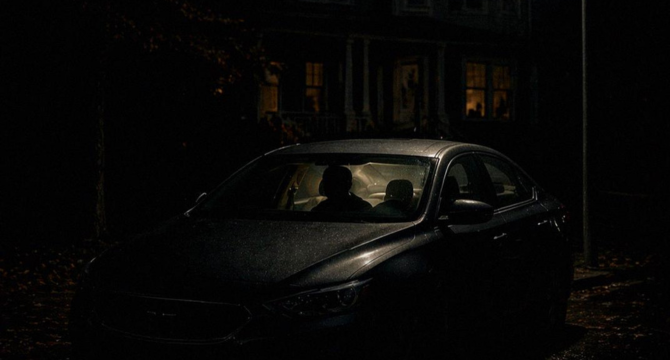
At first, I thought it was a coincidence.
That was what I told myself on Monday morning when I saw the gray car parked across the street, slightly off to the side, near the old maple tree with half its branches leaning over the curb.
It was not a fancy car.
Not new enough to stand out, not old enough to look abandoned. Just gray, quiet, and forgettable.
I had barely noticed it then.
I was already late for work, balancing my tote bag, coffee, and the little paper sack from the bakery downstairs. I remember locking my front door with my elbow and muttering, “Come on, Anna. One normal morning. Please.”
Normal mornings had become rare.
Ever since I moved into that building six months earlier, I had been trying to prove to myself that I could handle life on my own. No roommate. No partner. No mother calling every night to ask if I had eaten properly or remembered to double-lock the door.
I was 29 years old, but sometimes, when I stood in my tiny kitchen at night eating toast over the sink, I felt more like a kid pretending to be an adult.
Still, I was proud of that apartment.
Proud of the uneven bookshelves I had built myself. Proud of the curtains I had hemmed badly, but hung anyway. And proud of the fact that when I came home, the quiet belonged only to me.
So, on that first day, the car meant nothing.
The second day, I remembered it.
I was halfway down the front steps when I saw it again. Same spot. Same angle. Same dull reflection of morning light on the windshield.
I slowed for a second.
“That’s weird,” I whispered.
Then I shook it off.
People parked on the streets. Cars stayed overnight. Maybe the owner lived nearby. Maybe someone was visiting a neighbor. Or maybe I had watched too many crime shows while folding laundry.
But by the third day, I realized something wasn’t right.
He wasn’t leaving.
Every morning when I stepped outside, the car was there. And in the evening, still there. Sometimes with the engine running, sometimes just sitting quietly.
And always, with someone inside.
I couldn’t see his face clearly. The windshield caught too much glare during the day, and at night, the shadows swallowed the driver’s seat.
But I knew one thing: he was watching.
Not in a casual, waiting-for-someone way. Not like a delivery driver killing time on his phone. His head followed me as I stepped outside, crossed the street, and glanced back, as if every move I made mattered.
The first time I caught that movement, my stomach dipped.
I hurried to the bus stop and called my friend Hannah.
“Don’t laugh,” I said as soon as she answered.
“That’s how every terrifying sentence starts. What happened?”
“There’s a car outside my building. It’s been there for three days.”
“A car?”
“Yes. With someone in it.”
She went quiet.
I lowered my voice. “I think he’s watching me.”
“Anna, are you sure?”
“No,” I admitted, glancing over my shoulder. “That’s the problem. I feel ridiculous, but I also feel scared.”
“Then listen to scared,” she said. “Scared exists for a reason.”
After that, I started checking the street through the window before going outside. I would stand between the curtain and the wall, barely moving, peering down like I was the suspicious one.
He was always there.
I even began taking different routes home.
One evening, I got off the bus two stops early and walked through the small grocery parking lot, past the laundromat, then around the back of my building. My feet hurt by the time I reached the side entrance, but for one brief second, I felt clever.
Then I looked across the street.
The gray car was there.
Every time.
By Friday, I was sleeping badly.
Every little sound made me sit up in bed. Pipes knocking. Tires hissing over wet pavement. A door closing somewhere downstairs.
I kept my keys on the nightstand. I checked the lock twice, then three times. I told myself I was being dramatic, but my hands still shook when I brushed my teeth.
And one morning, the car was parked right in front of my building.
Not across the street anymore.
Right in front.
I stopped.
The sidewalk felt suddenly too open. Too empty. The coffee in my travel mug burned my palm, but I did not move.
The door opened.
One man stepped out.
He looked about mid-30s, with dark hair, tired eyes, and a dark coat buttoned neatly over his chest. He did not look like someone from my nightmares. That almost made it worse.
Then I noticed there was someone else still inside the car.
I instinctively gripped my keys, ready to defend myself if I had to.
They started walking toward me.
“Wait,” the first man said. “Please don’t be afraid.”
I took one step back. “Stay where you are.”
He stopped immediately and lifted both hands.
The second man opened his door but did not come closer yet. He was older, maybe in his early 60s, with gray hair cut close and a face that looked painfully familiar in a way I could not place.
“Are you… Anna?” the first man asked.
My throat went dry.
I nodded.
And at that moment, the second man stepped out of the car. They exchanged a glance.
“Let’s go somewhere we can talk,” he said calmly. “We need to tell you something.”
I did not move.
The younger man still had his hands raised, palms open, as if he knew one wrong step would send me running.
“No,” I said, my voice sharper than I expected. “You don’t get to watch my house for days and then ask me to go somewhere.”
He nodded slowly.
“You’re right,” he replied. “My name is Stefan. I’m a private investigator.”
I stared at him. “That is supposed to make this better?”
“No,” he admitted. “But it explains why I’m here.”
My grip tightened around my keys. “Who hired you?”
Stefan looked at the older man. That tiny glance made something cold slide down my spine.
The older man stepped forward once, then stopped when I stiffened.
“I did,” he said quietly.
I studied him then. Really studied him.
The line of his jaw. The shape of his eyes. The way his hands trembled, though he kept them pressed flat against his sides. He looked like a stranger, but there was something in his face that pulled at a memory I did not have.
“My name is Adrian,” he continued. His voice cracked on the next words. “Anna, I’m your father.”
For a moment, the world became soundless.
A bus groaned somewhere behind me. A dog barked from a balcony. My coffee slipped from my hand and hit the sidewalk, spilling dark liquid over my shoes.
“No,” I whispered.
Adrian’s eyes filled. “I know this is impossible to hear.”
“My father left before I was born.”
“That’s what you were told,” Stefan said gently.
I turned on him. “Don’t.”
Adrian swallowed hard. “Your mother and I had a terrible fight years ago. I said things I regret. She said things, too. When I came back to fix it, she was gone. New address. New number. No forwarding information.”
My chest hurt so badly I had to press my hand against it.
“I searched,” he said. “For years, Anna. I hired people. I checked old records. Every lead died. Then Stefan found an old clinic document. Your mother’s maiden name was misspelled, but the date matched. That led to another document, and then to this address.”
I looked at the gray car.
“So you stalked me?”
Stefan’s face fell. “I wanted to be certain. I am sorry. I should have found a better way.”
Adrian stepped closer, just enough for me to see tears sliding down his cheeks.
“I was afraid,” he confessed. “Afraid you would hate me. Afraid I had already lost the right to say your name.”
I wanted to be angry. Part of me was. Another part, a smaller and more frightening part, noticed that his eyes looked like mine.
I met him at a café two blocks away because I refused to get in his car.
Stefan sat at another table.
Adrian told me about the years he missed. Birthdays he wondered about. Letters that had come back undelivered. A tiny silver bracelet he had bought before I was born and kept in a box because he never found the baby meant to wear it.
When he slid it across the table, my anger cracked.
“I don’t know how to be your daughter,” I murmured.
He nodded, wiping his face with a napkin. “Then we don’t start there. We start with coffee. With the truth. And with whatever you are willing to give me.”
That night, I called my mother.
At first, she denied everything. Then she went quiet for so long I thought the call had dropped.
“Mom,” I said, barely breathing. “Is he my father?”
Her answer came out broken. “Yes.”
I sat on the edge of my bed, the bracelet in my palm. “Why? Why did you keep this from me?”
“Because I was hurt,” she whispered. “Because I was proud. And because after a while, the lie became easier than admitting I had stolen something from both of you.”
I cried then. Not neatly, not quietly.
She cried too.
“I thought I was protecting you,” she said. “But I was protecting my resentment.”
It took time after that. Nothing became perfect overnight. My mother and Adrian could barely speak at first without old pain rising between them. I was angry for weeks. Some days, I wanted answers. Other days, I wanted silence.
But Adrian stayed patient. He never pushed. He sent messages that asked simple things: “Did you eat today?” “How was work?” “May I call this weekend?”
Slowly, I answered.
Months later, the three of us sat together at my small kitchen table. My mother looked older than I remembered. Adrian looked nervous. I looked between them and realized something strange.
The truth had hurt us, but it had also opened a door.
I did not lose my mother. I did not instantly gain a perfect father. What I gained was more honest than that.
I gained the missing piece of my own story.
And for the first time in my life, no one was hiding outside, watching from a distance. We were finally sitting in the same room, learning how to become a family.