I didn’t plan on talking to anyone that night.
The bar — if you could even call it that — sat at the edge of a dimly lit street like something forgotten. The sign outside flickered, buzzing faintly, as if it were just as tired as the people inside. I pushed the door open anyway, drawn less by choice and more by the need to be anywhere but home.
The air smelled like stale beer and something burnt. A low murmur of half-hearted conversations floated through the room, blending with the clink of glasses. I slipped onto a stool at the far end of the counter, wrapping my arms around myself like I could somehow hold the pieces together.
“Whiskey,” I muttered.
The bartender didn’t ask questions. I appreciated that.
It had been a month. Just one month — and everything had unraveled.
I lost my job first. Then Victor — my husband of eight years — decided he “needed something different.” And as if that wasn’t enough, my son, Leo… my sweet, brave six-year-old… had been diagnosed with something I still couldn’t bring myself to say out loud without feeling like the world would collapse.
I stared into the amber liquid when it arrived, my reflection warping in the glass.
“Rough day?”
The voice came from beside me — calm, steady. Not intrusive, just… there.
I exhaled sharply. “That obvious?”
I turned my head slightly.
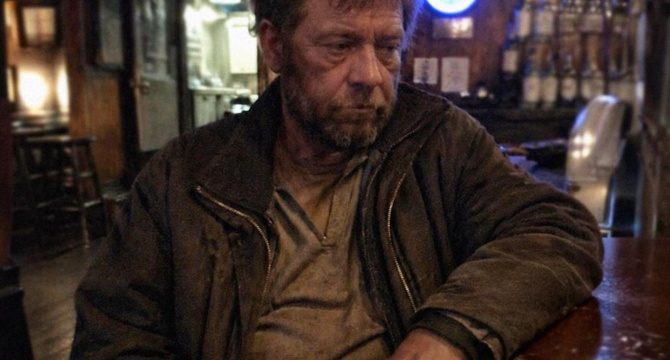
He didn’t look like much. Late 30s, maybe early 40s. Slight stubble, a few faint lines around his eyes. His shirt was simple, a little worn at the collar, like he’d had it for years. There was nothing remarkable about him.
And yet… something about the way he watched me felt different. Not curious, not pitying. Just… present.
“I’ve seen that look before,” he said, taking a slow sip from his glass. “Feels like everything’s collapsing at once, doesn’t it?”
I let out a dry laugh, shaking my head. “You have no idea.”
“Try me.”
I hesitated.
Normally, I would’ve brushed it off. Gave a polite smile, turned away, built my walls higher. But something in me — maybe exhaustion, maybe desperation — cracked.
“My name’s Clara,” I said quietly, tracing the rim of my glass. “And yeah… everything is collapsing.”
He nodded once, like I’d just told him something important.
“Hayes,” he replied. “And for what it’s worth… you’re not the only one who’s had everything fall apart.”
I glanced at him, skeptical. “You?”
A faint smile tugged at his lips, but it didn’t quite reach his eyes.
“More than once.”
There was something in the way he said it — like it carried weight. Like it wasn’t just words.
I should’ve left it there.
But instead, I asked, “What happened?”
And just like that, two strangers in a broken-down bar started telling each other the kind of truths people usually spend a lifetime hiding. I didn’t know it then… but that conversation was about to change everything.
We talked like the night had nowhere else to be.
At some point, the noise of the bar faded into the background. The laughter, the clinking glasses, the occasional burst of music — it all blurred into something distant. All that mattered was the space between us, the quiet understanding that kept pulling words out of me I didn’t even know I was ready to say.
“I lost my job three weeks ago,” I admitted, my fingers tightening around the glass. “No warning. Just a meeting, a polite smile, and a cardboard box.”
Hayes nodded slowly, like he was piecing it together. “That kind of silence after bad news… It’s louder than anything, isn’t it?”
I looked at him, surprised. “Yeah,” I whispered. “Exactly.”
“And your husband?” he asked gently.
I swallowed hard, my chest tightening. “Ex-husband now.” I let out a shaky breath. “Victor said he couldn’t ‘carry the weight’ anymore.” I gave a bitter laugh, shaking my head. “Funny thing is, I didn’t realize I was something to be carried.”
Ethan’s jaw tensed slightly. Not in anger, but in recognition.
“People leave when things stop being easy,” he said quietly. “It says more about them than it ever will about you.”
I stared at him, searching his face. “You talk like you’ve been there.”
For a moment, he didn’t answer. He leaned back slightly, his gaze drifting to the scratched wood of the counter.
“I built something once,” he said finally. “Something I thought would last. A company. A life. People I trusted.”
His voice remained calm, but there was something underneath it — something restrained. “Then one day, it all collapsed. Not because of failure… but because of betrayal.”
I felt a flicker of curiosity. “What happened?”
He exhaled slowly, rubbing the back of his neck. “Someone I trusted made decisions behind my back. Cost me more than money.” A pause. “Cost me time. People. Things you don’t get back.”
There was a heaviness in his words that didn’t match his simple appearance. It lingered in the air between us.
“And you just… started over?” I asked.
He looked at me then, really looked at me, his eyes steady. “You don’t really get a choice,” he said. “Life doesn’t wait for you to be ready.”
I let that sink in.
For a while, neither of us spoke. I could hear the hum of an old refrigerator behind the bar, the soft scrape of a chair across the floor somewhere behind me. My thoughts drifted, but for the first time in weeks, they didn’t feel suffocating.
“There’s something else,” I said finally, my voice quieter now.
Hayes didn’t interrupt. He just tilted his head slightly, giving me space.
“My son,” I whispered.
Even saying the words made my throat tighten.
“Leo… he’s six.” My lips trembled despite my effort to stay composed. “He’s sick.”
Hayes’s expression shifted — subtle, but unmistakable. His posture straightened, his attention sharpening.
“What kind of sick?” he asked, his voice softer now.
I shook my head, tears threatening. “I can’t even say it without feeling like it becomes more real.” I let out a broken breath. “The treatments… they’re expensive. And now that I don’t have a job…” My voice cracked completely. “I don’t know how I’m supposed to help him.”
Silence settled between us, heavier this time. I expected sympathy. Maybe even discomfort.
But Hayes didn’t look away.
Instead, he leaned forward slightly, resting his forearms on the bar.
“Clara,” he said quietly.
There was something in the way he said my name — steady, grounding.
“Sometimes life tears everything down at once,” he continued. “Not because it’s cruel… but because it’s making space.”
I let out a weak, almost disbelieving laugh. “That sounds nice. But it doesn’t feel like space. It feels like I’m drowning.”
He nodded once. “I know.”
His gaze didn’t waver.
“But drowning doesn’t mean you’re done,” he added. “It means you’re still fighting to breathe.”
I blinked, caught off guard by the simplicity of it.
We fell into another stretch of conversation — lighter this time, but still real. He told me about places he’d been, mistakes he’d made, nights where he thought he’d lost everything. I told him about Leo’s obsession with dinosaurs, how he used to insist on sleeping with a plastic T-Rex under his pillow “just in case.”
Ethan actually laughed at that — a genuine, warm laugh that softened his entire face.
“Smart kid,” he said. “Always be prepared.”
I smiled, the first real smile I’d felt in weeks.
Time slipped by without permission.
At some point, I realized my glass had been empty for a while. The bar had thinned out, the energy shifting into something quieter, more subdued.
I turned to Hayes, about to say something — anything to hold onto the moment just a little longer—
When the door swung open.
The sound cut sharply through the quiet.
A man stepped inside, tall, sharply dressed, completely out of place. His suit alone probably cost more than everything in the bar combined. His eyes scanned the room, urgently.
Then they landed on us.
My stomach tightened as he walked straight toward the counter.
Straight toward Ethan.
He leaned down slightly, his voice low but firm.
“Mr. Hayes,” he said, “your plane to Dubai is ready. We need to leave immediately.”
For a second, I thought I’d misheard.
I turned slowly toward Ethan, but he didn’t look surprised. He simply finished the last sip of his drink, calm as ever, and set the glass down with a soft clink. And that’s when everything I thought I knew about him… shattered.
I couldn’t move.
“Mr. Hayes?” I repeated under my breath.
Mr. Hayes — reached into his pocket as if this were routine, like being summoned to a private jet from a rundown bar happened every day. But before he stood, he turned to me.
“I have to go,” he said gently.
I blinked, trying to catch up with a reality that no longer made sense. “You’re… you’re leaving? Just like that?”
A faint, almost apologetic smile touched his lips. “Not entirely.”
He pulled out a small piece of paper, scribbled something quickly, then slid it toward me.
“Call this number tomorrow, Clara.”
I stared at it, my fingers hesitant as I picked it up. “Why?”
His eyes softened, something unspoken passing through them. “Just trust me.”
Before I could ask anything else, he stood. The man in the suit stepped aside immediately, almost deferential.
Hayes paused, glancing back at me one last time.
“I meant what I said,” he added quietly. “Sometimes things fall apart… so something better can find its way in.”
And then he was gone.
The next morning, I almost didn’t call. But something in his voice stayed with me. When I finally did, a calm, professional voice answered.
“This is Dr. Reynolds.”
I hesitated. “I… I was told to call. By Mr. Hayes.”
A brief pause.
“Yes,” he replied. “We’ve been expecting you, Ms. Carter. Your son’s treatment… will be fully covered.”
The room spun, and tears filled my eyes before I could stop them. Weeks later, I found myself back at that same bar. Same worn stool. Same dim light. I wasn’t sure why I came… only that I needed to.
And then—
“Rough day?” a familiar voice asked softly.
I turned, and Hayes stood there. And this time, I smiled first.