Three months after having my son, I stood in front of my closet and felt like I was looking at pieces of a woman I used to know. Dresses that once skimmed my waist stopped halfway up my back. Zippers stalled. Seams pulled.
It isn’t just your body that feels different. It’s your reflection. I was living in surrender. Soft pajamas. Loose tees. Hair in a clip. Days measured by feedings and laundry.
Dresses that once skimmed my waist stopped halfway up my back.
Before the baby, I had travel plans and a calendar full of work calls. Then life narrowed, and I kept telling myself it was only for a while.
Nathan had wanted that narrowing more than I did. He pushed me to quit my job. Every time I mentioned keeping a small client, he pressed his lips together and said, “Eva, why are you making this harder than it needs to be?”
By the time our son arrived, I had stopped asking and started disappearing in ways I didn’t even notice. So when Nathan’s company announced a formal party with spouses invited, something stubborn woke up inside me.
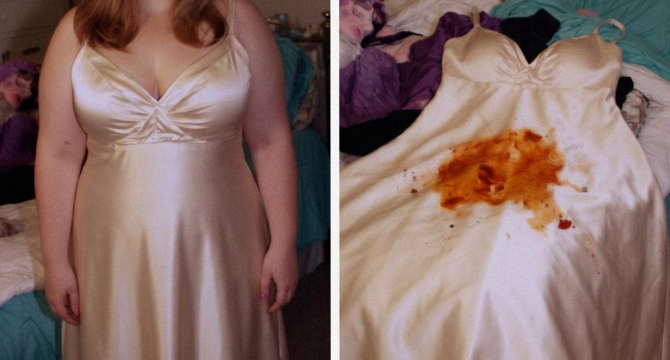
I called my mom, booked her for the evening, then bought the one dress I loved: a champagne-colored silk, simple and clean. It wasn’t magical, but it gave me something I hadn’t felt in months.
He pushed me to quit my job.
When I tried it on, I stared at my reflection for a long minute and whispered, “There you are! You look… perfect!”
I showed Nathan the dress that night while he sat scrolling through his phone. I turned once, not for praise, but because I wanted him to see how hard I had tried.
He glanced up for maybe two seconds and said, “It’s fine.”
“Fine?” I asked.
“You don’t need to make a big thing out of a work event, Eva,” he shrugged.
Later that night, I passed the office and heard Nathan’s voice through the half-closed door.
“Yeah, my wife might come,” he said, then laughed. “She’s still… recovering. Don’t judge me based on her looks, man!”
I wanted him to see how hard I had tried.
I froze. There are moments when your heart doesn’t break loudly.
My husband kept talking, easy and relaxed, as if he hadn’t just turned me into a joke. By morning, the hurt had settled into something colder, and cold can be useful when tears are not.
When Nathan came in to grab his watch, I asked, “Honey, are you embarrassed by me?”
He didn’t even pause. “Eva, don’t start.” Then he slipped his phone into his pocket, reached for his jacket, and added, “I need to get to the office early. I have to arrange some things for the party tomorrow.”
I just nodded. What else was I supposed to do? Nathan walked out like he hadn’t just taken a blade to the last fragile piece of confidence I’d managed to build back up.
There are moments when your heart doesn’t break loudly.
I stayed there in the bedroom, silent and heartbroken, staring at the dress bag in my hands as if it belonged to someone with a life that still fit her.
The following evening, I got ready slowly because I needed every step to count. I did my makeup, curled my hair, slipped into the dress, and breathed through the nerves that came with seeing myself dressed up again.
Then Nathan came into the bedroom holding a paper plate with a slice of pepperoni pizza, and even then something felt off. We were supposed to leave in 10 minutes. He never ate pizza in formal clothes.
“Are you ready?” he asked.
“Almost,” I said, smoothing my dress and reaching for my earrings.
He never ate pizza in formal clothes.
Nathan stepped closer, glanced at the dress, then turned too quickly. The plate tipped. Grease and red sauce landed right against the front of my dress. Bright oil spread over champagne silk while I stared at it.
Nathan looked at the stain, then at me, and there it was. Not panic. Not guilt. Relief.
“That’s unfortunate,” he said.
I just stood there, staring at the mess. “Unfortunate?”
He set the plate on the dresser. “You’d better stay home and get some rest.”
He said it gently, which made it worse.
“Yeah,” I replied. “You’re right.”
“You’d better stay home and get some rest.”
Nathan nodded, grabbed his keys, and left. The front door closed as tears came hot and tired. I peeled off the dress carefully, washed my face, and heard his voice again: “Don’t judge me based on her looks.”
That was when the sadness changed shape and became a decision.
A few weeks earlier, I’d quietly picked up small consulting assignments again: late-night calls and strategy notes written one-handed while rocking a bassinet. Work I hadn’t told Nathan about because I was tired of asking permission for my own mind.
One project led to a senior executive position. Then I heard the company’s name.
It was the same company where Nathan worked.
“Don’t judge me based on her looks.”
The man I’d been advising was Mr. Robertson, the CEO Nathan talked about like royalty. He knew my work and trusted it. I wiped my cheeks dry and called him.
“Mr. Robertson, I need a favor, and I promise you’ll understand when you see me.”
Thirty minutes later, I stepped out of a car in front of a hotel in a black dress I’d bought two years ago, back when it hung loose on me and I’d almost returned it, thinking I’d never need it. Mr. Robertson offered me his arm with the easy courtesy of a man who had spent decades putting people at ease.
When I told him what Nathan had done, a shadow crossed his face, and that was all. No lecture. Just belief.
Mr. Robertson looked toward the glowing entrance ahead of us, then back at me. “Are you ready to go in?”
I took a breath, lifted my chin, and said, “Yes.”
“I promise you’ll understand when you see me.”
A few employees noticed Mr. Robertson first and straightened. Then they noticed me on his arm, and their expressions shifted from polite recognition to open confusion.
Across the room, Nathan was laughing with a woman in a red dress, posture loose, face more relaxed than it had been with me in months. Then he looked up, saw us, and the color drained from his face. He took three quick steps toward us.
“Eva? Mr. Robertson? What on earth are you BOTH doing here?”
Nobody pretended not to hear. The woman in red quietly drifted into the crowd. Nathan looked from me to Mr. Robertson as if his mind couldn’t find a version of reality that made sense.
Then they noticed me on his arm.
“Good evening, Nathan,” Mr. Robertson said.
Nathan barely nodded. “Eva, explain this.”
“I don’t owe you panic just because you’re panicking,” I answered.
“What is this? Some kind of stunt?” Nathan exploded.
“No, honey! This is work.”
Nathan laughed. “Work? You don’t work.”
That line made several people nearby glance at each other.
“I do, actually,” I revealed. “I’ve been consulting again.”
“Eva, explain this.”
“For whom?”
“For me, among others,” Mr. Robertson cut in.
“When you asked me to quit after I got pregnant, I did it,” I admitted. “A few weeks ago, I started taking remote assignments. I didn’t know it was your company until I was already in it.”
“You hid this from me,” Nathan hissed.
“You made hiding feel safer than telling, darling.”
Nathan stepped closer. “That’s a huge thing to keep from your husband.”
“Lower your voice,” Mr. Robertson demanded.
“You hid this from me.”
Nathan stopped at once, and that told me how much of his confidence had always depended on choosing targets who couldn’t answer back.
“Sir, I don’t understand why she’s here with you,” he muttered.
“Because I invited her after hearing what happened before she left home. A man who ruins his wife’s dress because he doesn’t want colleagues to see her is not demonstrating judgment or character.”
Nathan’s eyes widened. “Sir, I don’t understand…”
“Explain why you brought pizza into your bedroom while dressed for a formal party,” Mr. Robertson added.
Nathan had no answer. He looked at me, and for the first time all evening, I saw fear.
“Sir, I don’t understand why she’s here with you.”
“Eva, can we talk somewhere else?” he whispered.
I smiled without warmth. “So I can be easier to manage?”
“Please,” Nathan pleaded. “Let’s not do this here.”
“We aren’t doing anything, Nathan,” I snapped. “You did something at home. You did something on the phone last night. This is the first time both versions of you have met.”
His eyes darted to Mr. Robertson. “I hope this won’t affect… anything.”
Mr. Robertson didn’t rescue him. “Performance reviews are based on performance.”
“And my role in those reviews was earned independently,” I added.
“Let’s not do this here.”
Nathan stared at me as each sentence dropped another floor out from under him. “Eva, I said something I shouldn’t have said. Let’s just go home.”
“I’ll go home later. You can decide how to spend the time in between.”
He reached for my elbow, then thought better of it. “I never meant to hurt you.”
“Nathan, you aimed right at me,” I said.
For the next hour, my husband hovered, bringing me sparkling water I hadn’t asked for, offering hors d’oeuvres with shaking fingers, and even asking me to dance. I refused each offer with the same calm voice: “No, thank you.”
At one point Nathan whispered, “You’re enjoying this.”
I turned to him. “No! I would’ve enjoyed being your wife tonight.”
“I never meant to hurt you.”
He looked at the floor. I saw real shame move across his face, but shame is not the same as change.
Near the end of the evening, the event coordinator asked Mr. Robertson if he’d like to say a few closing words. He glanced at me. “Would you care to?”
I took the microphone because, for once, I didn’t want to make myself small to keep someone else comfortable.
“Good evening,” I addressed the gathering. “I’m Eva, and I’ve been consulting with leadership on operational performance and communication standards. The review summaries going out Monday will be honest. They won’t be shaped by charm or by who feels most comfortable in a room like this. They’ll reflect work, conduct, and the way people treat others when they think it doesn’t count. Characters have a way of showing up everywhere.”
“The review summaries going out Monday will be honest.”
I didn’t look at Nathan until the end. I handed the mic back and walked toward the exit. Nathan followed me into the lobby.
“Eva, please don’t leave like this.”
I turned. “You already left me at home once tonight.”
Nathan came home half an hour after I did. He found me in the kitchen, makeup half-removed. He waited for me to fill the silence. I didn’t.
“I messed up,” he finally said.
“You did.”
“You already left me at home once tonight.”
“I was trying to spare you,” he stated.
I laughed. “Spare me from what? Being seen?”
“I wanted you to look good, Eva. You’re still getting back to yourself…”
“Back to myself? Or back to whatever version made you look better standing next to you?”
He stared at me for a beat. “That’s not fair.”
“Fair would’ve been letting me decide whether I wanted to go,” I said, shrugging.
“I said I’m sorry.”
“Sorry doesn’t erase what you revealed, Nathan.”
“I was trying to spare you.”
“What do you want from me?”
“A version of you I haven’t met yet,” I replied.
I thought that was the end of the conversation, but the real fallout was only waiting for the weekend to pass.
Monday evening, Nathan came home with shoulders rigid and tie pulled loose. I was on the floor with the baby, stacking soft blocks.
“You gave me a terrible review,” he said.
“I gave you an honest one.”
Nathan was visibly disappointed. “My promotion is gone.”
“Your promotion was never mine to take,” I affirmed.
The real fallout was only waiting for the weekend to pass.
“The others got rough reviews too,” he said. “They’re blaming me.”
I thought about that and said, “Because your behavior made them impossible to ignore.”
Nathan sank into a chair and covered his face. After a long silence, he sighed, “What am I supposed to do now?”
I bounced the baby gently. “Start by becoming someone our son should learn from.”
Since then, Nathan has been trying. He changes diapers without acting like he’s doing me a favor. He gets up for early feedings. He watches his words, especially the careless ones. I see the effort, but seeing effort isn’t the same as handing back trust before it’s been earned.
“Start by becoming someone our son should learn from.”
Nathan keeps waiting for me to slide into old patterns. I don’t. I speak plainly. I wear what feels good on my body. Last week I bought another dress, navy this time, and hung it where I could see it every morning.
The ruined dress wasn’t the deepest cut. What broke me was hearing, in one neat little act, how thoroughly my husband had reduced me to something to be managed and hidden until I became pleasing again.
Nathan asked me yesterday, “Do you think you’ll ever forgive me?”
I looked at him, then at our son, then back at the man who had finally begun to understand what he had done.
“Maybe one day,” I replied. “But the woman you tried to hide is the one deciding now.”