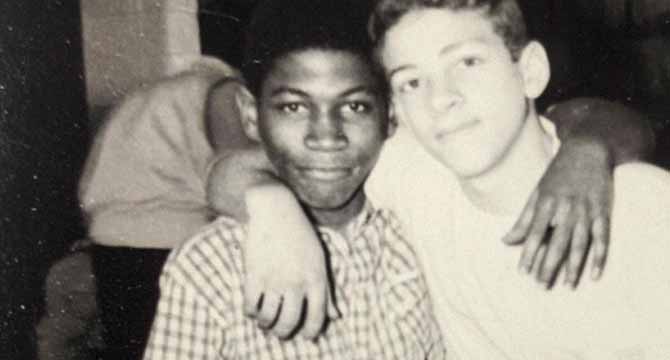
TearsRobert had lived in six different states, served 20 years in the military, and raised two sons who rarely called unless it was Father’s Day or they needed something fixed.
At 73, he walked with a cane and a slight limp from a knee injury he got back in ’84 during a training drill in Arizona. He still made his own coffee every morning and read the paper on the porch, just like his father used to.
Quiet moments, loud memories.
Michael was the same age and lived on the other side of the country in a house he’d bought with his late wife back in the ’70s. A retired mechanic, he still tinkered with old engines in the garage when his knees allowed it.
His hands were rough, knuckles thick with arthritis, but he could still twist a wrench better than most 20-year-olds. He had three kids, five grandkids, and an old class photo tucked in a drawer in the kitchen — a photo he hadn’t looked at in years.
But neither man had ever forgotten.
They met in school in 1961, back when life stretched out like an endless road, and summers felt like they’d never end.
Robert was loud and restless, always tapping his foot or flicking paper balls at the back of someone’s head. Michael was quiet, thoughtful, the kind of boy who lined up his pencils and never forgot his homework.
They were desk mates from the first day.
“You got a pencil?” Robert had asked, poking the boy beside him.
Michael handed one over without a word.
“I’m Robert. You can call me Bobby. Everybody does.”
“Michael,” he replied.
“Well, Mike, guess you’re stuck with me now.”
They weren’t the same, not really. But somehow, they fit.
After school, they’d walk home together, swinging their backpacks and throwing stones at street signs. When money was tight, Michael would split his apple in half and hand it over like it was nothing.
“Your mom packs this?” Robert would ask.
“Yeah. She said I need something healthy.”
“Well, she packs a mean apple.”
“Better than those chips you bring.”
“That’s not fair. Chips are a food group.”
They whispered jokes during class and got separated by teachers more than once.
“Mr. Stevens, Mr. Carter — front row, now.”
“Do you think they’ll ever give up?” Robert whispered as they moved seats.
“They keep trying,” Michael muttered.
“So probably not.”
They promised each other everything — that they’d stay friends forever, that they’d be each other’s best men at their weddings, and that nothing would ever break them apart.
But life doesn’t care about promises made by 13-year-old boys.
In 1966, Robert’s father lost his job at the steel plant. Within a week, the whole Stevens family packed up and moved to Oregon. There was no time for goodbyes.
No phone in the house. No email. Just addresses scribbled on the back of envelopes that were lost or changed. Letters sent, but never answered.
And that was it.
Michael stayed in town. Got a job fixing cars right out of high school. He married Linda, the girl who worked at the diner on 3rd Street. They had three kids, one too soon, one just right, and one they hadn’t planned for. He built a life in that town, one oil change and timing belt at a time.
Robert went the other way. He enlisted in the Army at 18 and served in Germany, Texas, and Alaska. He married a nurse he met on base and raised two boys. His life was always on the move, filled with different towns, new jobs, and old scars.
They buried their parents, said goodbye to friends, and watched the years stack up like winter coats.
And yet, they both held on to something.
Michael kept that photo. Sixth grade. All the boys standing crooked in front of a brick wall, hair parted, ears sticking out. There was Robert, front row, tongue out just as the shutter clicked.
Robert never forgot the nickname Michael had given him: “Rooster.” He never told anyone else. He still smiled every time he thought of it.
Then one lazy Saturday, decades later, Michael’s 19-year-old grandson, Tyler, was digging through boxes in the attic.
“Grandpa, who’s this?” he called out.
Michael looked up from his chair, adjusting his glasses. “That’s me. Sixth grade.”
“Dang. Y’all look like… tiny men in church clothes.”
Tyler laughed and snapped a picture of the photo, posting it on some alumni group online with a caption that read: “My grandpa Michael, class of ’61. Does anyone recognize the other kids?”
Halfway across the country, Robert’s granddaughter, Ellie, saw it while scrolling through her feed. She froze, stared, then grabbed her phone.
“Grandpa,” she said, voice shaking, “is this you?”
Robert squinted at the screen.
His heart jumped.
“Yeah, that’s me,” he whispered. “And that’s Mike.”
One message became five. Then a phone call.
“I thought you’d forgotten,” Michael said quietly.
“I never did,” Robert replied, his voice cracking.
They talked for over an hour. Then two. Laughter, tears, and long silences.
“Let’s meet,” Michael finally said.
“I’d like that.”
They chose a community center halfway between their homes. Neutral ground. Familiar strangers again.
On the day of the meeting, Michael wore his cleanest shirt and used cologne for the first time in years. His hands shook the whole drive there. Robert arrived early, leaning on a cane, heart thudding like he was 17 again.
And when Michael walked in and saw him, older now, thinner, grayer, and moving a little slower, something inside him twisted.
Robert looked up.
“Mike?”
Michael took one step forward, then froze.
Robert’s lips trembled as he smiled.
For a moment, neither of them spoke. The room held its breath.
Their hands trembled. Their eyes filled with tears. They stood still, staring silently at one another.
And no one could have imagined what would happen next.
Robert took a slow breath, his hand still shaking slightly as he leaned on his cane. Michael didn’t move at first. His eyes were red, and his jaw was clenched like he was trying to hold something in.
Then, slowly, he reached into his coat pocket.
“I was hoping you’d still like these,” Michael said, voice rough.
He pulled out an apple. A red one, just like the kind his mother used to pack in his lunch all those years ago.
Robert blinked, then laughed. It wasn’t just a chuckle, but a deep, full laugh that cracked through the stillness of the room.
“You’ve got to be kidding me,” he said, wiping his eyes. “You still remember that?”
Michael smiled, finally stepping forward. “You think I forgot the kid who used to trade me chips for apple slices? I always thought I got the better deal.”
Robert shook his head, laughing through the tears.
“You always did. I just wanted to look generous.”
They stood there for another second, then Robert nodded toward a nearby bench. “Let’s sit. My knees don’t forgive me the way they used to.”
They sat slowly, side by side, their shoulders brushing.
Michael looked at the apple, then split it clean down the middle with a pocketknife he pulled from his jeans. He handed half to Robert, then bit into his own.
No big speeches. No dramatic explanations. Just an apple, shared like they used to.
For a while, they chewed in silence.
“I thought about this moment a hundred times,” Robert said, finally. “I’d run through what I’d say if I ever saw you again. Apologies, long stories, all that. But now that you’re here…”
Michael looked over, his expression soft.
“You don’t need to say anything.”
Robert nodded slowly. “Still. I’m sorry we didn’t get a proper goodbye.”
“You were 13,” Michael replied. “Neither of us had control over what happened. I was mad at you for leaving back then, if I’m honest. For a long time.”
“I figured,” Robert admitted. “I was mad too. Not at you. Just… mad. One day I had a best friend, and the next day we were gone. No warning. No phone calls. Just boxes and goodbyes to people I barely knew.”
“My mom told me you’d write,” Michael said. “I waited. I did too.”
“I tried,” Robert added quickly. “But the addresses kept changing. We moved three times in two years. I think I sent two letters before we lost everything in a flood. After that, I stopped trying.”
Michael nodded, quiet again.
Then he looked over and said, “I kept the class photo. You remember Mrs. Daugherty’s class? Sixth grade?”
Robert grinned. “I do. You were the only kid wearing a tie.”
“My mom made me,” Michael muttered.
“And I stuck my tongue out in the front row.”
“I nearly peed myself laughing when that photo came back.”
They both laughed now, easier than before. It felt like slipping back into an old rhythm, the kind of bond that didn’t need time to warm up.
It had simply been waiting.
“Your granddaughter,” Michael said, “Ellie?”
Robert nodded. “She’s the one who saw the photo online. I don’t think she realized what she was starting.”
“My grandson posted it,” Michael said. “I don’t even know why. He was just messing around in the attic and found the old yearbook. Next thing I know, he’s calling me downstairs, holding his phone like he’d found a gold nugget.”
“Well, he kind of did,” Robert said.
Michael smiled and looked down at the half-eaten apple in his hand.
“You know,” he said, “when I saw you standing there, I thought time had lied. Like maybe it hadn’t really been 58 years. Maybe I just blinked.”
Robert nodded slowly.
“I thought the same. I kept seeing that scrawny kid with the serious face and shiny shoes.”
“And I saw you. That messy hair, the loud laugh. You were always louder than the whole class.”
“I still am. My wife used to tell me I could wake the dead with my snoring.”
Michael chuckled. “Linda used to say I talked in my sleep. Usually about car parts or apple pie.”
“Do you miss her?” Robert asked gently.
“Every day,” Michael said. “She passed away five years ago. Cancer. I kept the house, though. Couldn’t bring myself to leave.”
“I lost Margaret in 2017. Heart failure,” Robert said. “The boys wanted me to move in, but I couldn’t. Too many memories.”
Michael looked over.
“So we’re two stubborn old men, stuck in our ways.”
“I guess so,” Robert said, smiling.
They sat for another half hour, just talking. They shared updates about their kids, their grandkids, and the lives they had built without each other. There were so many names, so many stories, yet a thread ran through every memory, quiet but clear. They had never truly let go.
“I went to the river a few years ago,” Michael said, eyes distant. “The one we used to skip stones at.”
Robert looked over quickly. “Still there?”
“Yeah. Trees are taller. The water’s quieter. But it’s still the same spot.”
“Maybe we should go back,” Robert said. “Take our grandkids. Show them how it’s done.”
Michael raised an eyebrow.
“You still know how to skip stones?”
“You bet I do. I’ve had 58 years to practice,” Robert said with a grin.
They met the following week. Coffee first, then a walk around the lake. After that, it became a ritual. Every Sunday at 10 a.m., without fail. Same table at the café, same booth by the window, and the same waitress who always brought two black coffees without asking.
“Morning, boys,” she’d say with a smile. “You two keeping out of trouble?”
Robert would wink and reply, “No promises.”
They talked about everything and nothing.
The aches in their joints, the state of the country, old cars, and bad television. Sometimes, they just sat without speaking, content in the kind of silence that only comes from knowing someone for most of your life.
One Sunday, Michael brought an old shoebox.
“I thought you might want these,” he said, sliding the shoebox across the table.
Inside were folded notes, class schedules, and even a friendship bracelet Robert had made out of string one summer.
“You kept this?” Robert asked, stunned.
“I kept everything,” Michael said.
“I guess I always hoped…”
“You knew,” Robert said quietly. “You knew we’d find each other.”
Michael shrugged, but his eyes gave him away.
Their families began to meet. Barbecues, birthdays, and holidays. It was like two separate trees suddenly realizing their roots had always been intertwined. The grandkids bonded quickly, curious about the men who acted like teenage boys when they were together.
“Grandpa Mike, did you really ride your bike into a bush trying to impress a girl?” Ellie asked one afternoon.
Michael pointed at Robert. “Ask your grandpa why he dared me.”
Robert just laughed.
“It was funny then. Still is.”
Time had passed, yes. But somehow, it hadn’t won. The years had stretched, bent, pulled them apart — but not broken them. Their friendship had waited, quietly, beneath the noise of everything else.
Some friendships don’t fade. They just wait.
Now, even strangers at the café know their story. The two old men who meet every Sunday, who share apple slices with their coffee, and who finish each other’s jokes like no time has passed at all.
“Rooster,” Michael said one morning, the nickname slipping out naturally.
Robert looked up. “Haven’t heard that in a while.”
“I figured it was time.”
Robert smiled. “Yeah. It is.”
And just like that, the past and present became one. Not through grand moments or dramatic gestures. But through something as simple as a walk, a cup of coffee, and half an apple, shared between friends who never truly said goodbye.
But here’s the real question: when life gives you one unexpected chance to reclaim something you lost decades ago — do you let it pass, or reach out and hold on like you never let go?
Leave a Reply