When I was ten, my world split clean down the middle.
It was early fall, probably September. The kind of morning that smelled like wet earth and wood smoke. My dad, Andrew, kissed my forehead as I sat at the kitchen table with my cereal. He ruffled my hair and said, “Be good for your mom, pumpkin. I won’t be long.”
He was heading out to the forest that bordered our town.
He’d been doing weekend hikes there since I could remember. He called it his “reset button.” It was just supposed to be a few hours. A solo trail, like always. Nothing extreme.
He even left his backpack by the door, only grabbing a flask of coffee and the jacket he loved. That green canvas one with fraying cuffs and elbow patches, I used to run my fingers over.
But that day, he never came back.
At first, I didn’t understand the urgency.
I thought maybe he got caught up in something. Trees could be confusing. Maybe his phone died. But when the sun went down, and his spot at the dinner table stayed empty, something in my mother’s face cracked. I saw it — just for a second — when she stepped outside to call the police. Her hands shook.
They started the search the next morning.
First, it was just local rangers and volunteers.
Then came the dogs. Then the helicopters. Dozens of people combed through the forest, calling his name.
“Andrew! ANDREW!”
I stood near the edge of the trees with my uncle, Theo, clinging to his jacket, hoping the next person walking out of those woods would be my dad, smiling like nothing happened.
But days turned into weeks.
Weeks into months.
They never found a body. No broken branches. No blood. Not even a dropped wallet or a torn sleeve.
Just silence.
Eventually, people stopped coming by with casseroles and questions. They stopped saying, “Maybe tomorrow.”
The words shifted. “Missing” became “gone.”
And “gone” slowly turned into “dead.”
But I never saw a coffin. And I never stopped wondering.
Mom tried to move on, but something inside her hollowed out. She kept my dad’s things like breadcrumbs leading back to him — his flannel shirts, his hiking boots, a stack of Polaroids from before I was born, and most of all, his watch.
God, the watch.
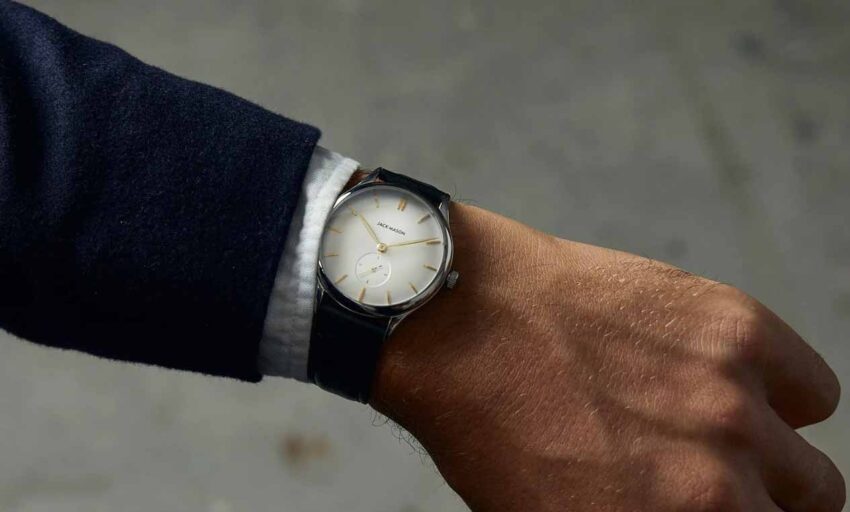
It was a custom-made piece with a gold bezel, a dark brown leather strap, and a navy dial that looked black unless it caught the light. It had been a gift from Kyle, my dad’s best friend since college.
I used to catch them laughing together over beers on our porch, Kyle with his loud voice and bear hugs, and Dad smiling like a teenager.
The back of the watch had an engraving I memorized before I could even spell properly:
“To my best friend, Andrew.”
I used to sneak it out of the box and hold it up to my ear to hear if it still ticked.
Years passed.
I graduated from high school. Finished college. Got my first job. My mom eventually sold the house. We each packed a few keepsakes. I kept the photos, one of his old books, and a flannel that still smelled like pine and Old Spice.
The watch had gone missing by then. We assumed it got lost in the shuffle.
Another small grief in a sea of them.
By the time I turned 30, I was teaching English literature, living in a walk-up with a rescue cat named Walter, and pretending I didn’t still dream about hearing my dad’s voice again. Some losses don’t heal. They simply settle into your bones.
Then came the night that turned everything upside down.
My friends and I had planned a small reunion dinner, just five of us from college catching up at a rustic little restaurant outside town. Brick walls, Edison lights, and those artisanal menus with too many adjectives.
It was a Friday night, warm for October, and I was laughing at a story Jess told when our waiter approached.
He couldn’t have been older than 20.
Slim build. Slightly curly dark hair. Sharp cheekbones softened by youth. His name tag read Nolan.
And from the moment he walked up to our table, something gnawed at me.
It was his eyes.
They were brown and warm with a quiet intensity. I’d seen them before, but where?
The night moved on, but I couldn’t stop watching him. Not in a weird way. Just this eerie pull.
Like something buried was clawing its way to the surface.
He brought us our food. Cleared our plates. Came back with the dessert menu.
And then, when he leaned over to place the bill on the table, my heart stopped.
On his wrist was a watch.
Not just any watch.
It was my father’s watch.
The same bezel. The same strap.
It had the same wear marks near the buckle.
I stared, frozen. My breath caught. My chest clenched like a fist. And before I could talk myself out of it, I reached across the table, grabbed his hand, and tilted his wrist toward the light.
“N-no — wait, what are you —?” Nolan stammered, confused.
But I’d already seen it.
The engraving.
“To my best friend, Andrew.”
The restaurant faded into static. I felt like I’d been dropped underwater.
My voice came out raw.
“How old are you?” I asked, shaking.
He blinked. “Eighteen. Why?”
My blood turned to ice.
I stood up so fast my chair screeched back.
“WHERE DID YOU GET THAT WATCH?!”
The whole restaurant fell silent.
He looked stunned. Frightened.
And me?
I was staring into the face of a boy who looked like my father and was wearing his ghost on his wrist.
The words echoed louder than I’d meant. Too loud. My voice cracked in front of a room full of strangers, forks suspended midair, conversations paused mid-sentence. The low clink of a wine glass setting down was the only sound that followed.
Nolan’s eyes widened, his brows knitting together in confusion.
“What — what are you talking about?”
I was standing now, heart hammering so loudly I could hear it in my ears. I didn’t care that people were staring or that my friends looked mortified. I pointed to the watch still clinging to his wrist like a time capsule cracked open.
“This watch. That watch — where did you get it?”
He instinctively pulled his arm back. “It was my dad’s,” he said quietly, glancing nervously around.
My breath hitched.
“Your dad’s?” My voice softened, but only slightly. “Who’s your dad?”
His expression changed — subtle, guarded.
“His name was Andrew. He died when I was a baby.”
I felt my knees go weak.
Jess caught my arm, whispering, “Irene, what’s going on?”
But all I could do was stare at Nolan, at his face, and those eyes.
“I think you need to sit down,” he said, tentative now, almost kind. “I didn’t mean to upset you.”
I ignored the lump rising in my throat.
“You said his name was Andrew?” I asked again, slower.
He nodded, clearly uncomfortable.
I nearly collapsed.
That was my father’s name.
My mom never remarried.
I looked at Nolan, and it all snapped into focus like an old photograph being developed.
He had my father’s jawline. His exact mouth. Even the way he blinked slowly when overwhelmed felt like I’d time-traveled. But he’d said he was 18.
That meant he was born two years after my dad disappeared.
I pressed a trembling hand to my chest, trying to stay upright.
“I need… I need to talk to you. Somewhere private.”
Nolan blinked, still cautious. “I’m working right now. Maybe after my shift?”
I nodded, numb. “Please. I’ll wait.”
I sat down shakily. My friends were whispering, concerned. Jess leaned in.
“What’s going on, Irene? Who is he?”
I shook my head. “I don’t know. But that’s my father’s watch. I’m sure of it.”
An hour later, the restaurant emptied.
Nolan stepped outside through the back entrance.
He’d changed out of his apron, now in a faded hoodie and jeans, but the watch was still on his wrist.
I was waiting by the curb, arms crossed tightly around myself.
He approached cautiously. “You really scared me back there,” he said.
“I’m sorry,” I whispered. “It wasn’t about you. It’s just that watch.”
He looked down at it. “You said it belonged to your dad?”
I nodded, forcing air into my lungs.
“Yes. He disappeared 20 years ago. Went into the forest and never came back.”
Nolan’s expression shifted, something like disbelief flickering in his eyes. “That can’t be right.”
“Why not?”
He scratched the back of his neck. “Because that’s my dad. He raised me. He died last year.”
I stared. “What?”
He sighed, glancing around like he needed a cigarette he didn’t have. “He wasn’t… okay. He had memory problems. Especially toward the end. Like, whole chunks of his past were just gone. Sometimes he’d call me by the wrong name. Other times he’d cry over things that didn’t make sense.”
“What did he tell you about his life? Before you?”
“Not much,” Nolan admitted. “He said he used to live far from here. That he had some kind of accident. Said he was found injured in the woods by hikers. He had no ID, nothing on him. The hospital labeled him a John Doe.”
My head was spinning.
“Was he married? Did he ever talk about a wife? A daughter?”
Nolan shook his head. “No. He lived alone. Raised me by himself. Said my mom died during childbirth.”
I covered my mouth.
That wasn’t true.
I was very much alive.
And his story of an accident, memory loss, and the forest lined up.
Too perfectly.
I sat down on a nearby bench. Nolan hesitated, then joined me.
I turned toward him slowly. “Nolan. What if your dad were my dad?”
He didn’t speak right away. The streetlight above us flickered.
“That would mean…” he trailed off, doing the math in his head. “That he disappeared… then reappeared? Somewhere else? With no memory?”
I nodded.
“And two years later, you were born.”
Nolan’s hands fidgeted in his lap. “That doesn’t make sense. How could he forget everything? How could no one find him?”
I shrugged, feeling the ache of 20 years collapsing in on me. “The forest is big. People get lost. People disappear.”
“But why wouldn’t he remember you?”
I didn’t know. And the truth stabbed deep. I’d spent my whole life wondering where my father had gone. It never occurred to me that he might have been alive. Just without us.
“He didn’t even know his real name?” I asked.
“Not until I was around 12. That’s when he found the watch again. Said someone had mailed it anonymously to the house. No return address.”
I blinked. “That’s impossible. My mother and I thought it was lost.”
He shrugged. “Maybe someone else found it, someone from his past.”
Kyle.
The name hit me like a wave.
Kyle had vanished after my dad’s disappearance.
He said he couldn’t take the guilt. He was the one who gave him the watch, the one who last saw him. They’d hiked together sometimes. Maybe he’d been holding on to it all these years.
Had Kyle found my dad? Had he seen him living another life and chosen not to say anything?
A lump formed in my throat.
“I need to ask you something,” I said, my voice soft. “Can I see a picture of him? Your dad?”
Nolan hesitated, then pulled out his phone. A few swipes later, he turned the screen toward me.
And there he was.
Older. Grayer. Lines around the eyes. A little thinner than I remembered.
But it was him.
“Dad,” I whispered.
Nolan looked at me sideways. “You really think it’s the same person?”
Tears filled my eyes. “I know it is.”
He stared down at the screen, too. “This is insane.”
“I don’t know how to explain it. But it happened. Your dad was my dad.”
Silence stretched between us.
Then Nolan asked, “So what does that make us?”
I looked at him, just 18 years old. He was a boy, but still my father’s son.
“My brother,” I said.
He blinked, stunned. “That’s… wow. I never had any family. It was just him and me.”
I nodded, tears sliding freely now. “Same here.”
We sat there for a long time.
Two strangers with matching grief, tied together by a man who had vanished from one life and built another. Not out of cruelty, but out of confusion, circumstance, and maybe even survival.
Eventually, Nolan said, “Do you want to come see the house? His things are still there. I didn’t throw anything out.”
I looked up, surprised.
“I’d like that,” I said, voice trembling.
And for the first time in two decades, I felt like I was about to walk toward something instead of away from it.
Nolan lived just 20 minutes away, in a quiet neighborhood lined with old maple trees and low stone fences.
The drive was mostly silent.
Neither of us knew what to say. We were strangers connected by the deepest mystery of our lives.
His house was small, weathered, but clean. The porch light flickered as he unlocked the front door. “I haven’t touched most of his stuff,” he said, stepping aside to let me in. “Didn’t have the heart.”
The scent hit me instantly.
Sandalwood. Old paper. The faint trace of coffee and dust.
I hadn’t smelled that since I was ten.
The living room had warm tones, with faded browns and soft greens. A bookshelf lined with worn novels. A coat draped over a chair, untouched.
And there, on a side table, was a photo in a cracked frame.
Nolan picked it up and handed it to me. “He loved this one. Kept it by the bed.”
It was a picture of the two of them, Nolan, maybe five years old, sitting on my father’s shoulders, both of them grinning into the sun.
My throat tightened.
“He was a good dad,” Nolan said, almost apologetically. “I mean, I know you must hate him now, or hate me—”
“No,” I interrupted softly. “I don’t hate either of you.”
And I meant it.
I’d mourned my father for two decades.
I’d buried him in every part of my life — in my achievements, my holidays, my silences. But here, in this home he built with what little memory he had left, I found pieces of the man I remembered.
Not perfect. But present.
Nolan led me to a small room down the hall. “This was his study,” he said. “There might be something in here.”
I stepped in slowly.
There were notebooks stacked in uneven piles.
Sketches of trees.
Pages of journal entries, some coherent, others drifting off into fragments and loops. I sat on the floor, flipping through them, trying to make sense of what had become of him.
In one entry, his handwriting sharp and clean, he wrote:
“There’s a little girl in my dreams. Brown curls. Laughs like spring rain. I can’t remember her name, but she feels like everything I lost.”
I swallowed hard.
That was me.
I found another page.
This one was more chaotic, like he wrote it during a restless night.
“Names don’t stay. But the feeling does. I know I loved someone. I can feel her arms around my neck. A voice calling, ‘Daddy.’ I don’t know where I left her.”
Tears blurred the ink. I pressed the notebook to my chest.
“He knew,” I whispered. “Somewhere inside him, he knew.”
Nolan sat beside me, silent.
“I thought he chose to leave us,” I said. “I thought he walked away. But it wasn’t like that.”
“No,” Nolan said, his voice steady.
“He never would’ve done that.”
I nodded slowly. “You’re right.”
We spent the next hour going through boxes filled with photos, letters, receipts, and even old camping gear. Each piece filled a space in the puzzle of who he became after the forest.
At the bottom of one dusty box, I found a worn leather envelope.
Inside was a letter.
The handwriting was shaky, as if written in his final days.
“To the daughter I hope I find someday,
If you’re reading this, then maybe I finally remembered enough for you to find me.
I don’t know what happened in that forest. One moment I was walking, the next — nothing. Just darkness. When I woke up, I couldn’t remember who I was. Just flashes. A river. A girl’s laugh. A name I couldn’t hold on to.
But the dreams kept coming. And I know you’re real. I know I had a life before this one.
I hope you lived well. I hope you were loved, even when I couldn’t be the one to give it.
I am sorry. For everything. But if there’s even a small part of you that can forgive me, know this: I never stopped loving you. Even when I didn’t remember how.
Love, Dad.”
I didn’t realize I was crying until Nolan gently touched my shoulder.
“I never saw that,” he said quietly.
We sat on the floor, the letter between us like a bridge across time.
And for the first time since I was a little girl, I felt something I hadn’t dared feel in years.
Peace.
In the days that followed, Nolan and I stayed in touch. We began to meet regularly for coffee, walks, and slow conversations. It was strange at first, building something out of nothing. But he was patient. So was I.
We laughed about the oddities we shared, like our mutual dislike for olives, the way we both chewed pens when deep in thought, and even the same nervous habit of tapping our fingers when waiting for bad news.
Genetics. Or fate.
Maybe both.
A few weeks later, I brought our mother to the house.
She had gone ghost-pale when I first told her. She sat in stunned silence for minutes before finally whispering, “Andrew… my God.”
When she stepped into the house, she touched the walls as if they were sacred. After seeing the picture of Nolan and Dad, her knees buckled slightly, and I had to hold her up.
But she didn’t cry. Not then.
She waited until we showed her the letter.
Then she wept like I’d never seen before.
Nolan stood beside her, awkward and unsure.
She reached for his hand.
“You’re his son,” she said softly. “And that means you’re part of us too.”
Nolan blinked hard, nodding.
In that moment, I saw something shift in all of us. The grief didn’t vanish. It never does.
But it softened and made room for something else.
Connection.
Family.
Healing.
Now, months later, the watch sits in a glass box in my apartment. Not hidden. Not on display. Just present. Like a heartbeat in the room.
Nolan visits often. He met my husband, my students, and even Walter the cat. He’s planning to go back to school next fall. Says he wants to study forestry.
“Feels right,” he told me one afternoon. “I think Dad would’ve liked that.”
I smiled. “Yeah. He would’ve.”
Sometimes we still talk about the forest. About that strange void where everything changed. We may never understand what really happened in those woods. No one ever found the exact spot. No clues. No trail.
Just a man who walked in and forgot who he was.
But in a way, he found himself again.
Among the people who remembered him.
And now, in the family that has finally found each other.
I used to think my story ended the day my father disappeared.
Turns out, it was just the beginning of another one.
But here’s what I still wonder: what kind of world lets a father disappear from one life only to build another, never knowing the pieces he left behind? And when two strangers suddenly share the same blood, how do you start to rebuild a family that never knew it was broken?