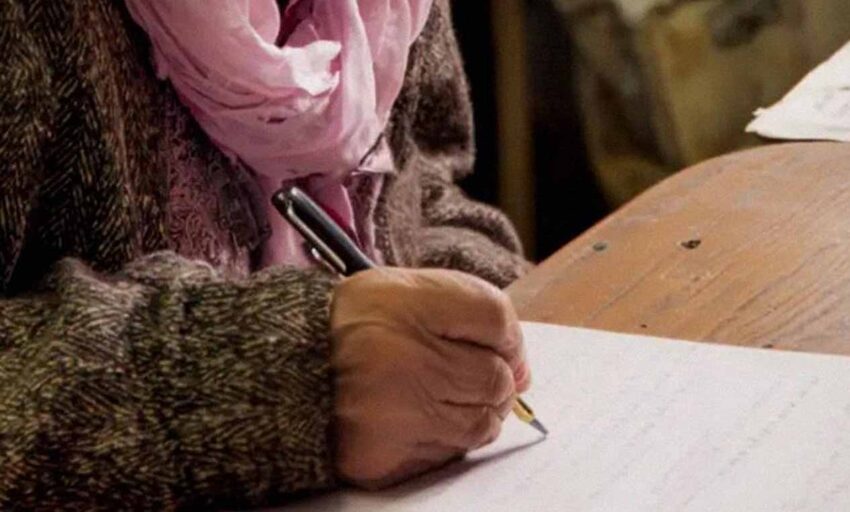
I’m an English teacher at an adult education school. It’s the kind of place people come to when life got in the way the first time around. Some dropped out to work. Some had kids too young. Some just never had the chance.
Over the years, I’ve taught hundreds of students. But there’s one I’ll never forget.
Her name was Mrs. Danvers.
Over the years, I’ve taught hundreds of students.
She was 85 years old. Always in thick glasses and a pink scarf draped over her shoulders. She was the oldest student I’d ever taught, and somehow the most consistent.
Every morning, she was the first to arrive.
“Good morning, Mrs. Danvers,” I’d say as she shuffled through the door.
“Good morning, Miss Pamela,” she’d answer softly, then take her seat at the front desk. The one closest to mine.
She never missed a class.
Not once in eight months. Not for weather. Not for doctor’s appointments. Not even when she caught a cold and showed up with tissues tucked under her arm.
She was the oldest student I’d ever taught.
Her homework came on creased paper, written in tiny, shaky letters. I always graded hers the longest because I had to squint to read it.
And her spelling was terrible.
She’d write “skool” instead of “school.” “Becos” instead of “because.” “Thier” instead of “their.”
My coworkers noticed.
“She’s not going to pass the final,” they’d whisper in the teacher’s lounge. “And if she fails, Pamela, it’ll reflect on you.”
“I don’t care,” I’d say.
I stayed after class every single day to help Mrs. Danvers.
Her spelling was terrible.
I’d sit beside her at the desk, explaining the same grammar rule three different ways until something clicked.
She’d just nod, grip her pencil tighter, and whisper, “Again, please.”
So I’d explain it again. And again. Until her tired eyes lit up with understanding.
“Thank you, Miss Pamela,” she’d say every time. “You’re very patient with an old woman like me.”
“You’re not old, Mrs. Danvers. You’re determined.”
She’d smile at that. “My sweetheart used to say the same thing.”
“Your husband?”
“You’re very patient with an old woman like me.”
“Yes. We’d be married 57 years this October. He still waits for me to come home every day.”
Joy lit up her eyes like a candle catching flame.
“Prepare well for the graduation exam, okay?” I said softly.
Mrs. Danvers nodded, but the flicker of joy in her eyes dimmed just a little. Beneath her warm smile, I saw anxiety creeping in like a shadow at dusk.
The graduation exam was held in my classroom on a Friday afternoon.
Students were required to write a lengthy essay about their lives and how our school had helped them. At least five pages.
The flicker of joy in her eyes dimmed just a little.
Most students finished within two hours.
Mrs. Danvers finished last.
She sat at her desk long after everyone else had left, her pencil moving slowly across the page. Her hand cramped halfway through, and I saw her flex her fingers before continuing.
When she finally stood up, she looked exhausted.
She walked up to my desk and placed her crumpled pages in front of me. Her hands were trembling.
“I hope you read it carefully, Miss Pamela,” she said, looking straight into my eyes. “Very carefully. Please.”
She sat at her desk long after everyone else had left.
There was something desperate in her voice.
“Of course I will. Go rest. You did wonderfully.”
She nodded but didn’t move right away. She just stood there, looking at me like she wanted to say something else.
“Just… thank you,” she whispered. “For everything.”
Before I could ask what she meant, she turned and left.
That night, I stayed late grading.
The classroom was silent except for the hum of the fluorescent lights and the scratch of my red pen. Pages stacked up beside me.
She just stood there, looking at me like she wanted to say something else.
Mrs. Danvers’ essay was the last one in my hands.
I picked it up and started reading slowly.
The first page was what I expected. Shaky handwriting. Mistakes. But the content was sweet. She wrote about how scared she’d been to enroll. How everyone told her she was too old.
The second page talked about our classroom. About how patient I’d been.
Then I reached the third page.
“I didn’t come here for myself,” she wrote. “I came here for my husband.”
Mrs. Danvers’ essay was the last one in my hands.
She explained that her husband had been diagnosed with stage four cancer six months before she enrolled. The doctors said he had maybe a year left. Fifteen months, if lucky.
My heart ached.
“My beloved loved poetry his whole life,” she continued. “He used to read poems to me when we were yung. Robert Frost. Emily Dickinson. Walt Whitman. He’d recite them while we danced in our kichen.”
I kept reading, my eyes beginning to blur. Her spelling wasn’t perfect. But in that moment, it didn’t matter. Not when every word held decades of love.
Her husband had been diagnosed with stage four cancer.
“But I never learned how to write,” she wrote. “I left skool at 14 to work in a factory. I can barely spell. But my sweetheart is dying, Miss Pamela. And I want to give him something beautiful before he goes. I want to write him a poem. Just one. So he knows how much I loved our life together.”
By the time I reached the final page, tears were sliding down my cheeks.
I didn’t even realize I’d stood up until my chair scraped the floor.
I grabbed my coat and keys, essay still in my hands, and ran out of the building.
In the parking lot under the yellow streetlight, I flipped to the last page.
“I want to give him something beautiful before he goes.”
Something was taped there.
A small envelope. No stamp. No return address.
Just my name, written in her shaky print:
MISS PAMELA — PLEASE OPEN.
My hands shook as I opened it.
Inside was a single sheet of paper, folded carefully.
Something was taped there.
At the top, in her uncertain handwriting, it said: “For my love.”
Then came the poem:
“You held my hand when I was yung
And danced with me in our kichen.
You red me poems under the moon
And made my hart feel richer.
Fifty-seven years have past
But your smile still makes me cry.
I’m not redy to let you go
But I know we’ll meet in the sky.
“Your smile still makes me cry.”
You tawt me what love truly means
In every laugh and every tear.
You were mine always, darling
And I’ll love you past the stars from here.”
I read it once. Then again. Then a third time.
The spelling was wrong everywhere.
“Yung” instead of “young.” “Kichen” instead of “kitchen.” “Red” instead of “read.” There was a misspelling in almost every line.
The spelling was wrong everywhere.
Every grammar rule I’d ever taught her was broken in this poem. But I didn’t care.
Because it was the most beautiful thing I’d ever read.
It wasn’t about perfect spelling or proper punctuation. It was about 57 years of love poured onto a page by an 85-year-old woman who’d learned to write just to say goodbye to the man she loved.
I stood in that parking lot and cried.
This was what Mrs. Danvers had been hiding all along. Not shame. Not failure. Just love too big to keep inside anymore.
It was the most beautiful thing I’d ever read.
This poem didn’t need corrections.
It was already perfect.
The next morning, I called an emergency staff meeting.
I told them everything. About Mrs. Danvers. About her husband. About the poem.
By the time I finished, half the staff was crying.
“What can we do?” Mrs. Lawrence asked.
“We’re going to honor her.”
We spent the morning planning. One teacher ran to the flower shop. Another drove to the print shop downtown.
The next morning, I called an emergency staff meeting.
I carefully typed Mrs. Danvers’ poem exactly as she’d written it. Every misspelled word. Every grammatical error. Every imperfect, beautiful line.
We had it printed on cream-colored paper and framed in dark wood with gold trim.
It looked like something you’d see in a museum.
At noon, we piled into three cars and drove to Mrs. Danvers’ house.
She answered the door in her pink scarf, looking confused.
It looked like something you’d see in a museum.
“Miss Pamela? What are you doing here?”
“We came to see you,” I said, holding out the flowers.
She stared at them, then at the group of teachers standing on her porch. “All of you?”
“All of us. May we come in?”
She nodded, stepping aside.
We filed into her small living room. Photos covered every surface. Most were of her and a man I assumed was her beloved. Young and smiling. Old and gray. Always together.
We filed into her small living room.
I sat beside her on the couch and handed her the silk-wrapped package.
“What’s this?” she asked.
“Open it.”
Her hands trembled as she unwrapped it. When she saw the framed poem, she gasped.
“Oh my goodness. You… you printed it?”
“We did.”
“But the spelling…”
“It’s perfect,” I interrupted gently.
Her hands trembled as she unwrapped it.
She looked at me, confused. “But I spelled so many words wrong.”
“Mrs. Danvers,” I said, taking her hand. “I didn’t correct it. And I’m not going to. Because it doesn’t need corrections. The spelling might not be textbook-perfect. But the love is. And that’s what matters. That’s what will matter to your husband.”
She started crying.
“I thought it was too messy. Too full of mistakes. I wanted you to correct them.”
“This is the most beautiful piece of writing I’ve ever read. In 20 years of teaching, nothing has ever moved me like this.”
“But I spelled so many words wrong.”
She clutched the frame to her chest, tears streaming down her face.
“Thank you,” she whispered. “Thank you so much.”
Mrs. Danvers looked up at me, her eyes red but shining.
“Can I ask you something, Miss Pamela?”
“Anything.”
“Will you come with me to the hospital? To give this to my sweet man?”
A quiet ache bloomed in my chest. “Of course. Right now?”
She nodded. “He’s been asking about the class. I want to show him that I did it. Before… before it’s too late.”
She clutched the frame to her chest, tears streaming down her face.
“Then let’s not waste another minute.”
We drove to the hospital. Mrs. Danvers held the framed poem in her lap the entire way, running her fingers over the glass.
When we reached her husband’s room, she paused at the door.
“He’s not doing well. But he’s still here. Still listening.”
I squeezed her shoulder. “Then this is exactly the right time.”
Her true love was lying in the hospital bed, thin and pale but awake.
When he saw Mrs. Danvers, his whole face lit up.
Mrs. Danvers held the framed poem in her lap the entire way.
“There’s my girl,” he said, his voice weak but warm.
She rushed to his side and took his hand.
“I brought you something, darling.”
She held up the framed poem. His eyes widened.
“You wrote a poem… for me?” he whispered.
“I did,” she said, her voice shaking. “Because I wanted to give you something beautiful, my love.”
His eyes filled with tears. “Read it to me,” he whispered. “Please.”
So she did.
“You wrote a poem… for me?”
She read every line, her voice breaking on some words, steady on others. When she got to “I’m not ready to let you go,” her voice cracked completely.
He squeezed her hand. “Keep going, sweetheart.”
She finished the poem, tears streaming down both their faces.
“That’s the most beautiful thing anyone’s ever given me.”
“Really?” she cried.
“Yes. Because I can hear your voice in every word. I can feel your heart. That’s better than any perfectly spelled poem in any book.”
She read every line, her voice breaking on some words, steady on others.
“You were mine always, darling.”
“And you were mine,” he whispered back. “You still are. You always will be.”
I stood in the doorway, watching them hold each other, and realized I’d never seen love like this before.
Mrs. Danvers passed her final exam.
A few weeks later, she came to graduation in her pink scarf, holding her husband’s framed poem against her chest.
When I handed her the diploma, she hugged me tightly.
“Thank you for teaching me,” she said. “Not just how to write. But that it’s never too late to say what matters.”
Mrs. Danvers passed her final exam.
“You taught me more than I ever taught you, Mrs. Danvers.”
She smiled through her tears. “My old man passed away last Tuesday. Peacefully. Holding my hand.”
My heart broke.
“I’m so sorry.”
“Don’t be,” she said. “He kept the poem on his bedside table until the very end. Every day, he’d look at it and smile. The nurses said they’d never seen anyone hold on to something so tightly.”
“He was right to treasure it.”
“My old man passed away last Tuesday.”
“I think I’ll keep coming to class even after graduation,” she added. “I liked learning. I’d love to learn more. And my sweet man would want me to keep going.”
I hugged her again, tighter this time.
“You can come to my class anytime you want. Forever.”
I may be the teacher, but Mrs. Danvers taught me something far more lasting: some lessons are written in ink. Others are written in love.