We live in Colorado, where the mountains loom so close that you forget how easily they can turn on you.
They sit there quietly every morning, white and blue and deceptively calm, as if daring you to believe they are nothing more than scenery. Kellan grew up in their shadow.
They sit there quietly every morning, white and blue and deceptively calm…
Hiking has always been our thing. No phones, no music, just boots on dirt, breath in cold air, and conversation that never feels forced.
It is where my son talks and where I listen.
That Saturday morning felt perfect in the way only winter mornings can.
The sky was clear, the kind that makes you feel reckless simply by existing in it. There were no storm warnings or advisories. I checked twice.
Hiking has always been our thing.
The trail we usually took was familiar, almost boring by our standards. It was safe. That word stayed with me. Safe.
Kellan was 16, tall and lean, with that quiet confidence teenagers tend to have. His mother died when he was eight, and grief matured him in ways I wish it hadn’t.
Still, he smiled that morning, shouldering his pack.
“You ready, Dad?” he asked.
“Always,” I said, and I meant it.
That word stayed with me.
An hour in, I stopped to adjust my pack strap.
Kellan drifted ahead, boots crunching softly over packed snow. That was when I heard it!
A deep sound, so low it barely registered. Like the earth clearing its throat.
“Kellan,” I called. “Do you hear that?”
He turned, his brow furrowing just as the ground shifted beneath us!
The snow did not explode. It slid, heavy and controlled. It became silent for half a second, then roared with a force that knocked the air from my lungs!
“Do you hear that?”
“Kellan, RUN!” I screamed.
He didn’t run away. Instead, he ran toward the sound of crying.
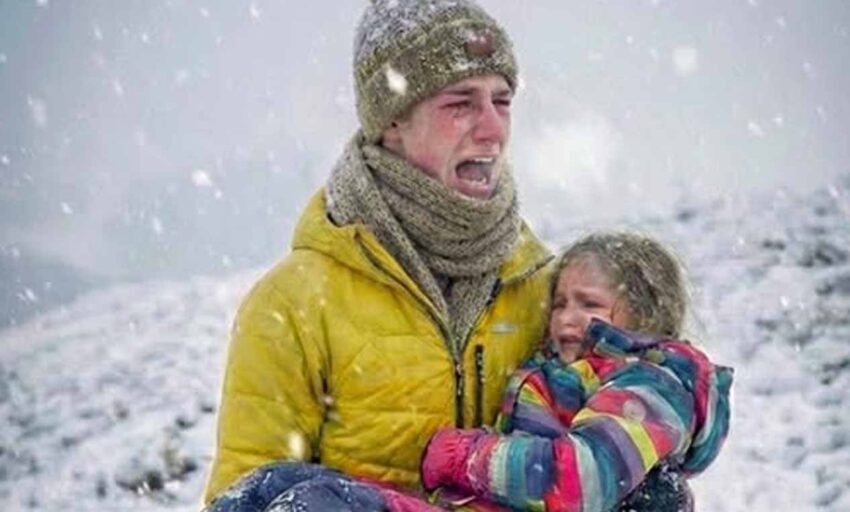
A small figure tumbled down the slope, half buried, arms flailing, screaming for her mom!
She was tiny, five at most.
Her scream cut through everything.
Kellan reached her first, dropping to his knees. He clawed at the snow with his hands as it tore at his gloves. I followed, heart hammering, lungs burning as if they might collapse.
“Kellan, RUN!”
“We’ve got you,” Kellan kept saying. “I’ve got you. You’re okay. What’s your name?”
“Dove,” she whispered, lips already blue.
We pulled her free just as the snow settled. Kellan wrapped her in his jacket and talked nonstop, vowing things to distract her from the trauma.
The world went eerily quiet, as if it were waiting.
Rescue came fast, but not fast enough. Dove lived, although she was shaking.
“I’ve got you.”
At the trailhead, Dove refused to let go of Kellan’s hand.
Her fingers were small and trembling, clutching him as if he were the last solid thing left in the world.
“He saved me,” she kept saying. “He promised.”
I stood there shaking so badly that I had to sit down. My son stared straight ahead, jaw tight, eyes too old. He was luckily unharmed.
“He saved me.”
A deputy took our statements.
Her name was Mallory. She was calm and methodical, and thanked Kellan more than once. The deputy revealed that Dove had been with her mother, who didn’t survive.
She asked for our address, explaining it was routine. I gave it without thinking.
That mistake would haunt me later.
I gave it without thinking.
We went home exhausted, numb, grateful, and hollowed out by what could have been.
I barely slept. I was grateful that my son was alive.
I thought that was the end. Boy, was I wrong.
The next morning, I found the envelope taped to our front door.
There was no stamp, no return address, just handwriting so neat it made my skin crawl. Our last name was on the front.
“To the boy who saved my daughter.”
I barely slept.
Inside was a single sheet of paper.
“Your son saved my daughter. That debt will not go unpaid. Come to the old ranger station off County Road 9 at 6:15 p.m. Bring the orange whistle from your son’s backpack. Come alone. Don’t involve the police. And don’t tell your son.”
My stomach dropped.
I failed to notice that Kellan was reading it over my shoulder.
“Dad,” he said quietly. “How would they know where we live?”
That was the question I couldn’t answer.
My stomach dropped.
“You weren’t supposed to see that. And we aren’t going,” I said too fast.
I was terrified, but also curious.
“But what if it’s her family?” he asked. “What if she needs something?”
I hated how reasonable he sounded.
We argued in low voices, pacing the kitchen.
I wanted to burn the paper. He wanted to understand the message behind it.
In the end, I decided to go, but we compromised the way parents always do when they are afraid. Kellan came along.
“What if she needs something?”
I brought precautions.
An extra phone, a GPS tracker, and a pocketknife. I told myself it was enough.
The area was empty when we arrived. Wind cut across the ridge, sharp and biting.
A man stepped out from behind a stand of trees, hands visible, posture careful.
“My name is Graham,” he said. “Do you have the whistle?”
I showed it to him with shaky hands.
“Thank you for coming.”
“Who are you?” I demanded.
“My sister was Dove’s mother,” he said. “She died protecting her.”
That sentence hit like a physical blow.
I brought precautions.
Graham explained quickly, haltingly.
He had owned a cybersecurity firm years back. One of his former partners went bad, started using tracking software for things it was never meant for. When he confronted and threatened him, the partner turned dangerous.
Soon enough, Graham’s sister realized her daughter was being monitored, and she ran!
She changed towns, names, and lived off-grid as much as she could.
“I lost them,” he said. “Until yesterday.”
“How did you find us?” I asked.
“I didn’t,” he said. “Someone else did. Someone with access.”
She changed towns, names…
Graham explained that an intern who worked in Deputy Mallory’s office helped him.
The guy is still new, isn’t earning enough yet, and is desperate for cash. Graham offered money for information about where we lived.
But he didn’t trust the guy, so he asked him to share something only Kellan and I would know and have access to. The intern had heard Mallory mention the whistle hanging from my son’s bag, hence he asked us to bring it.
But he didn’t trust the guy…
Graham then showed me how his former partner tracked his sister and niece.
We saw screenshots, metadata, and a sheriff’s terminal accessed remotely hours after the avalanche. Our address was pulled and shared.
“What do you want from us?”
“I am trying to protect you and your son by giving you background information,” Graham replied. “I am sorry for the note. I panicked.”
Dove was safe, he said. With him now. She’s hidden and guarded.
“What do you want from us?”
The drive home was silent.
That evening, Kellan confronted me at the kitchen table. “We cannot pretend this didn’t happen,” he said. “Someone is watching and using our name. We can’t guarantee that Graham will keep us safe. He didn’t say he would.”
I knew then that this wasn’t over.
Kellan suggested we go to Deputy Mallory privately, but I refused at first — until I remembered she had hesitated before giving me my son’s backpack. Too hesitant. Something didn’t sit right.
That night, I couldn’t stop thinking about the envelope. About Graham and Mallory.
“He didn’t say he would.”
After everything we’d learned from Graham, I had to know the truth.
So I made a plan.
I called the station and asked to speak with her directly. Told her I had remembered something important about the avalanche, something the department should probably document. She agreed to meet that afternoon.
Before leaving, I told Kellan what I was doing. His jaw tightened when I mentioned her name.
She agreed to meet that afternoon.
“I want to come,” he said.
“Kellan, this might not be—”
“She talked to me, too. Let me help.”
We agreed: I would talk to her while he quietly searched her cruiser. It was risky, yes. But after everything, I trusted him more than half the adults involved in this.
We met in a quiet pull-off near the north ridge trailhead. Mallory pulled up five minutes after us in her patrol SUV, stepped out looking casual, hand resting on her duty belt.
“I want to come.”
“Jon,” she said. “Everything okay?”
“Just wanted to clarify a few things,” I said. “Do you mind if we talk inside my car? It’s cold out here.”
She hesitated — just for a heartbeat — then opened the passenger door.
I slid in, and we talked. I asked about avalanche patterns, equipment failures, and reporting procedures.
She answered smoothly, but her eyes kept flicking to the side mirror.
“Everything okay?”
Outside, Kellan moved as if he were walking nearby, hands in his pockets, keeping to the far side of the vehicle.
I watched him disappear and assumed he was by the deputy’s car, so I kept Mallory talking; her eyes facing me.
“Where did Dove’s mother’s body get taken?” I asked suddenly.
She blinked. “I-I’m not sure, yet.”
A flicker again. Not guilt. Strategy.
Before she could ask me anything, I saw Kellan straighten outside the driver’s side.
I stepped out of the car.
“I-I’m not sure, yet.”
He pulled something from his jacket — a small black burner phone wrapped in duct tape.
“It was taped under the seat,” he whispered. “This number matches one of the ones Graham traced.”
My heart started pounding.
“Deputy,” I said loudly. “You might want to explain what this is.”
Mallory, who’d gotten out and come around to my side, stood frozen for a moment, then exhaled slowly and leaned against the car.
My heart started pounding.
“Look, I didn’t know a child would die,” she said.
“You leaked our address,” I said. “You gave someone access to private data.”
“I was paid,” she said flatly. “I monitored incoming reports, flagged ones that matched certain parameters, and delayed some of the dispatch responses. That’s all. I didn’t know why at first. Later, I figured it out. But by then it was too late.”
“And you kept going,” I said.
She nodded once. “There’s a man who’s been building something underground. Tracking movement. Behavior. Looking for something in the woods.”
“You leaked our address.”
“In the woods?” Kellan said. His voice was steady.
Mallory looked at him. “Look, I’ve said too much already.”
My mouth went dry.
“Why?” I asked.
She didn’t answer. Just looked off toward the trees. Then she turned back to me.
“I’m not proud of it,” she said. “But I kept the kid’s name off the books. I tried to ensure your rescue stayed clean. You want a copy of everything I have? Fine. Take it. Just don’t call me again.”
She reached into the car and handed me a flash drive.
My mouth went dry.
Then she got in and drove away without another word.
Kellan and I didn’t speak while driving. What Mallory didn’t know was that I’d recorded our whole conversation, too.
We drove straight to Graham’s cabin that evening, tucked deep into the woods beyond a locked gate. Kellan had asked to see Dove the next day. Her uncle, who saw her as his daughter, agreed.
Graham let us in without a word and listened as I laid the flash drive and recording on his table.
…I’d recorded our whole conversation…
“She confessed,” I said. “Everything.”
Graham took the drive, sat down slowly, and nodded. “This helps.”
“What happens now?” Kellan asked.
“There’s a network my former partner works with. We’re trying to disrupt it.”
Kellan looked at me, then back to Graham. “You’ll protect her?”
“She’s moving tonight,” Graham said. “New house. New name. New start.”
Something inside me loosened for the first time in days.
“What happens now?”
A week passed.
The snow began to melt just a little, softening the ground and leaving icy veins across the roads. Things settled into something like normal.
Then another envelope arrived.
This one was clean, white, and handwritten. No mystery this time.
It was from Graham.
Inside was a card. Plain, with no return address.
“If anything ever happens again, you’ll be the first I call. I’ve taken measures to get you protected and your names removed from all of this,” it read. “My contact is enclosed. You saw what others missed. That’s rare.”
I read it twice. Folded it back into the envelope and set it on the mantle.
No mystery this time.
That night, I found Kellan sitting on the porch, wrapped in a blanket, watching the stars.
I sat beside him.
“You okay?” I asked.
He nodded. “I just keep thinking how it all started. A normal hike. One choice.”
“You ran toward someone,” I said. “That’s not normal.”
He shrugged. “I didn’t think. I just moved. But I don’t want to be part of anything dangerous,” he said. “I just want to live.”
I put my arm around his shoulders.
“You can,” I said. “But if anything ever happens again…”
“I know,” he said, smiling faintly. “We’ll be ready.”
“That’s not normal.”