When I was five years old, my aunt Marie sat me down at her kitchen table, slid a plate of toast in front of me, and told me something that shaped my whole life.
“Your mother ran away,” she said, like she was commenting on the weather. “A normal woman doesn’t abandon her child, Alma.”
I remember staring at the jelly packet in my hand because I did not know what else to look at. I remember my uncle Ray chewing bacon like none of this was strange. I remember thinking that if I cried, I would somehow prove I was too much trouble.
So I didn’t cry.
That sentence followed me for years. Sometimes Marie said it when I forgot to rinse my cereal bowl, when I needed money for a school trip, and for no reason at all.
“Be grateful we took you in.”
“Your mother didn’t want you.”
“Don’t act spoiled. You’re already a burden.”
I grew up in their house, but I never belonged in it. Their real kids got new sneakers. I got discount-store shoes that pinched my toes. They got birthday parties. I got a grocery-store cupcake and a reminder that “money doesn’t grow on trees.” At dinner, I learned to eat fast, speak little, and disappear whenever possible.
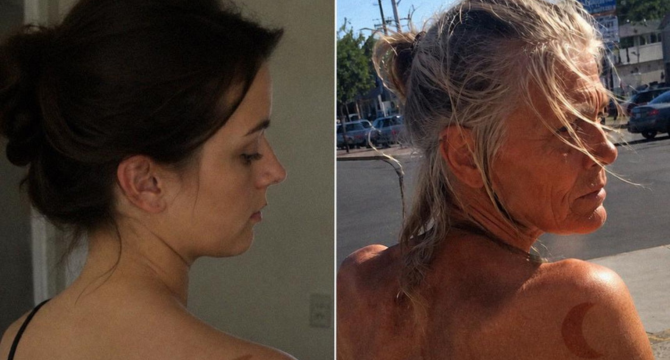
The only thing I had from my mother was a crescent-shaped birthmark on my left shoulder.
Marie used to sneer at it when I was little.
“Got that from her,” she would say. “At least she left you something.”
By the time I turned 18, I had stopped asking questions about the woman who gave birth to me. I told myself I didn’t care. I packed an old backpack, two pairs of jeans, a hoodie, my diner uniform, and the tiny amount of cash I’d saved from working after school.
Marie stood in the doorway with her arms crossed.
“So that’s it?” she asked.
I shrugged. “I’m leaving.”
Ray didn’t even look up from the television. “Good. One less mouth to feed.”
Marie laughed once, cold and sharp. “Don’t come crawling back when life gets hard.”
I wish I could say I walked out feeling powerful. The truth is, I walked out feeling hollow.
Freedom sounded beautiful when I was a kid. In real life, it looked like double shifts, overdue bills, ramen noodles, and a tiny room in a cracked old building where the pipes knocked all night.
The neighborhood was rough. Men argued outside my window at two in the morning, sirens were constant, and the convenience store on the corner had once been robbed.
That was where I first saw Linda.
She sat outside the store almost every evening on a milk crate near the vending machine. She had a weathered coat, silver-threaded hair that badly needed brushing, and a paperback book with a broken spine.
She never held up a cup or asked anyone for money. She just read.
At first, I barely noticed her. My life was too full of survival to leave room for curiosity. Then one freezing night in November, I came home from my second job and realized my keys were gone.
I checked every pocket three times, but there was nothing.
My landlord was useless and lived across town. He grunted over the phone, “I’ll come when I can,” and hung up.
It had started raining. Not hard, but steady enough to soak through my hoodie. I sat on the front step of my building, hugging my knees, trying not to cry from pure exhaustion.
About 20 minutes later, I heard footsteps.
A plastic cup appeared in front of my face.
“Here,” a soft voice said. “Hot tea.”
I looked up. It was Linda.
She also held out a faded blanket that smelled like detergent and cold air.
“You’re freezing, sweetheart,” she said.
Something in me broke a little at that word. Sweetheart. No one had called me that in a voice like that. Not ever.
“I can’t take your blanket,” I said.
“You can for tonight.”
I wrapped it around myself with shaking hands. “Thank you.”
She lowered herself onto the step beside me like it was the most natural thing in the world. We sat there under the weak porch light, listening to rain tap against the railing.
After a while, she asked, “You live here alone?”
“Yeah.”
After that, we started talking.
Not every day. But often enough.
Sometimes I brought her a sandwich from the diner at the end of my shift or old sweaters I did not wear anymore. In return, she left little things for me.
A flower tucked into the crack of my mailbox.
A note in shaky handwriting that said, “Good luck on your interview,” or “You look tired. Please rest.”
There was something about Linda that made me feel calm and uneasy at the same time. Calm because she was gentle. Uneasy because being around her stirred up something I could not explain.
Sometimes when she smiled at me, it felt like my chest was remembering a song my mind had forgotten.
One afternoon in early spring, I brought her a bag of clothes I’d cleaned out of my closet.
“There’s a tank top in there that’s too stretched out for me,” I said. “But the fabric’s still good.”
Linda looked embarrassed. “You don’t have to keep doing this.”
“I know.”
She smiled. “All right.”
I was about to head to work when she pulled the tank top out and, without thinking much of it, removed the long-sleeve shirt she was already wearing and slipped it on.
Then I saw her shoulder.
I stopped breathing.
There, on her left shoulder, was a crescent-shaped birthmark.
Same size, curve, and with a darker spot near the edge.
Linda noticed my face. “What is it?”
I stepped closer before I even knew what I was doing. My voice came out thin. “That birthmark.”
Her hand flew to her shoulder. “Oh.”
I yanked down the collar of my own T-shirt and showed her mine.
For a second, neither of us moved.
The world around us seemed to go quiet. All I could hear was my own pulse.
“Excuse me,” I whispered. “Do you… Do you have any children?”
Linda looked like I’d slapped her.
Her eyes filled so fast it scared me.
“I did,” she said.
“Did?” I asked. “What does that mean?”
She looked away. “It means life is cruel.”
“No.” I grabbed her wrist before I could stop myself. “Please don’t do that. Don’t say something weird and then shut down. Tell me the truth.”
She stared at my hand on her sleeve, then at my face.
“What’s your birthday?” she asked.
I told her.
She started crying.
It was the silent kind of crying that looked old, like she’d done it so many times her body knew the shape by heart.
My mouth went dry. “Linda.”
She shook her head. “I shouldn’t. I shouldn’t tell you like this.”
“Tell me what?”
She covered her mouth with her hand. “Your real name isn’t Alma, then.”
She looked at me like she was looking at the sun after years underground.
“I named you Anna,” she whispered.
I stumbled back so fast I almost tripped over the curb.
“No.”
“It’s true.”
“No.” My voice got louder. “No, absolutely not. My mother ran away.”
“I never ran away from you,” she said. “Never. They told you that?”
“They told me you left me.”
“I left you with my sister for three weeks.”
I just stared at her.
“My husband had left,” she went on, words shaking. “He drained our account, vanished with another woman, and left me with debt collectors at the door and an infant in my arms. I was working two jobs. I wasn’t sleeping. I got evicted.”
She took a deep breath. “I was desperate. Marie said she’d help me. She said, ‘Let me keep the baby for a little while. Get on your feet, then come back for her.'”
My head was pounding. “No.”
“She had a spare room. A steady house. She said family was supposed to help family.”
“So why didn’t you come back?” I demanded. “Why didn’t you get me?”
“I did!”
Linda pressed both hands to her chest, trying to steady her breathing.
“I came back after two months. I had a room lined up and a new job. I thought I was finally climbing out. Marie sat me down and told me she’d already filed emergency custody papers. She said you were settled, that I’d disrupt your life.”
I could barely speak. “So you gave up?”
“I did not, never. Then she said the judge would never choose me over them because I had no husband, no money, and no permanent address. She said if I fought, she’d tell the court I was unstable.”
The lies. It was all lies. That’s what my mind kept thinking.
Her eyes flashed, suddenly fierce through the tears. “No. I fought until I broke.”
She reached into the pocket of her coat and pulled out a creased envelope. It was so worn it looked like it had been unfolded a thousand times.
“I carry this with me,” she said. “Because it reminds me I didn’t imagine you.”
Inside was a faded baby photograph.
Me.
Or Anna.
I knew it instantly. I had seen the same photo once in Marie’s junk drawer when I was ten. She snatched it away before I could ask questions.
On the back, in neat handwriting, were the words: “Anna, six months old. First laugh after a bath.”
My knees nearly buckled.
Linda kept talking, maybe because once the truth started coming out, it could not stop.
“I wrote letters, and Marie never answered. I came by the house, and Ray threatened to call the police. Once I saw you through the window, and I waved, but Marie yanked the curtain shut.”
Her voice cracked. “I tried legal aid, but I had nothing. No savings. No records, they hadn’t twisted. Every person I spoke to looked at me and saw a poor woman losing a child to a more stable home. Then I lost my job and my room. Then…” She looked around at the sidewalk, the store, and the cracked street. “Then life kept happening.”
I felt sick.
I wanted to yell at her. I wanted to hug her. I wanted to run.
Instead, I said, “How do I know you’re not lying?”
She nodded once, like she’d expected that. “You don’t. Not yet.”
So I bought a DNA test with my next paycheck.
I did it in a pharmacy bathroom because my hands were shaking too hard to wait. I swabbed my cheek. Linda swabbed hers behind the store, then apologized for crying on the sample card. I mailed it the next morning and spent the next week living in a nightmare.
I couldn’t look at Marie’s number on my phone without wanting to throw up. I couldn’t sleep. I couldn’t stop replaying every cruel thing she’d ever said about my mother.
When the results came, I opened them in the break room at the diner.
Probability of maternity: 99.9998%.
I sat on the floor between the mop bucket and the soda syrup boxes and cried so hard I scared my manager.
The woman I had hated my whole life was the one person who had not abandoned me.
After that, something in me went very quiet.
I took Linda to a clinic first. Then to a social worker. Then to the DMV to begin replacing her documents. I found out she had once worked as a nursing assistant.
She still said “please” and “thank you” to everyone. She still folded blankets with hospital corners. She still apologized every time she took up space.
The first night I checked her into a cheap motel, she stood inside the doorway staring at the clean bed like it was a holy object.
“You sleep here,” I told her.
She touched the blanket with trembling fingers. “I forgot what this feels like.”
A month later, after a lot of overtime and help from a local housing program, I got her into a small studio apartment.
The day I handed her the key, she just looked at me.
“I don’t know how to thank you,” she said.
My throat tightened. “Maybe start by not thanking me like I’m a stranger.”
That made her cry again. It also made me cry, which annoyed me.
We were still learning about each other.
There are awkward and tender moments sometimes.
She liked her tea too weak. I hated mushy vegetables. She called old movies “pictures.” I learned she hummed when she was nervous. She learned I went silent when I was hurt.
One evening while unpacking donated dishes in her new kitchen, she said quietly, “I used to imagine your voice. I wondered if it sounded like mine.”
I swallowed hard. “Does it?”
She smiled through tears. “A little.”
When I was ready, I called Marie.
“I need to come by,” I said.
She sounded suspicious. “Why?”
“Because I’m done being lied to.”
There was a pause. Then she gave me a day and time, probably assuming she could still control me.
I showed up on a Sunday afternoon with Linda beside me.
Marie opened the door, saw Linda, and actually staggered back.
Ray stood from his recliner. “What the hell is this?”
I walked into the dining room like I belonged there for the first time in my life. I set the DNA results on the table. Then I put down copies of the housing forms, the old photograph, and every piece of evidence I’d gathered.
Marie recovered first. “Oh, for God’s sake. She found you? Anna, don’t be stupid. This woman is a mess.”
Linda flinched at my birth name on Marie’s lips.
I stayed very calm. Calmer than I felt.
“You lied to me for money all these years,” I said. “Government checks, benefits, and sympathy. And maybe because you liked having someone in the house to feel superior to. But now I know the truth.”
Ray slammed a hand on the table. “Watch your mouth.”
I looked him dead in the eye. “Or what? You’ll throw me out again?”
Marie crossed her arms. “You have no idea what we sacrificed for you.”
Linda spoke then, voice shaking but clear. “You stole my child.”
Marie turned on her with a bitter laugh. “I saved that child from growing up in a car with you.”
“No,” I said. “You made sure I grew up unwanted in your house instead.”
That shut her up for half a second.
Then she started talking fast, meanly, and defensively. “You think love is enough? She had nothing. Nothing. We gave you structure. Food. School. A home.”
I leaned forward. “And every single day, you made sure I knew I was not wanted. Do you know what kind of person does that to a child?”
Her face hardened. “The kind that provided for your ungrateful self.”
Linda made a broken sound beside me.
I picked up the DNA results and slid them closer to Marie. “I came here so you could see that I know. I know that you are both selfish people who took a child from its mother and mistreated her, her entire life.”
Ray cursed, and Marie went pale.
For the first time in my life, neither of them had the last word.
We left them sitting there with the papers on the table between them like a body.
It has been eight months since then.
Linda is not on the street anymore.
She has curtains she picked out herself. A blue mug she refuses to let me use because it is “her favorite.” A little herb plant in the window that she is trying not to kill.
Sometimes when I visit after work, she makes grilled cheese and tomato soup, and we sit at her tiny table like we are practicing being a family.
It still feels fragile. Beautiful, but fragile.
I still have anger in me. A lot of it. Some days it burns so hot I do not know where to put it. Some nights I lie awake thinking about little-girl me sitting at that kitchen table, swallowing lies with her breakfast.
But now I know something that changes everything.
I was never abandoned.
I was taken.
And the woman I was taught to hate was the one who kept loving me anyway, through every slammed door, every unanswered letter, every year of silence, and every cruel story told in my ear.
Last night, I was leaving Linda’s apartment when she said, “Anna—”
I paused.
She looked nervous. “Sorry. Alma. I still don’t know which name you prefer.”
I stood there a long time before answering.
Then I said, “When it’s just us, you can call me Anna.”
She covered her mouth and started crying.
I rolled my eyes and said, “You cry a lot.”
She laughed through it. “You do too.”
And for the first time in my life, being seen like that did not feel dangerous.
It felt like home.