Last week, I stood in front of my childhood home for the first time in years, gripping the gate so hard my fingers hurt.
I am 31, and I thought I had prepared myself for that moment. I told myself I was only there to do what had to be done. My parents had passed away, and the house had been sitting empty. Overgrown, quiet, almost forgotten. I had come back to clean things up before selling it, nothing more.
That was the plan, anyway.
But the second I stepped onto the property, it stopped feeling like a task and started feeling like I had walked into a life that had gone on without me.
The paint had peeled from the porch rails. The front windows were dull with dust. Weeds had pushed through the cracks in the walkway as if the earth had been trying to reclaim the place one inch at a time.
I unlocked the front door and stepped inside, and the silence hit me first.
Not peace. Silence.
The kind that settles into walls after laughter has been gone too long.
I spent the first hour opening windows, letting stale air out, and letting sunlight in. I folded old blankets, sorted dishes, and stacked papers into neat piles that made me feel more in control than I really was.
Every room held some version of my parents.
My dad’s reading glasses still sat beside his favorite chair. My mom’s floral apron still hung from the hook by the pantry, as if she might walk in and tie it around her waist any minute.
More than once, I had to stop and press the heels of my hands against my eyes.
I kept telling myself, Just get through the day, Brooke. One room at a time.
By late afternoon, I stepped through the back door, more to breathe than to work. The backyard spread out before me in a tangle of tall grass and neglect, and for a moment, I just stood there, taking it in.
Then I saw them.
The rose bushes were still there.
Even after all those years, they had survived. Wild and overgrown now, but stubbornly alive. A strange ache rose in my chest.
My mom loved those roses. She used to spend hours taking care of them, never letting anyone else touch them.
I could still picture her kneeling in the dirt with her gardening gloves on, her face damp with sweat, her attention fixed entirely on those flowers. If I got too close, she would glance over her shoulder and say, “Careful, Brooke. Not this spot.”
As a kid, I always wondered why she was so protective of that exact spot.
Back then, I had come up with all kinds of theories.
Maybe the soil was delicate. Maybe there were bulbs underneath. Maybe she just liked having one part of the yard that belonged only to her.
I never pushed too hard for an answer. My mother could be warm and loving, but there were parts of her that closed up without warning. When that happened, even my father kept quiet.
Standing there now, with the wind moving softly through the weeds, I felt that same old curiosity stir inside me.
Something pulled me closer.
I wish I could explain it better than that. It was not logical. It was not even a decision, not really. It felt more like a memory I had never fully understood, tugging at my sleeve.
Without really thinking, I grabbed a shovel from the shed and started digging around the roots.
The metal handle was rough in my palms. The soil was hard, untouched for years. Each push of the shovel took more force than it should have, and soon my arms were trembling from the effort.
Clumps of dry dirt broke apart with a dull crunch. The smell of earth rose around me, rich and old.
I told myself I was being ridiculous.
I told myself there was probably nothing there.
Then I heard it.
Clang.
The sound echoed through the yard.
I froze.
Every hair on my arms stood up.
For a second, I just stared at the patch of disturbed ground, my breath caught somewhere high in my chest. Then I dropped to my knees and started brushing away the dirt with both hands.
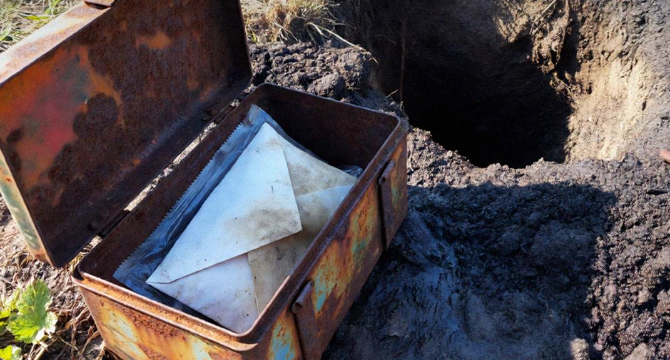
I uncovered something metallic.
A small, rusted lockbox.
My heart started racing.
I pulled it out, hands shaking, and wiped off the mud. It looked old. Very old. Rust flaked beneath my fingers. The edges were worn, and the little latch was stiff with age.
I hesitated for a second.
Then I opened it.
Inside… there was a single piece of paper, carefully wrapped in plastic.
I slowly took it out and unfolded it.
And then I froze.
Because the handwriting on that page… was unmistakable.
It was my mother’s.
I sank down onto the dry ground beside the rose bushes, the paper trembling in my hands. For a moment, I could not bring myself to read it.
My mother had been gone for two years, and yet there she was in the curve of each letter, in the neat, careful way she formed every word.
It felt impossible and intimate all at once, like she had reached across time and touched my shoulder.
Inside the lockbox, beneath the folded paper, I noticed a layer of dried rose petals. Their color had faded to a deep brownish red, and they crumbled slightly when I brushed them aside.
Underneath them was a short list, written in the same familiar hand.
A bucket list.
My mother’s bucket list.
I stared at it, confused at first, then slowly began to read each line. Most of them were simple things, some sweet, some achingly ordinary.
See Brooke graduate.
Dance with my husband in the kitchen again.
Watch the roses bloom one more spring.
Make peace with the past.
Every item had been crossed off in blue ink.
Every item except one.
Help my daughter forgive herself.
The words blurred instantly. I pressed my hand over my mouth, but the sob still escaped.
“No,” I whispered, shaking my head as tears spilled down my cheeks. “Mom…”
My eyes dropped back to the box. There were more things inside. Several envelopes, each dated in her handwriting. A tiny silver charm bracelet I had lost when I was 16.
A pressed rose wrapped in tissue paper.
A little ribbon I used to wear in my hair when I was a girl. Gifts. Letters. Pieces of me she had somehow kept safe all this time.
I reached for the first envelope with unsteady fingers and opened it.
“Brooke, if you found this, then maybe you are finally ready.”
I had to stop reading for a second because I was crying too hard to see.
I wiped my face and tried again.
“You have been carrying pain that was never meant to become your whole life. I know you blame yourself for what happened. I know because I have watched it live in your eyes for years, even when you smiled. But one mistake, even a terrible one, should not become the cage you live in forever.”
A memory crashed into me so hard I nearly doubled over.
I was 19 again, standing in our kitchen after midnight, my face white, my hands shaking. My younger cousin Lena, who was 17, had borrowed my car that evening after begging me not to tell anyone.
I knew she had been drinking at a party.
I knew I should have said no. Instead, I tossed her the keys because I was tired of being the responsible one.
She made it three blocks before she crashed into a curb and flipped the car into a ditch.
She survived, but barely. Her leg was shattered. Her face needed stitches. For months, everyone said the same thing: that she was lucky to be alive. But all I heard was the truth underneath it.
It was my car. My choice. My fault.
My mother was the only person who ever tried to reach me after that. Everyone else told me to move on or reminded me that Lena had made her own decision. My mother never said that. She sat beside me on my bed while I cried and simply held my hand.
I pulled out another letter.
“You punished yourself long after everyone else stopped. You built your life around guilt and called it responsibility. You became careful, kind, and selfless, but there was sadness in you, too. I saw it every day. I wanted to help you sooner, but healing cannot be forced. It has to be chosen.”
I laughed through my tears, a broken little sound. “You knew me too well,” I murmured into the empty yard.
The last note was shorter.
“The roses were my reminder that buried things do not stay dead forever. Some grow roots. Some bloom. I hid this here because I needed you to find it when you were ready to stop digging up your pain and start laying it down.”
By then, I was openly sobbing, bent over the lockbox in the fading light. I could almost hear her voice, calm and warm, saying my name the way she always had when she wanted me to listen.
For the first time in years, I let myself say it out loud.
“I was wrong,” I whispered. “I made a terrible choice.”
The yard held still around me.
Then I took a shaky breath and said the part I had never been able to admit.
“But I have suffered for it long enough.”
Something in me loosened then. Not all at once, and not neatly. Grief does not work like that. Neither does guilt. But the knot I had lived with for so many years began, finally, to give way.
I sat there until the sun dipped low, my mother’s letters spread across my lap, the old rose bushes stirring softly in the evening breeze.
I had come to that house to clean it out and let it go.
Instead, I found the one thing she had been trying to give me all along.
Permission to forgive myself.
When I finally stood, I held the lockbox close to my chest and looked at the roses one more time.
“Okay,” I said quietly, as if she might still hear me. “I’m ready.”
“I love you, Mom,” I whispered.
In the quiet, I could almost hear her answer.
“I know, Brooke.”
Holding the lockbox close, I wiped my tears and nodded. “I’ll try.”