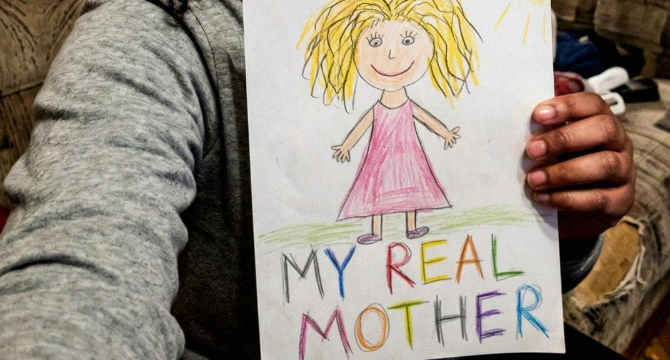
I’m 35, and until a few weeks ago, I really believed I was doing everything right.
I work hard and help pay for this house.
I make sure my son has what he needs and stay up late answering emails because private school tuition does not pay itself. My husband, Daniel, is 38, and his job keeps him away more than either of us likes.
Sometimes, his business trips last two weeks. Sometimes three. Once, he even stayed away for five weeks.
So most of the time, it’s just me carrying the daily routine.
I spend my day coordinating rides, checking homework, signing forms, ordering groceries, collapsing into bed, and then doing it all over again.
At least, that’s how I saw it.
My son Ethan is 11. He’s quiet in a way that makes people assume he’s shy, but he’s not shy — he’s observant and sensitive.
He’s the kind of kid who notices if your smile is fake.
He has always loved drawing more than almost anything. Sketchbooks, pencils, markers, charcoal, cardboard from cereal boxes — he’ll turn any surface into a little world.
Because I work late so often, I enrolled him in an after-school art program. It felt like a smart solution. He wouldn’t be sitting home alone, and he’d be doing something he loved. I told myself that was what good mothers did — they found practical solutions.
Everything I do is for him.
That was the sentence I used whenever guilt started creeping in.
My mother-in-law, Margaret, is 62, warm in that old-fashioned way that can feel comforting or quietly judgmental depending on the day. She lives across town in the house where Daniel grew up and has always offered to help more than I’ve accepted.
“I can pick Ethan up sometimes,” she’d say.
“That’s okay. I’ve got it handled.”
We were not close, but there wasn’t any dramatic feud either. Just tension under the surface. She believed children needed presence and a parent who sat at the table long enough to listen to rambling stories about recess. I believed love could also look like 12-hour workdays and exhausted ambition.
Once, when Ethan was younger, she said, “He doesn’t need the best toys, Maya. He needs time.”
I smiled. “He has both.”
She nodded, but not like she agreed.
Lately, Ethan had gotten quieter with me. He answered questions in one sentence.
One night, he looked up from his sketchpad and said, “You’re always busy, Mom.”
I laughed it off. “Busy is how I pay for your art supplies, kid.”
He gave a small smile and looked back down. I should have stayed. I should have sat on the edge of his bed and asked what he really meant.
Instead, I went back to work.
One evening, while cleaning his room, I found a stack of drawings hidden under his bed.
At first, I thought they were old practice sketches. But when I pulled them out, my stomach dropped like I’d missed a stair.
They showed a woman and a child.
The child was clearly Ethan because he had the same dark hair, the same skinny limbs, and the same little gap in his front teeth, which I secretly loved. But the woman wasn’t me.
It was a Caucasian woman with light hair, a softer face, and a different nose. A kind smile drawn over and over in careful pencil strokes.
On every drawing was the same caption, “My mom and me.”
My hands started shaking.
I sat on the floor with those papers spread around me, heart pounding. There were at least eight drawings.
In some, they stood in a kitchen. In some, they sat at a table. In one, the woman had her hand on his shoulder while he smiled up at her.
It felt like finding evidence of a life I knew nothing about.
When Ethan came home, I was waiting. I held up one of the pages. “What is this?”
He froze in the doorway.
“Who is this woman?”
He looked at the drawing, then at me, then away. “They’re not mine. I found them at school.”
He would not meet my eyes.
I wanted to push harder, but the scared look on his face stopped me. So I let it go for that night, though let it go is probably the wrong phrase. I carried it around like a fever.
The next few days, I watched him more closely. He was careful with me in a way children should never have to be.
He answered politely and stayed in his room.
Daniel was away again and harder to reach than usual. I almost told him about the drawings, but I didn’t know how to say it without sounding irrational.
Then a few days later, I got off work early and decided to pick Ethan up myself. I didn’t warn anyone. I told myself I wanted to surprise him. The truth is, I wanted to see if everything still lined up the way I thought it did.
But when I got to school, he wasn’t there.
The art room was half-empty. I walked up to the teacher.
“Where is my son?”
She looked confused. “Your husband picked him up.”
Relief hit me for a second. Then she added, “He’s been picking him up every day for the past week.”
I couldn’t believe what I’d just heard.
Daniel had not said one word about being back. Not one word about picking Ethan up. Not one word about changing the routine.
At that point, I remembered the tracking app I’d installed on Ethan’s phone two days ago. I opened it.
The location was a house I knew very well.
My mother-in-law’s.
I jumped in my car and drove straight there, gripping the wheel so hard my fingers hurt, every worst-case scenario playing at once.
Why didn’t he tell me? What is happening? Why was Ethan lying?
And underneath all of that was the ugliest fear: replacement. The drawings. The woman who looked nothing like me. The caption, over and over: My mom and me. My son calling someone else Mom, even if only on paper. My husband secretly collecting him from school.
I thought of affairs first, because betrayal always reaches for the most obvious costume. Then something stranger — Margaret encouraging Ethan to think of her as his mother because she believed I wasn’t enough.
Every possibility made me feel sick.
Margaret’s house looked exactly as it always did when I pulled up. I parked badly and sat there staring.
Then, through the screen door, I heard something.
Laughter.
Margaret said, “No, honey, carry the one.”
Ethan groaned dramatically. “Grandma, I know that.”
I pushed the door open without knocking.
The smell hit me first. Tomato sauce. Garlic. Fresh bread. The kind of smell my house almost never had anymore.
Margaret was at the kitchen table with Ethan beside her, math worksheets spread out in front of him. Daniel was at the stove in shirtsleeves, stirring a pot like this was the most natural thing in the world.
All three looked up.
“Mom?” Ethan’s face lit up. Not guilty. Not afraid. Just surprised.
“What is this?” I asked.
Daniel set the spoon down. “Maya.”
“The school told me you’ve been picking Ethan up every day for the past week.”
“I was going to tell you.”
“When?”
“Tonight.”
“That answer always means never.”
Ethan shrank in his seat. Margaret spoke then, calm but firm. “Maybe lower your voice.”
I looked at her. “Did you know he didn’t tell me?”
“I assumed he had.”
That irritated me because I believed her.
Ethan picked up his pencil and put it back down. “Am I in trouble?”
The question sliced through me. “No,” I said too quickly.
Then he held up his drawing toward Margaret. “Grandma, look what I made!”
He smiled at her first. Not me.
Such a small thing. A normal thing. But it hurt in a way I wasn’t prepared for.
“Can someone explain this to me?” I said, quieter now.
Daniel pulled out a chair. “Sit down.”
“I don’t want to sit down.”
“Maya.”
“I want the truth.”
He exhaled. “Mom offered to help with pickup. Ethan was spending too much time alone — even with the art program, he’d come home and just wait for you while you worked late. He was lonely.”
The word landed hard.
“I am doing my best,” I said.
“I know you are.”
“Then why not tell me?”
He hesitated, and that hesitation answered for him.
“Because you’d hear it as criticism,” Margaret said gently.
I turned to Ethan. “Did you want to come here every day?”
He twisted his pencil. “I like being here.”
“Why?”
His voice was small but clear. “Because she waits for me.”
Then, he added, “You’re always working.”
There it was. The bitter truth.
I looked toward the counter, where a magnet held up one of Ethan’s sketches — Margaret and Ethan at the table. Same angle as the drawings under his bed.
“The drawings,” I said. “Were they yours?”
He nodded.
“Why did you lie?”
His face crumpled a little. “Because I thought you’d be mad.”
“About what?”
He looked at Margaret, then Daniel, then finally at me. “I draw what I feel.”
That one sentence said more than any accusation could have.
I sat down because my legs felt weak. He kept going, carefully, the way children do when they know adults are fragile.
“I didn’t mean she was really my mom. I just… she’s there after school. She helps with stuff. We make food. She listens when I talk about things. So I drew it like that.”
Daniel said, “No one was trying to replace you, Maya.”
No one was trying to replace me.
That was the moment the panic drained out. I took a deep breath as I realized there was no affair, no manipulation and no stolen child. There was just a gap that I never wanted to acknowledge.
I whispered, more to myself than anyone, “Why didn’t I know?”
Daniel answered, “Because you were surviving.”
I stayed for dinner because leaving would have made everything sharper. Daniel served pasta, Margaret cut bread, and Ethan talked cautiously, testing the air. I sat listening to the rhythms of a life I should have recognized much sooner.
On the drive home, Ethan fell asleep in the back seat. I stared out the window and thought about every moment I’d treated like it could wait. The dinners I missed because one more meeting felt urgent. The times Ethan stood near me while I answered emails, and I said, “Give me five minutes,” then forgot. The nights I checked on him after he was asleep and told myself presence counted, even if he wasn’t awake to feel it.
I had loved him fiercely. I still do.
But love is not always felt in proportion to sacrifice. Sometimes it is felt in proportion to attention.
That was the part no one tells you when you are trying to be the dependable one. You can be keeping the lights on, paying tuition, securing the future, and still leave a child lonely in the middle of it.
The next evening, I went to Ethan’s room and knocked on the open door.
He was on the floor with his sketchbook. I sat across from him.
“I want to talk about the drawings,” I said.
“Are you mad?”
“No.”
He traced the edge of the sketchbook. “I didn’t mean she was my real mom.”
“I know. You drew who was there with you. You drew what felt true.”
He looked down. “Yeah.”
“I’m sorry,” I said.
His head snapped up. “For what?”
“For not noticing sooner. For being around but not really present.”
He was quiet, then said carefully, “Sometimes it feels like your job gets the best part of you.”
I covered my mouth and nodded because denying it would have been insulting. “That’s fair.”
I called Margaret the following Monday.
She answered on the second ring.
“I wanted to say thank you,” I said. “For taking care of Ethan. For showing up when he needed someone.”
Her exhale was quiet. “He is my grandson.”
“I know. And I should have listened to you sooner.”
When she spoke again, her voice had softened. “You were trying to hold everything together.”
“That’s not the same as being present.”
“No,” she said gently. “It isn’t.”
Over time, things shifted.
I started turning my phone off before dinner and left work early twice the following week. On Thursday, I picked Ethan up and took him for hot chocolate. I asked about the art club and didn’t check my email once. He talked for 20 straight minutes about perspective drawing and a classmate who kept smudging charcoal with his sleeve.
It was wonderful.
A few nights ago, I found him drawing at our kitchen table while I made dinner. He looked up and said, “Do you want to see this one before I finish it?”
It was a sketch of the three of us walking into a grocery store in the rain.
I used to think love meant sacrifice, working harder, and giving more. But sometimes love just means showing up.