I’m Taylor, 34, and for as long as I can remember, I’ve carried this strange feeling that part of my life never fully made sense.
It was never one big dramatic thing I could point to.
It lived in smaller moments.
In the way my parents would go quiet when I asked too much about the past. In the way my mother would smile too quickly and ask me whether I wanted more potatoes on my plate.
And in the way, my father always seemed to find something else to do when certain topics came up, like fixing a cabinet that did not need fixing or checking the mail twice in one afternoon.
My parents passed away a few years ago, and with them went all the answers I never thought to ask. Grief has a cruel way of making you notice what is missing only after it is too late.
When they were alive, I told myself their silence did not matter.
We weren’t rich, but we had a quiet, stable life. I had food on the table, clean clothes, birthday cakes with too much frosting, and parents who never missed a school play or a parent meeting.
That should have been enough.
Still, they never talked much about the past, especially about the house they sold long before I was old enough to remember it.
All I knew was that it used to be ours.
That fact sat in the back of my mind for years like an unfinished sentence. Sometimes I would hear my mother mention the street name and stop herself.
Once, when I was maybe 12, I found an old photo album with three pictures of a yellow house with a wide front porch.
My father took it from my hands so gently that it almost hurt more than if he had snapped. He told me it was “just an old place” and tucked the album away where I never saw it again.
A few days ago, something pulled me back there.
Maybe it was nostalgia. Maybe it was grief. Or maybe it was something deeper I couldn’t explain.
I had been sorting through the last of my parents’ things that morning, trying to decide what to keep and what to donate. Most of it was ordinary.
My mother’s scarves still smelled faintly like her perfume. My father’s reading glasses were tucked inside a Bible with notes in the margins.
Then I found an envelope with no letter inside it, only an old key and that familiar address written across the front in my mother’s careful hand.
I stared at it for a long time.
By late afternoon, I was driving there with both hands tight on the wheel, my chest full of nerves I could not name.
The house was far from what I imagined.
Abandoned. Broken windows. The yard was overgrown with weeds. It looked like no one had lived there in years.
I parked by the curb and sat there for a moment, looking at it. This was supposed to be part of my family’s story, but it felt like a place the world had forgotten.
The porch sagged.
Paint peeled off the siding in long, curled strips. One shutter hung loose, tapping softly in the wind. I could hear my own breathing inside the car.
I hesitated before stepping inside.
Dust covered everything. The air smelled damp and heavy. Every step echoed through the empty rooms.
I moved slowly, brushing my fingers along the wall near the hallway as if the house itself might remember me. The kitchen was stripped bare.
A cracked teacup lay on the floor near the sink.
In what must have been a bedroom, rain had damaged the ceiling, leaving brown stains that spread like old bruises. I told myself I was only looking. That I would take one last walk through the place and leave.
That’s when I noticed him.
A man.
Sitting in the corner of what used to be the living room.
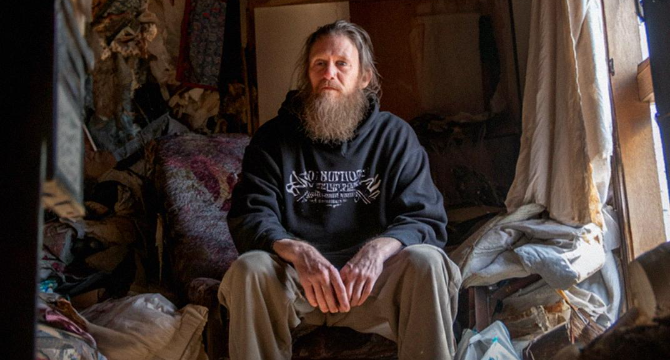
Thin. Dirty. Clearly homeless.
I froze so fast it hurt my back.
My first instinct was fear. My second was shame for feeling it. He looked worn down by life in a way I could not pretend to understand.
His coat was torn at the sleeve, and his beard was rough and uneven, streaked with gray. He looked older than me by at least 10 years, maybe more, but there was something fragile in his eyes when he lifted them to mine.
He looked up at me slowly.
For a moment, neither of us spoke.
I took a cautious step closer.
“Do you… need any help?” I asked quietly.
He didn’t answer right away.
Instead, he slowly raised his hand and reached it out toward me.
“You came?” he said softly. “Finally…”
My heart skipped.
And then I saw it.
On his hand.
The exact same birthmark… as mine.
My voice trembled.
“Who are you?”
He stared at me for so long that I almost backed away.
Then he let out a shaky breath and lowered his hand into his lap.
“I knew one day someone would come back,” he murmured. “I just didn’t know it would be you.”
I swallowed hard. My pulse thudded in my ears. “You know me?”
His eyes moved over my face with a painful kind of tenderness. “Not the way I should have.”
I stayed where I was, every nerve in my body tense. “Then answer me. Who are you?”
He looked down at his palm, rubbing his thumb over the birthmark as if he had done that a thousand times before. When he spoke again, his voice cracked. “My name is Jonah. I’m 50.”
The number hit me first.
Too old to be a brother, close in age. Too young to be a grandfather. My mouth had gone dry.
He glanced around the ruined room before looking back at me. “Your parents lived here once. So did I.”
A chill ran through me. “How?”
His eyes filled, though he seemed embarrassed by it. “Because I was their son first.”
For a second, nothing in the room made sense. The broken windows, the dust, the weak light slipping through the cracks in the boards. It all blurred together.
“No,” I whispered, but it did not come out with conviction.
It came out like fear.
Jonah nodded slowly, as if he had expected that. “I was 18 when they sent me away. I was not easy. I drank. I fought. I made a mess of everything I touched. Your father used to say I had fire in me and no sense to contain it.” He gave a hollow laugh. “He wasn’t wrong.”
I felt my knees weaken, so I sat down on the edge of an overturned chair across from him. “Why would they never tell me?”
His face tightened. “Because by the time you came along, they had already buried that part of their lives. They sold this house after I left. Started over somewhere else. And maybe they thought they had earned the right to pretend it never happened.”
I thought of my mother’s careful silences.
My father’s habit of walking away when the past came too close. I had spent years believing their quietness meant there was nothing to say. Now it felt like I had grown up inside a story with half the pages torn out.
“You could have found me,” I said, though even to my own ears it sounded more wounded than angry.
Jonah nodded once. “I tried.”
That made me look up.
He reached into the pocket of his coat and pulled out a small plastic bag, cloudy with age. Inside it was a folded photograph. He handed it to me with trembling fingers.
I opened it carefully.
It was old, soft at the edges, and faded with time. My parents stood on that same porch outside, younger than I had ever known them. My mother was smiling. My father had one hand on the railing.
Between them stood a teenage boy with dark eyes and a stubborn expression.
Jonah.
On the back, in my mother’s handwriting, were four words: “Our boy. Come home.”
My chest caved in.
“I wrote letters after I got clean,” he said quietly. “I came back once. Years ago. The neighbors said they were gone. After that, life got away from me again.” He looked ashamed. “I kept the photo anyway.”
I stared at him, at the deep lines in his face, at the sadness he wore like another layer of skin. For the first time, I could see traces of my father in the set of his jaw, and my mother in the shape of his eyes. And in him, impossibly, I could see myself.
The anger I thought I should feel never arrived the way I expected.
What came instead was grief.
Grief for my parents, for the son they lost, for the brother I never knew, and for the years that had hardened Jonah into a man sitting alone in the wreck of a house that used to belong to all of us.
“You waited here for someone to come back?” I asked softly.
He nodded. “It was the last place I belonged to anybody.”
That broke me.
I moved before I could overthink it and knelt in front of him.
He flinched at first, like kindness was something dangerous. Then I took his hand, the one with the same birthmark as mine, and held it tightly.
“You belong to me now,” I said, my voice shaking.
Jonah covered his face and wept.
I cried with him, there in the dust and silence, in the home my parents had left behind 40 years ago, in the middle of a truth they had carried to their graves.
I had walked into that house searching for a piece of my past.