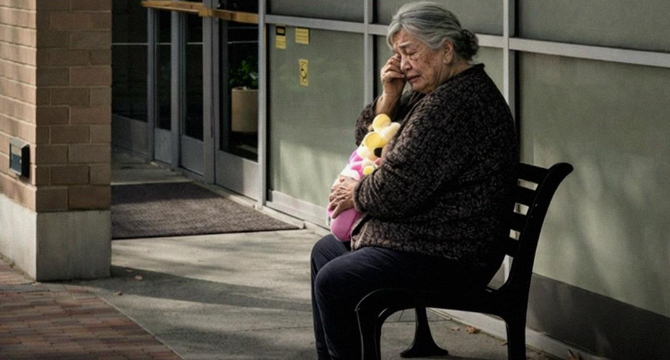
I never imagined that the most painful day of my life would happen outside a maternity ward while my daughter was giving birth. But that’s exactly where I found myself.
I’m 58, and my daughter, Sarah, is 28. I was sitting in a stiff plastic chair under harsh hospital lights, clutching my purse so hard my fingers ached. Every time the double doors swung open, my heart jumped. I kept thinking someone would call my name.
I kept thinking my daughter would change her mind.
Yesterday morning, Sarah went into labor with her first child. I rushed to the hospital with tears of hope in my eyes. I truly believed the birth of her baby might heal the wounds between us.
Instead, when I approached the maternity ward, the head nurse stopped me with the kindest face and the cruelest words.
“Sarah had left very clear instructions. You are not allowed inside the delivery unit.”
For a second, I just stared at her. I thought maybe I’d heard wrong.
“There has to be some mistake,” I said. “I’m her mother.”
The nurse looked sorry. “She didn’t want you present during the birth.”
That was the moment my heart shattered.
A few years ago, when Sarah was in college, she discovered a secret I had been hiding for decades. Before Sarah was born, when I was just a terrified teenager, I gave birth to a baby girl. I was alone, scared, and convinced I couldn’t give that child the life she deserved, so I placed her for a closed adoption.
I had buried that part of my life so deep that sometimes I almost believed it had happened to someone else.
But secrets like that do not stay buried forever.
Sarah found the adoption papers while helping me clean out the attic one Thanksgiving. I still remember the way her hand froze over the file.
“You gave away a baby?” she asked.
I tried to explain. I told her I had been 17, broke, and scared. I told her I had loved that baby enough to want more for her than I could offer.
But Sarah heard only one truth.
“So you could do that?” she asked. “You could just let go of your child?”
“It wasn’t like that.”
“Then what was it like, Mom? Because from where I’m standing, it sounds a lot like abandonment.”
For years, I tried to forget it. But Sarah couldn’t.
Our relationship became cold, tense, and full of unspoken pain.
She still called on birthdays and visited on Christmas. But there was distance in everything.
When she got pregnant, I hoped things would soften. I imagined us folding tiny clothes together, arguing over baby names, and laughing the way we used to when she was little. I thought becoming a mother might help her understand what fear can do to a woman.
Instead, it seemed to harden something in her.
And now I was outside while my daughter labored behind closed doors, banned from the moment I had prayed would bring us back together.
I sat alone outside that building for 12 agonizing hours, replaying every mistake I had ever made.
At first, I was angry. Not at Sarah, not really, but at the cruelty of the moment. I had shown up. I had waited. I had loved her every day of her life, even through the distance. Didn’t that count for something?
But anger burns fast. Guilt lasts longer.
As the hours dragged on, the hospital quieted around me.
Somewhere down the hall, a baby let out a sharp first wail, and every time I heard one, my chest tightened. I wondered if my granddaughter had already been born. I wondered if Sarah was holding her and thinking about me with bitterness.
I thought about being 17.
I remembered the peeling paint in the county clinic, the smell of antiseptic, and the social worker who spoke so gently that it made me cry harder. I remembered signing forms with a borrowed pen. I remembered asking, “Will she be okay?”
The woman across from me said, “She’ll have a chance.”
That was the sentence I built my whole life on.
She’ll have a chance.
People talk about adoption like it is just a decision and just a signature. It isn’t.
It is a living thing. It follows you into your marriage, into your second pregnancy, into every birthday you quietly count in your head. It sits beside you when your daughter turns five, then ten, then 15, and you wonder about the child you lost first. It whispers that you are both selfish and selfless, cowardly and loving, all at once.
Sarah never accepted that contradiction.
To her, motherhood was simple. You stayed. You fought. You kept your child.
Around midnight, I started to accept something I had been refusing to name. Sarah may never forgive me.
At around four in the morning, the double doors of the maternity ward finally opened.
I rose so fast my knees nearly gave out. I smoothed my blouse with trembling hands, trying to prepare myself. I thought I was finally about to meet my grandchild. I thought maybe Sarah had relented.
A young nurse walked straight toward me.
She wasn’t carrying a baby. Instead, she was holding an envelope.
“Your daughter asked me to give this to you before you come inside.”
I took it with numb fingers. My name was written across the front in Sarah’s handwriting. Inside were papers, yellowed at the edges from age and folding. My breath caught before my brain even caught up.
They were my old adoption papers — the very ones I had signed decades ago.
My hands trembled so badly that one page slipped to the floor.
“No,” I whispered. “No, no, no.”
Every painful memory rushed back at once. I had spent years trying not to look directly at that pain, and now here it was in my lap under fluorescent lights.
Then I noticed something else tucked behind the papers.
A photograph.
In it, Sarah lay in her hospital bed, exhausted and glowing, holding her newborn. And beside her stood a young woman I had never seen before.
They were smiling through tears.
I stared at the woman’s face. She had dark hair pulled back from her cheeks. Her mouth was trembling, like she had just stopped crying. There was something in her eyes that snagged inside me so hard I had to grip the chair.
Confused and shaken, I flipped the photo over. Sarah’s handwritten message changed everything.
Mom,
I didn’t shut you out because I hate you. I needed time to do something before you came in.
For years, I’ve been searching for her.
Your first daughter. My sister.
I found her a few weeks ago.
I couldn’t believe what I just read.
Her name is Emily. She’s been through more than I can write on one note, and I’ll let her tell you her story if she wants to. But she came. She came for me tonight.
I asked her to be here when the baby was born because this child deserves to enter a family that tells the truth.
I didn’t want to overwhelm you during labor with this. I wanted you to have this moment first.
Come inside, Mom.
It’s time.
I could barely breathe.
“Emily,” I said out loud, tasting the name like a prayer I had no right to speak.
The nurse touched my shoulder gently. “She’s waiting for you.”
I followed her through the double doors in a daze. My shoes squeaked on the polished floor. Every step felt unreal, like I was walking into a life I had dreamed and mourned in equal measure.
When the nurse opened Sarah’s room, I stopped in the doorway.
Sarah looked up first. She was pale and tired, her hair plastered to her forehead, but her eyes were soft in a way I had not seen in years. In her arms was the most beautiful baby I had ever seen, tiny, pink, and blinking at the world.
Then I saw the woman standing by the bed.
My first daughter, Emily.
No photograph could have prepared me for the shock of seeing her breathe. She looked at me with wary hope, like someone standing on thin ice, not sure whether to step forward or run.
I began to cry before I said a word.
“I’m sorry,” I whispered. Then louder, breaking apart, “I’m so sorry.”
Emily’s eyes filled with tears.
“I didn’t come for an apology only,” she said. “I came because I wanted to see you. I needed to know if you ever thought about me.”
A sound came out of me that didn’t feel human.
“Every day,” I said. “There wasn’t a year, a birthday, a Christmas, a single day I didn’t wonder where you were. I gave you away because I thought it would save you, and I have hated myself for losing you ever since.”
Sarah was crying too.
“I didn’t understand that before,” she spoke between sobs. “I thought what you did meant you didn’t love her. And if you could do that once, maybe love wasn’t as safe as I thought it was.”
I moved closer to the bed. “Sarah…”
She looked at me with tears sliding into her hairline. “Then I found Emily, and I heard her story. I saw what she carried, and I saw what you carried. None of it was simple. None of it was clean. I’m still hurt, Mom. But I don’t want hurt to be the only thing we inherit.”
Emily gave a watery laugh. “That makes three of us.”
Sarah shifted the baby in her arms and held her out toward me. “Meet your granddaughter.”
I took that tiny child with shaking hands. She was warm and impossibly light, and the moment I held her, something inside me that had been clenched for 30 years finally loosened.
I looked from the baby to Sarah to Emily, and it felt as though the room was full of all the lives I had lost and been given back.
In the days that followed, nothing became magically easy.
Emily had struggled in life. She had bounced through hard places, bad relationships, and years of feeling unmoored. Sarah and I still had painful conversations. There were questions I could not answer in a way that erased the past.
But we began.
Emily came home with me for Sunday dinner, then stayed the night, then started leaving a toothbrush in my bathroom.
Meanwhile, Sarah watched it all with careful eyes. She saw me show up. She saw me listen when Emily was angry, and hold her when she cried, and sit with her through silences that said more than words could.
Slowly, Sarah’s own anger began to thaw.
One evening, as the baby slept in her bassinet, Sarah leaned against my kitchen counter and said, “I think I’m starting to understand that love can fail and still be love.”
I reached for her hand. “And I’m learning that truth told late still costs people dearly.”
She squeezed back. “Then we keep telling it now.”
So we did.
What began in that hospital room was not just the birth of a child. It was the reunion of a broken family. A family shaped not by the worst thing that happened to us, but by what we chose to do after we faced it.
I used to think second chances arrived like miracles, clean and shining.
Now I know they arrive like people… crying, messy, tired, and asking to be loved anyway.
And maybe that is the holiest thing of all.
If the people we love can be wounded by our silence and healed by our honesty, how many families are still waiting outside a locked door for someone to finally let them in?