Lily had learned to live on very little.
At 20 years old, she had mastered the art of stretching every dollar. She could make a single bag of rice last an entire week and knew how to soften old bread to make it work in soup. Most days, she kept her complaints to herself, even when things felt too heavy to bear.
She worked the evening shift at Tony’s Pizza, a hole-in-the-wall joint tucked between a laundromat and a liquor store on Maple Street. It always smelled of burnt cheese and oregano, no matter how often the counters were scrubbed.
The pay was barely enough, but it kept her going.
Whenever she slowed down, everything hit her at once: grief, worry, and exhaustion.
Lily had been eight when the accident happened. One minute, she was in the backseat of her parents’ old Buick, singing along to the radio. Next, there were sirens and shattered glass.
After that, it was just her and Grandma Dottie, who wore floral nightgowns and played jazz records when she cooked. They lived in a house that leaned like it was tired, the paint peeling off the front porch, the roof always threatening to cave in.
And now, even Dottie was slipping.
Doctors said her lungs were giving out, slowly. Breathing took more effort. Walking across the living room was a victory. Every pill, every oxygen tank, every ride to the clinic chipped away at what little Lily had.
Still, she showed up to work each day with her hair in a neat ponytail, her apron clean, and her voice soft. She remembered regulars by name. She knew which kids liked extra pepperoni and which ones cried if their slices had too much crust.
She always smiled, even when her chest felt tight, and her socks were wet from walking through puddles.
It was a Wednesday, mid-November. Rain slapped against the shop’s front window like it was in a bad mood. The bell above the door jingled weakly, and Lily looked up from the register.
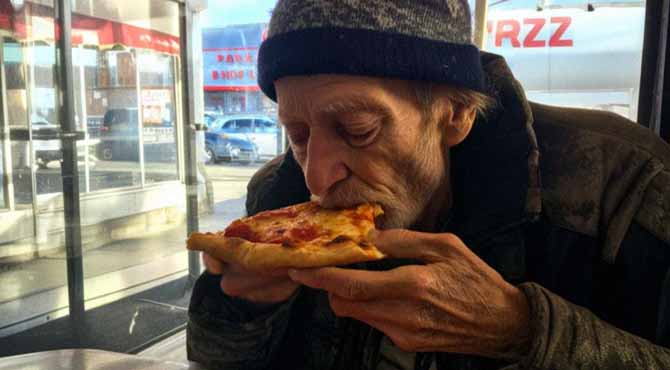
A man stood there, hunched and soaking.
His jacket was torn at the sleeves, hanging awkwardly from his bony frame. His hair was gray, long, and clumped together in the back. He smelled faintly of smoke and something sour, but there was a tremble in his hands that made her pause before judging.
He didn’t come all the way in. He just stood near the door and cleared his throat.
“I don’t have money,” he said, his voice barely above the hum of the heater. “But I’m so hungry.”
Lily blinked. Customers came in angry, loud, and sometimes drunk. But this man just looked lost. Like someone who’d been floating too long and didn’t remember what solid ground felt like.
She stepped out from behind the counter. “Do you like cheese or pepperoni?”
He blinked at her, confused.
“I’ll get you something hot,” she said, already punching the order into the machine. “Give me a few minutes.”
He hesitated. “I didn’t mean to—”
“It’s fine,” Lily said, offering him a soft smile. “Really.”
She paid for the slice and a soda out of her own pocket. The man, maybe in his mid-60s, sat in a corner booth, huddled over the food like it might disappear if he looked away. She wiped down the counter, then grabbed a chair and sat across from him.
“I’m Lily,” she said gently. “You got a name?”
He swallowed hard, then nodded. “Henry. I think.”
“You think?”
He nodded again, slower this time. “I… I’m not sure. It’s the only name that feels familiar.”
Lily watched him closely. His eyes were sharp but tired, like someone who remembered pain more than peace.
“I remember some things,” he added. “Not much. A little house with a red mailbox. Laughter, maybe kids. A woman who wore perfume, floral, maybe jasmine. And a street name, something with ‘Elm’ in it. But it’s all foggy. It’s like trying to grab smoke.”
“No photos?” she asked quietly.
He shook his head.
“Phone? ID?”
“Nothing,” he said, spreading his hands.
“It’s like I just appeared one day.”
Lily felt something tug in her chest.
It was familiar, that ache of wanting to remember a family you no longer had. Her fingers curled into the fabric of her jeans.
Henry looked down at his soda, voice cracking. “I think I had a family once. But I don’t know how to find them.”
Lily didn’t speak right away. The rain tapped harder against the windows, as if the sky were listening. She looked at him, this broken stranger with kind eyes and no name, and saw something painfully human. He wasn’t pitiful. He was just lost.
She thought of the empty frames in her hallway, the ones that used to hold pictures of her mom holding her at the beach, her dad pushing her on a swing. All gone in the crash.
Only memories were left, and even those were starting to fade.
“I don’t know how,” she said finally. “But I’ll help you.”
Henry blinked. “You don’t even know me.”
“No,” she agreed. “But I know what it’s like to feel alone. And I wouldn’t want my family giving up on me, even if I forgot who I was.”
He looked at her for a long moment. “You’re kind.”
She smiled faintly. “Don’t tell my manager. He thinks I’m the meanest one here.”
Henry chuckled softly, the first sign of light in his eyes.
And that was it. No dramatic music. No lightning-bolt moment. Just a girl in a pizza shop making a decision she didn’t fully understand yet.
For the next eight days, Lily and Henry would search.
Search for the pieces of a man’s past. For a family that might not even know he was missing. And for answers that neither of them was sure existed.
In the days that followed, Lily gave every spare minute she had to Henry.
Every morning before her shift and every night after closing, she laced up her worn sneakers, grabbed her tote bag full of notes, and met Henry outside the library.
He was always there, sometimes holding a cup of coffee she suspected he got for free, and other times just quietly staring at the street, as if something familiar might pass by.
They started with the shelters.
One by one, they visited every center within the two towns, showing pictures, asking questions, and checking intake logs. Most people were kind. A few offered vague possibilities. One man, a wiry stranger named Rick, nearly convinced them he had known Henry back in 2019.
“He used to hang around 8th and Green,” Rick insisted, scratching at his neck. “He had a daughter, I think. Real sweet. Long brown hair.”
Lily’s heart jumped. “Do you remember a name?”
Rick hesitated, his eyes flicking toward Henry’s pocket. “Maybe for a little something. You know, for my memory.”
Henry frowned. “You’re lying.”
Rick shrugged and walked away, muttering.
That night, Lily sat with Henry on a bench outside the library. The wind was cold, and the lights inside were dimming.
“I’m sorry,” she whispered.
Henry shook his head. “That’s not on you.”
“It feels like it is.”
Henry looked at her, and in his gaze was something gentle but firm. “You’re doing more than anyone has in a long time.”
The next few days didn’t get easier. In fact, they got worse.
Tony, her manager, cornered her during her Friday shift. He was in his 40s, loud, always smelling like garlic and stress.
His arms were crossed tightly across his stained apron.
“You’ve been late twice this week. And don’t think I haven’t noticed you sneaking out during breaks.”
“I’ve been dealing with some personal stuff,” Lily said, wiping sauce off her hands.
“Yeah? Well, I’m dealing with low staff and cranky customers. If this keeps up, I’ll have to let you go.”
Lily just nodded, biting her tongue until she could clock out.
That evening, her grandmother’s breathing grew worse. Lily spent hours by her bedside, counting the seconds between wheezes. The home nurse shook her head and made another note on the chart.
“She needs to be in the hospital again. Soon.”
Lily didn’t cry, but the pressure in her chest built until it felt like she couldn’t exhale.
By day six, she was running on fumes. Her clothes smelled like pizza grease, and she hadn’t had a proper meal in almost two days. She didn’t tell Henry that her stomach growled every time he took a bite of the bagels that people at the shelter handed him.
But Henry noticed.
“You’re not eating,” he said quietly one afternoon, pushing a half-sandwich toward her as they sat at the library computer desk.
“I’m fine,” she lied.
“Lily.”
She glanced at him.
He didn’t say anything else, just held her gaze.
“I just can’t spend anything right now,” she admitted. “Grandma’s meds are over five hundred this month.”
Henry didn’t respond. He just slid the sandwich closer.
“I’m not taking your food.”
“Then let’s share it.”
That was the thing about Henry. Even without his full memory, he was kind. He didn’t talk much, but when he did, it meant something. He had soft eyes and a quiet patience that made people want to open up.
On the eighth day, Lily was exhausted and almost ready to give up.
She had printed out every possible street name that included the word “Elm.” Henry’s memory had been consistent on that point.
A small house. Children’s laughter. A woman’s perfume. Something about jasmine.
They were back in the library, sitting at a computer, when an older librarian, Ms. Greta, paused beside them. She was in her 70s, with white hair pulled into a bun, and glasses perched low on her nose.
“You said something about Elm Grove?” she asked, looking at Henry.
He blinked. “Yes. That sounds familiar.”
“That’s near Willow Creek. There’s an old neighborhood there. It used to be home to the Barnes family. Big estate. The last I heard, the younger cousin inherited everything after the older one went missing.”
Lily’s heart skipped.
“Missing?” she repeated.
Ms. Greta nodded. “Yes, I remember it made the local papers. The older cousin… what was his name… Henry, I believe.”
Henry’s mouth parted. He looked frozen, like the name had struck something deep inside.
Lily leaned forward. “Do you remember that? The name Barnes?”
Henry slowly nodded.
They spent the next hour digging through local news archives. Lily clicked and scrolled while Henry stared at the screen. Eventually, they found a photo, old and faded with time. But the man in it had the same kind eyes and the same tired smile.
Henry covered his mouth.
“That’s me,” he said.
It turned out he had family, just not the kind he remembered. There was no wife and no children, but he had a cousin. The younger one, Jacob, had searched for Henry for years before finally giving up and assuming the worst.
Lily found a number.
They called, and a woman answered. “Mr. Barnes’ office.”
Lily introduced herself, explained everything. At first, there was silence. Then a rush of movement. By that evening, Jacob himself arrived at the library in a black SUV, wearing a suit and a look of disbelief.
When he saw Henry, he had an emotional meltdown.
“God,” Jacob whispered. “You’re alive. You’re really alive.”
Henry stood there, uncertain.
Jacob stepped forward slowly, tears welling in his eyes. “You vanished. We thought maybe you’d… I never stopped checking shelters. But after a while—”
“I didn’t know who I was,” Henry said softly. “I didn’t know how to find you.”
Jacob hugged him tightly, and for the first time, Henry didn’t pull away.
Later that night, Lily sat on the curb outside Tony’s, sipping from a water bottle and trying to process everything. Henry was going home with his cousin. He’d be okay now.
A few days passed. Her grandmother had been moved to a private room in the hospital. The bill had arrived, and Lily stared at it with dread until a nurse gently informed her that the entire balance had been paid.
“By who?” she asked.
The nurse smiled. “An anonymous donor. But he left this.”
She handed Lily a note written on thick, expensive paper.
“For the girl who helped me remember who I am. — H”
Lily stood in shock. She wanted to cry, but her chest just felt warm and light. Like something huge had been lifted.
The following Monday, she walked into Tony’s expecting the usual chaos. But the place was quiet. Tony wasn’t behind the counter.
Instead, a man in a sharp navy suit stood at the register.
“Lily?” he asked.
“Uh… yeah.”
“I’m Mr. Lang. I represent the new ownership of Tony’s Pizza.”
She blinked. “New ownership?”
He smiled and handed her a folded sheet of paper. Her name was at the top.
So was a new job title.
General Manager.
She stared at it, then back at him. “I don’t understand.”
“Mr. Barnes recently acquired this location. He wanted to thank you properly.”
Lily opened her mouth but couldn’t find the words. She just nodded.
As she looked around the place she once thought she’d be fired from, everything felt surreal. The same counter, same tables, same faded red booths.
But everything had changed.
Later that night, she told her grandmother everything.
Dottie laughed softly and squeezed her hand.
“You did well, Lily. You always had that light in you.”
And for the first time in her life, Lily believed her.
She had spent so many years surviving — barely scraping by, always waiting for something to break. But now, the tide had shifted. She had helped a stranger become whole again, and in doing so, something inside her had healed, as well.
Lily wasn’t just surviving anymore.
She was finally, truly living.
Lily only meant to buy him a slice of pizza. She didn’t expect to spend eight days helping a stranger recover a life he had forgotten — or to find healing of her own in the process.
Leave a Reply