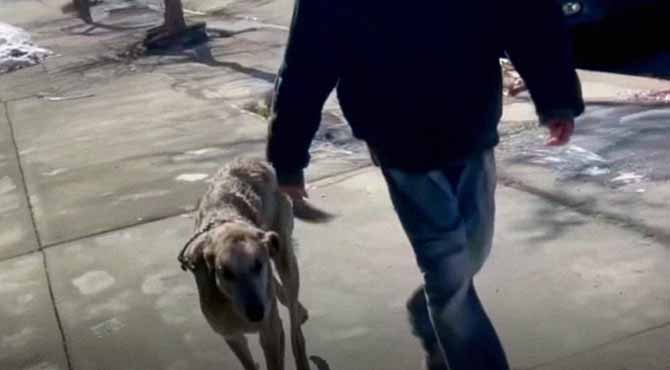
People online only saw a shaky, brief phone video of “some crazy dude and his ugly limping dog.” They didn’t know the full story, that the man, Eli, was 55 years old, a decorated veteran, and that the dog was the only reason he was still alive.
Eli had returned from multiple combat tours with severe PTSD that transformed everyday life into a minefield. Car backfires became explosions that sent him diving for cover. Crowded spaces triggered panic attacks so intense that his chest felt like it was being crushed in a vice.
His days blurred together in an exhausting cycle of waiting for the next nightmare, whether he was awake or asleep. The crushing weight of his trauma didn’t just haunt him; it systematically shattered every piece of his life.
His marriage fell apart first.
His wife had tried to understand, had tried to be patient, but she grew tired of living in constant fear of what might trigger him next. She couldn’t handle the midnight screams, the sudden drops to the floor, and the way he would stare through her like she wasn’t there. When she finally left, Eli couldn’t even blame her.
His relationship with his daughter crumbled next. Their visits grew shorter and more strained with each passing month. She was 12 when he deployed the first time, 16 when he came back for good.
The father she remembered was gone, replaced by a hollow-eyed stranger who flinched at birthday balloons and couldn’t sit through a fireworks display. Eventually, the visits stopped entirely. She stopped calling, and he stopped trying.
Reduced to a tiny basement room that his disability check barely covered, Eli found that sitting still was the most dangerous thing he could do. Stillness invited the memories to flood in, so he walked the streets constantly.
Mile after mile, day after day, trying to outpace the ghosts that followed him.
One freezing night in late November, behind a supermarket dumpster, Eli’s desperate solitude was interrupted by a small, skinny, filthy dog. The animal was digging frantically in a torn trash bag, its back leg dragging pitifully behind it.
Every step the dog took looked like agony, but it kept moving, kept searching for food. Eli didn’t think. He just pulled out half of his meager sandwich, the dinner he’d been saving, and tossed it toward the dog.
The dog snatched it up and disappeared into the shadows.
The next night, as Eli walked his usual route past the supermarket, the dog was waiting in the same spot. Eli shared more food, this time sitting on the cold concrete while the dog ate a few feet away. On the third night, as Eli started to walk away after feeding the dog, it stood up and followed.
Eli kept walking. The dog kept following.
Their bond was truly sealed in a moment of crisis that happened just two blocks from the supermarket.
A nearby car backfired with a sound like a gunshot, and Eli instantly dropped to the pavement, his body hitting the ground hard as he covered his head with his arms. He was shaking uncontrollably, his mind no longer on a city street but back in a warzone where the explosions were real, and the danger was everywhere.
The dog startled too, jumping at the sudden noise. But instead of running away as any sensible stray would, the dog limped directly to Eli’s side. He pressed his warm, bony body against Eli’s ribs and stayed there.
The dog didn’t move or leave. It just breathed slowly against Eli’s chest until the shaking gradually subsided and Eli could remember where he was.
From that moment on, the dog never left his side. Eli named him Buddy.
Over the following weeks, something shifted in Eli. He still walked the streets for hours, still jumped at sudden sounds, but now he had someone who needed him.
Buddy needed food, water, and someone to look out for him. And somehow, in taking care of this broken dog, Eli found a reason to take care of himself. He started eating more regularly because Buddy needed him strong. He started keeping a schedule because Buddy needed routine.
They became an unbreakable team, two damaged souls finding healing in each other.
They became an inseparable, familiar sight around the neighborhood: the quiet, haunted man and the limping stray dog, walking the same routes every single day.
Eli talked to Buddy about his pain, about the things he couldn’t say to anyone else, and Buddy listened with unwavering presence. The dog seemed to understand that his job was more than companionship. Buddy instinctively guarded the space between Eli and the chaotic world, positioning himself like a shadow service dog that had never received formal training.
Their quiet routine was brutally disrupted one Tuesday afternoon outside a strip mall. A group of five teenagers spotted them near the entrance. What began as snickering and pointing quickly escalated into something darker.
“Yo, check out the homeless dude,” one boy shouted, elbowing his friend.
“And that busted dog,” another added, laughing. “Thing walks like it’s drunk.”
They started cruelly imitating Eli’s careful, measured walk, then exaggerating Buddy’s limp with theatrical stumbles. One threw a handful of dirt that scattered across Buddy’s back. Another kicked an empty soda cup that bounced off Eli’s leg.
“Hey, man, you okay?” one asked in a mocking voice.
“Your dog need a wheelchair?”
Eli tried to walk away, his head down, his hand gripping Buddy’s makeshift rope leash. But one of the boys stepped forward and shoved him hard in the shoulder. Eli stumbled backward and hit the pavement with a sickening thud.
Buddy panicked. The dog started limping in frantic circles, barking desperately, trying to place his small body between Eli and the teenagers. His tail was tucked tight against his body, but he refused to back down.
“Dude, the dog’s losing it,” one teenager laughed, holding up his phone. “Yo, get this. Street lunatic and his busted mutt.”
They filmed the entire incident, their phones capturing every cruel second. But the video they posted later that evening was maliciously edited.
They cropped out the shoving, the thrown dirt, the kicked cup, and most importantly, the fear in Eli’s eyes. All that remained was Eli on the ground, his body turning with tight, wild eyes, and Buddy pressed against his leg.
They muted the sound completely and added a vile caption, “Disgusting how people like this exist. You and your dog both need therapy 💀”
The video went instantly viral, spreading across social media platforms like wildfire.
By morning, it had been viewed over two million times. Comments poured in, each one more dehumanizing than the last.
“NPCs in real life.”
“Sidewalk freaks. Why do we allow this?”
“Real-life glitch in the matrix.”
“That dog is suffering. Someone call animal control.”
Crying-laughing emojis saturated every comment section. People shared it with their friends with captions like “You have to see this” and “I can’t stop watching.”
The cruelty became entertainment, and the entertainment became a shared joke that millions participated in without a second thought.
What the online mob didn’t know, what they couldn’t have known from that edited clip, was that a woman who lived in the neighborhood had been waiting at a bus stop just 30 feet away. She had witnessed the entire exchange from start to finish. And she had filmed it too.
Her video had sound. It captured the jeers, the mocking voices, the slurs they called him. It captured the sickening thud when Eli hit the ground and the way the teenagers laughed instead of helping. Most importantly, it captured Eli’s shaky voice reaching for Buddy and whispering, “Easy, Buddy. Easy, boy. They’re just noise. I’ve got you, okay? I’ve got you.”
It showed Buddy repeatedly stepping in front of Eli, his tail low but steady, his small body trembling but refusing to move.
He was defending his human with everything he had.
The woman stared at her phone, then at the viral video being shared everywhere. Her hands shook with anger as she uploaded her footage.
She posted her unedited version with a powerful caption, “You’re not watching a joke. This man is a veteran with PTSD. The ‘ugly limping dog’ has been protecting him for months. Shame on everyone who laughed.”
She tagged local veteran groups, animal rescues, and news stations. Then she waited.
The response was immediate and overwhelming. Within hours, her video had been viewed four million times. The comments shifted from mockery to outrage, then to something deeper: a collective sense of shame.
“I shared the other video. I feel sick.”
“We owe this man and his dog an apology.”
“How did we become this cruel?”
A reputable animal rescue organization called Eli two days later. He almost didn’t answer the phone.
“Mr. Eli? My name is Sarah. I’m calling from Second Chance Animal Rescue. We saw what happened to you and Buddy, and we want to help.”
“We’re fine.”
“Sir, Buddy’s leg needs medical attention. We can provide that. Full care, no cost to you.”
Three people from the rescue arrived at Eli’s basement room that afternoon. They expected a wild, broken street dog but found a gentle, anxious shadow utterly devoted to Eli. Buddy pressed against Eli’s leg the entire time, observing the strangers.
Sarah knelt slowly. “He’s a good boy, isn’t he?”
“Best I’ve ever known,” Eli said quietly.
“We can fix his leg. Surgery, medication, and physical therapy. Everything he needs.” She paused. “But we have a condition.”
Eli’s jaw tightened. “What condition?”
“That you accept help too. We have a partner veterans’ non-profit. They can connect you with PTSD treatment, peer support, and better housing that allows service animals.”
Eli shook his head immediately. “No. Fix him. I’m fine.”
Sarah looked at him with eyes that had seen too many broken things. “Mr. Eli, Buddy started following you because you fed him. But he stayed because you’re his person. He doesn’t want a better life without you in it. And frankly, you both deserve better than this basement.”
Eli looked down at Buddy, who gazed back with complete trust.
“Okay,” he whispered. “Okay.”
Buddy received the complex surgery needed to repair his shattered leg. The veterinarian said it was a miracle the dog could walk at all.
While Buddy healed in the rescue’s facility, Eli started attending therapy sessions. He joined a peer support group where other veterans understood without him having to explain. The non-profit helped him move into a small apartment that welcomed service animals.
Six weeks later, a new video began circulating online. It showed Buddy walking perfectly, no limp or pain, proudly wearing a vest that read “Service Dog in Training.” Beside him walked Eli, still quiet, still carrying his invisible wounds, but standing noticeably taller.
The caption was simple yet profound: “The man and the dog that got virally mocked. Turns out they were saving each other the whole time.”
This time, the comments were not mocking. They were honoring.
“Thank you for your service, sir.”
“Good boy, Buddy. Good boy.”
“Two survivors. One team.”
“I’m sorry we laughed. I’m sorry we didn’t see.”
Eli didn’t read the comments.
He didn’t need the internet’s approval anymore.
He had Buddy, he had support, and for the first time in years, he had hope that tomorrow might be better than today.
If you witnessed someone being mocked or mistreated in public, would you have the courage to speak up and record the truth, even if millions were already laughing?
Leave a Reply