Clara hadn’t come from money, but she had spent her adult life learning how to carry herself as if she had. Her heels never clicked too loudly on the marble floors, her voice remained steady whenever she greeted a guest, and her posture was always perfect, almost regal.
None of it came naturally, though. She had built it all from the ground up, learning through trial, error, and hard-earned lessons.
She was now 32, and not a single day had come easily.
Ten years ago, she’d been answering phones at a dusty motel off the freeway, working double shifts and drinking stale coffee to stay awake between laundry runs.
Now, she was the assistant front office manager at the Bellmont Grand, one of the state’s high-end hotels. It was the kind of place where celebrities booked private wings, and influencers begged for collaborations.
Clara had climbed every rung of that ladder with blistered hands, sleepless nights, and a smile she had learned to wear like armor.
She lived alone in a modest one-bedroom condo, decorated neatly with secondhand finds.
Small reminders of her mother, who had passed away just a year before Clara started working at the Bellmont, were tucked into every corner.
Her mother had been a schoolteacher with a soft heart and tired eyes, a woman who always gave more than she had. Clara had loved her fiercely, but she had also promised herself that she would never live paycheck to paycheck, as her mother once did.
And that’s why, when the storm rolled in that Friday night, Clara was already on edge.
Outside, the rain pounded against the massive glass windows like a drum line; the wind howled through the automatic doors every time a guest stepped inside.
Her nerves were tight, pulled thinner than usual because upper management was lurking around, watching everything.
Bellmont was expecting a high-profile celebrity group to check in that weekend, and Clara had volunteered for the late shift to prove she could handle pressure.
She stood behind the polished mahogany desk, adjusting her name badge with perfectly manicured fingers, when she noticed some movement at the entrance.
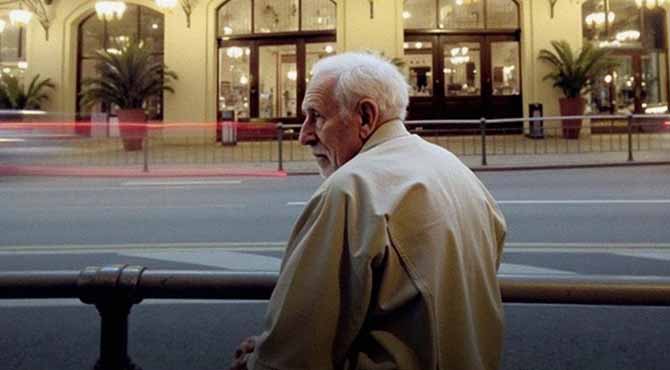
A figure stepped into the warm, golden lobby light, soaking wet and hunched over, with water pooling beneath his shoes. The man looked to be in his 70s. His coat clung to him like wet newspaper, his gray beard was unkempt, and his hands trembled as if he had been outside for far too long.
Clara’s first thought was that security must have missed him. Her second thought was a jolt of pure panic.
He didn’t belong here.
“Please,” the man said softly. His voice was raspy, barely louder than the wind outside. “I only need to stay inside until the storm calms. I don’t need a room.”
Clara hesitated. Something in her chest tightened, like a pulled muscle. But then she pictured other guests noticing him, the complaints that would follow, and the disappointed look on her manager’s face. She couldn’t afford a single mistake, not tonight.
She lifted her chin, smoothed her blazer, and tried to keep her voice even.
“I’m sorry, sir,” she said tightly. “You can’t stay here. This is a luxury hotel.”
The man looked at her with eyes too kind for someone being turned away. They weren’t angry or bitter. Just tired. He nodded once, slowly.
“I understand,” he whispered.
And then, without a single word more, he turned around and walked back into the storm.
Clara watched him go, her heart pounding. She hated how the lobby lights reflected off the puddle he had left behind. She hated that the other front desk associate, Marsha, pretended not to notice. Most of all, she hated the silence that followed, the kind that made guilt echo like footsteps in an empty hall.
Her manager, Mr. Dunley, passed by minutes later. He was in his 50s, with silver hair slicked back, always wearing the same crisp navy suit. He gave her a curt nod.
“That was a good call, Clara,” he said. “We can’t have people like that in here scaring guests.”
Clara forced a smile, nodded, and turned back to the check-in screen.
But something in her cracked.
She had grown up hearing her mother say things like, “Always leave room in your heart for the hurting,” or “Never turn away someone with no roof when the sky turns cruel.”
Those words used to be her compass. But somewhere along the way, she’d stopped following them.
That night, she couldn’t sleep. Not even a little.
Every time she closed her eyes, she saw the old man’s back, hunched against the rain, his coat soaked through as he walked away from the warmth behind him.
The next morning, her eyes were heavy, and her stomach twisted with unease.
She arrived at the hotel even earlier than usual, hoping the morning chaos might drown out the memory.
She grabbed a black coffee from the lobby cart, took a deep breath, and tried to focus on her emails.
But before she could even take a sip, one of the housekeepers, a young woman named Freya, stopped at the front desk with a look of concern on her face.
“Clara,” she said quietly, leaning in. “I think someone was sleeping on the bench behind the service entrance last night.”
Clara’s stomach dropped. “What do you mean?”
“It was an old man,” Freya explained, adjusting her housekeeping apron. “He looked sick. I didn’t want to bother anyone, but he was there when I left last night and still there this morning. He looked soaked, through. And he was coughing really badly.”
Without a word, Clara stood up.
She didn’t grab her coat. She didn’t even finish her coffee.
She walked straight through the staff corridor and out the rear door.
Rain had slowed to a mist, but the cold still bit her skin. The sky was gray and the pavement damp. And then she saw him.
The old man.
He was slumped over on the bench near the service entrance, his legs tucked close to his chest. His coat was still wet, and his hair clung to his face. He wasn’t asleep; his eyes were open but unfocused, as if he wasn’t fully present. He looked smaller than she remembered.
She stepped closer, slowly.
“Sir?” she said softly. “Excuse me, sir…”
The man stirred, blinking up at her.
His face twisted into a weak smile.
“Excuse me, ma’am,” he said hoarsely, “I need a place to stay. Please help… I beg you.”
Clara froze.
Her hands were shaking now; her breath caught somewhere in her throat. All she could think was, Why him? Why today?
She wanted to scream — not at him, but at herself. She hadn’t slept for 36 hours. She had worked back‑to‑back shifts to chase a promotion and to earn respect in a job where no one cared who you were unless you wore the right suit.
And now, here he was again, standing in front of her when she felt least prepared to face herself.
A drenched, trembling old man, asking for shelter.
“Why are you still here?” she asked, her voice cracking despite her best efforts. “You could have gotten sick. You could have—”
But the man only nodded.
“I didn’t know where else to go.”
For a moment, Clara just stared at him. She didn’t know what to say.
She was tired. So tired. But somehow, not nearly as tired as he looked.
She reached for her phone, opened the security line, and paused.
This was her moment. The kind that separates who you are from who you pretend to be.
And Clara’s chest ached with the weight of all the choices she hadn’t made.
She looked down at him again. His hands were blue around the edges. His cough had worsened. She could feel the eyes of a few staff members watching from the door. But she didn’t care.
“Sir, are you alright?” she asked, her voice barely above a whisper.
The man turned his head slowly. His eyes met hers, not with resentment or blame, but with quiet exhaustion. It was the kind that settles in your bones when hope has been stretched too thin.
He gave her a weak smile.
“The storm destroyed my house last week,” he said, his voice hoarse from the cold. “Been trying to get to a shelter where my daughter volunteers, but the buses… they were canceled last night.”
Clara’s heart sank. Her hand instinctively went to her mouth.
He hadn’t lied. He hadn’t tried to scam his way into the hotel. He hadn’t asked for a room or a meal or pity — just safety. Just a few dry hours of peace.
And she had thrown him out.
The man shifted, trying to sit up straighter. His joints seemed to protest every movement. “You remind me of my wife,” he said quietly, with a tired chuckle. “She used to say people always had kindness in them, even if they’d forgotten how to use it.”
The words hit Clara like a gut punch.
That phrase — people always had kindness in them — was something her mother had said more times than she could count.
Whenever Clara came home crying after a hard shift, or when they watched the news and saw something awful, her mother would gently remind her, “Kindness isn’t dead, Clara. Sometimes it’s just been buried for too long.”
She felt her throat tighten. Her mother had been gone for nearly three years now, but suddenly it felt like she was standing right behind her. Watching. Waiting.
And maybe even disappointed.
Clara knelt on the damp ground, her hand resting near the man’s.
“I am so sorry,” she said, her voice thick. “I should never have turned you away.”
The old man just smiled again.
“It’s alright, miss. Most people don’t even stop to talk.”
But it wasn’t all right. Clara knew that. Her decision had sent this man into the freezing night. He could’ve died out here. And the truth was, she’d known it deep down even as she’d watched him walk out the door.
She stood up slowly, brushing dirt off her skirt. Her heart raced, but her mind was clear.
Something had to change.
“I’m going to help you,” she said gently. “Please let me make this right.”
The man blinked up at her. “Are you sure?”
“I’ve never been surer of anything.”
Clara guided him inside, one arm steadying him as they walked. The moment the automatic doors opened, and they stepped into the warm, gold-lit lobby, heads turned.
Guests stared. A few staff members exchanged awkward glances.
Her front desk team froze in surprise.
But Clara didn’t flinch.
She led him to one of the plush chairs near the fireplace and wrapped him in one of the hotel’s thick, embroidered robes. Then she called the kitchen for hot tea and a full breakfast plate. No scraps. No shortcuts.
“Make it warm,” she told the chef. “Comfort food. The best we have.”
The man, whose name was Mr. Hale, accepted everything with a quiet sort of grace. He drank the tea with both hands wrapped around the mug and only looked up when Clara knelt beside him again.
“I don’t want to cause trouble,” he said, his voice raspy. “You’ve already done more than enough.”
“You haven’t caused anything,” Clara replied. “I did that. And now I’m fixing it.”
Mr. Hale smiled faintly. “You don’t have to go further, really.”
But Clara had already made up her mind.
She stood, walked to the front desk, and took a deep breath.
“Marsha,” she said to the receptionist on duty, “I’m checking Mr. Hale into the Presidential Suite.”
Marsha blinked. “Wait… what?”
Mr. Dunley, the manager, had just walked in with his clipboard. He overheard the tail end and did a double-take.
“Clara,” he said sternly. “That room is reserved for high-paying clients. What are you doing?”
She turned to him calmly, but her voice was firm. “I’m giving Mr. Hale the Presidential Suite.”
Mr. Dunley looked like he might choke. “You can’t just — Clara, that suite is worth thousands a night! This isn’t some community shelter. Our brand—”
“Tonight, it’s worth something else,” Clara said. “And if there’s a price for compassion, I’ll pay it. But that man nearly froze to death outside our doors. I won’t pretend we’re too good to help someone like him.”
There was a long pause.
Silence, heavy and expectant.
Then Dunley muttered, “Do what you want.”
And Clara did.
She helped Mr. Hale up to the suite herself. It was on the top floor, spacious and elegant, with velvet curtains, a fireplace crackling quietly in the corner, and windows that looked out over the glowing city skyline.
He stepped inside slowly, eyes wide.
“I don’t understand,” he whispered.
Clara felt her throat tighten again. She walked to the window, taking a breath before answering.
“Because yesterday, I forgot I was human. And you reminded me what it means to remember.”
His eyes filled. He reached for her hand, holding it gently.
“Your mother would be proud,” he said.
Those five words shattered her.
Clara turned away quickly, covering her face, but the sob escaped anyway. Not a sob of shame, but of release. Of something buried, finally resurfacing.
In that moment, she didn’t feel like the polished hotel manager or the girl chasing approval. She just felt like Clara again, the daughter of a woman who always believed in kindness.
Mr. Hale stayed the night. The doctor Clara had called checked him out and confirmed he needed rest, but he’d be alright. When the sun rose, the rain had cleared. The city glittered in the morning dew.
Later that day, Clara stood in the lobby again, wearing a clean blazer, fresh lipstick, and with her hair pulled back in a neat bun. But this time, she wasn’t trying to impress anyone.
A young woman rushed through the glass doors, likely in her mid-30s, wearing jeans and a puffer jacket, her cheeks red from the wind.
She looked around anxiously before spotting Clara.
“You must be Clara,” she said breathlessly. “I’m Mr. Hale’s daughter, Tessa.”
Clara smiled gently. “He’s upstairs. Safe.”
Tessa’s eyes welled up instantly. “I don’t know how to thank you. He told me what had happened. He said you saved his life.”
Clara shook her head. “He saved mine, too. Just in a different way.”
Tessa pulled her into a hug before Clara could protest. It was tight, grateful, and warm.
“You didn’t have to do this,” Tessa said, her voice breaking. “But you did. And I’ll never forget it.”
Clara smiled through the emotion rising in her chest. “Neither will I.”
That night, Clara went home and finally slept deeply and peacefully, with no guilt hovering at the edge of her dreams.
The next morning, she woke with a clarity she had not felt in years.
She returned to work with the same sharpness and precision. But something had shifted.
She no longer saw guests as walking complaints or as potential for room upgrades. She asked about their stories, remembered their names, and listened more than she spoke. The staff noticed first, then the guests. People began to request Clara at the desk, not just the manager, but her.
In time, she was promoted — not just for her efficiency, but for her heart.
And every Christmas, like clockwork, Mr. Hale returned to the Bellmont Grand.
He always brought a small tin of homemade cookies, usually lemon shortbread, Clara’s favorite. They sat in the lobby by the fire, catching up on the year. Sometimes he brought Tessa, and sometimes he came alone.
But every time before leaving, he would press the tin into her hands and say the same thing:
“Kindness is a luxury everyone can afford.”
Clara never forgot.
And for the first time in a long while, she felt at peace, certain that her mother would be proud of the woman she had finally allowed herself to become.
But here’s the real question: when someone spends years trying to be better, and finally chooses compassion over pride, does that one choice rewrite their story — or will their past always define them?
Leave a Reply