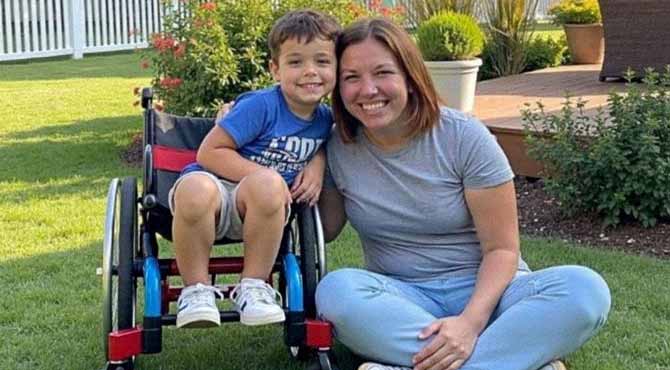
My name’s Amy. I’m 37 now, but back then, I was 27, burnt out, broke, and barely keeping it together in a shoebox apartment in Queens.
I worked two jobs, waitressing in the mornings at a diner and pulling evening shifts at a bookstore. It wasn’t glamorous, but it paid just enough to keep the lights on and my fridge semi-stocked with yogurt cups and instant noodles.
I wasn’t expecting to become anyone’s mother. I was just trying to survive in the city, with chipped nails, aching feet, and dreams I no longer had time for.
I’d always loved my nephew, Evan. He was born when I was in college, a wide-eyed little thing with thick lashes and the kind of laugh that made you forget the world was broken.
But life hadn’t been easy for him. He was born with a congenital condition that affected his legs. He wore braces, needed physical therapy, and sometimes cried from pain when he tried to stand.
Still, he was the sweetest and most cheerful kid I’d ever known.
That night, everything changed.
It was a Friday. I had just come off a double shift, my hair smelled like hash browns and bookstore dust, and my legs were sore from standing 12 hours straight. I was looking forward to a hot shower and collapsing on my couch with some bad TV.
Instead, I turned the corner to my apartment building and saw her.
Lila.
My older sister. She was standing under the flickering streetlamp outside my building, wrapped in a beige coat, with her long hair tied back, her face hard to read. Beside her stood Evan, holding a tiny suitcase covered in cartoon stickers. He was four years old at the time. His braces glinted under his jeans.
“Lila?” I blinked, not sure if I was seeing things.
She didn’t move. Her hand rested on Evan’s shoulder as if she were steadying herself. There were no tears. No emotion. Just that blank, frozen look people get when they’ve made up their minds.
“Amy,” she said, avoiding my eyes. “I can’t do this anymore.”
I stood there, stunned as the cold crept into my shoes.
“What do you mean you can’t do this?” I asked barely above a whisper.
Lila took a breath, as if she were bracing herself. Then she pushed Evan gently toward me.
“I met someone,” she said. “He doesn’t want kids. He’s offering me a fresh start. I deserve a better life.”
My heart dropped. I stared at her, unable to process what she was saying.
“So you’re just abandoning your son?!” My voice cracked.
Her jaw tensed. “Amy, you don’t understand. Taking care of him is… exhausting. I want a normal life.”
I stepped forward instinctively, placing my arm around Evan’s small shoulders. He looked up at me, confused but quiet.
“You always loved him,” Lila said, softening her voice. “You’ll do better than me.”
Then, as if she had rehearsed the whole thing, she bent down, kissed Evan’s forehead quickly, dropped his suitcase on the sidewalk, and turned on her heel.
“Wait, Lila! What the hell are you doing?”
She didn’t answer. She walked to a waiting black car, opened the door, got in, and shut it behind her.
She never looked back.
Evan tugged on my coat sleeve. His voice was so small it nearly broke me.
“Auntie… where’s Mommy going?”
I dropped to my knees, even though my legs ached, and wrapped him in my arms.
“I’m here,” I said. “I’m not going anywhere. I promise.”
Inside, I was panicking. I didn’t have space. I didn’t have money. I didn’t even have a plan. But I had him, and that had to be enough.
That night, I made him hot cocoa with extra marshmallows and let him sleep in my bed. I sat beside him for hours, just listening to his soft breathing, wondering how someone could walk away from a child like that.
Over the next few days, reality hit me hard. I called Lila a dozen times. No response. I emailed, texted, and even messaged her on Facebook.
Nothing.
It was as if she’d erased herself from his life overnight.
I found myself on the phone with his pediatrician, his physical therapist, and his school, piecing together a routine I hadn’t prepared for.
I asked questions I never thought I’d need to ask: What kind of braces does he need? How often does he go to therapy? Can Medicaid cover this?
I was drowning.
One night, after Evan had fallen asleep, I sat on the bathroom floor, my head in my hands. I had $43 in my checking account and a rent bill coming up. I didn’t know how I was going to afford his leg braces, let alone groceries.
But every time I thought about giving up, I remembered the way he looked at me.
Like I was his whole world now.
And somehow that gave me the strength to keep going.
The early months were brutal. I sold my car and started taking the bus everywhere. I picked up extra shifts, sometimes working 16-hour days. My apartment became cluttered with therapy gear, including foam rollers, balance boards, and special chairs. My landlord complained about the noise and the clutter, but I didn’t care. My world had changed.
And Evan never once complained.
He smiled through every appointment — even when it hurt and even when he fell.
“Auntie,” he’d say, gripping my hand tight, “one day I’m going to run. You’ll see.”
That kind of hope — it does something to you. It keeps you going.
People stared at us in public. Whispered. I caught mothers pulling their kids away from him at the playground, like his braces were contagious. It stung, but Evan didn’t notice. He was too busy trying to climb the jungle gym.
His teachers underestimated him, too. They assumed he couldn’t keep up.
But Evan was sharp. He read early, loved puzzles, and asked big questions about the stars and planets. He worked twice as hard as the other kids, and slowly, he proved everyone wrong.
By the time he turned ten, he was walking short distances with crutches. The doctors called it a miracle.
I knew better.
It was grit. It was a sacrifice. It was a little boy who refused to let his legs define his life.
Ten years went by. I got a better job managing a small local bookstore. We moved into a modest little house with a backyard big enough for Evan’s therapy routine. He had his own room, his own bookshelves, and his own little desk by the window where he liked to draw.
By then, I was “Mom” in everything but name.
And then came the day I’ll never forget.
He came home from school, his cheeks flushed from the cold, crutches under his arms, and a wide grin on his face.
“Guess what?” he said, dropping his bag.
“What?” I asked, drying my hands with a dish towel.
He held up a certificate. “Best Academic Achievement,” it read.
“I want to be a physical therapist,” he said, breathing hard from the walk. “I want to help kids like me.”
I laughed through the tears and pulled him into a hug so tight he let out a squeak.
Everything, from the debt to the stress to the lost sleep, felt like it had led to this one moment.
I thought maybe, just maybe, we were finally getting our happy ending.
But fate wasn’t done with us.
Exactly one week later, someone knocked on our door.
And when I opened it, my blood ran cold.
I thought maybe it was the pizza delivery guy or one of our neighbors. Instead, I found myself staring into the past.
Lila.
I hadn’t seen her for almost 11 years, but there she was, standing on my porch as if she belonged there. She looked thinner, sharper around the eyes.
The carefree glow she once had was gone, replaced by a kind of tired elegance, like someone trying too hard to look effortless. Her makeup was perfect. Her hair was straightened and pinned back, but her eyes were the same. Selfish. Calculating.
Behind her stood a man in a charcoal suit, holding a leather briefcase.
He gave me a nod, as if we were about to have a polite business conversation.
“Hi, sis,” Lila said, like it was the most casual thing in the world. Like she hadn’t dropped her son at my feet and vanished into thin air.
I didn’t answer. I just stared.
“We need to talk,” she added, her voice lower now. She glanced around, like she was worried about the neighbors seeing.
I stepped outside, closed the door slightly behind me, and folded my arms.
“You have a lot of nerve coming here.”
Lila gave a half-shrug, like she’d expected that reaction. “Look, I made a mistake. A huge mistake. I know that. I shouldn’t have left Evan.”
The man stepped forward, clearing his throat. “My name is Daniel. I’m Lila’s attorney. We understand this is delicate, but—”
“Wait. Attorney?” I cut in.
Lila’s voice picked up fast and eager. “I want him back, Amy. I want to be his mother again.”
My stomach dropped. I blinked, trying to make sense of what I had just heard.
“You want him back? After all these years? After everything he went through without you?”
Daniel adjusted his tie, his tone calm. “Lila is prepared to file for custody. We’re asking you to consider a mutual agreement before pursuing legal action.”
I stared at them, stunned. Then, without meaning to, I laughed. I actually laughed.
“You’re serious? You think you can walk back into his life now and just… claim him? You abandoned him. You didn’t send a single dollar. Not one birthday card. Not one phone call. And now you want to play mom?”
Lila’s jaw tightened, but she stayed composed.
“I heard he’s doing well,” she said. “Really well. Colleges are interested. And I know schools love stories like his. You know, resilience, inspiration. There are scholarships. Opportunities. He’s valuable now.”
Valuable.
That word made my blood run cold.
“You see him as a story. As a paycheck,” I said quietly. “He’s not your son. He’s your second chance at a reputation.”
Lila’s mouth opened, but before she could speak, the door behind me creaked open.
“Auntie?” Evan’s voice called. “Is everything okay?”
I turned just as he stepped out onto the porch. He was 15 now, taller, still slim, with the same bright eyes and determined stance. He leaned on his crutches, his expression wary as he looked at the woman who had once left him behind.
His gaze moved slowly from Lila to the man next to her, then back to me.
“Mom?” he said, his voice uncertain. That word had only just begun to slip into his vocabulary with me. Quietly at first. Testing it out. It still made my heart ache every time.
Lila lit up instantly, like she’d been waiting for that moment. “Sweetie! It’s me!”
She stepped forward, smiling widely, arms half-raised.
Evan didn’t move. Instead, he took a small step back and slid one hand into mine.
“You’re not my mom,” he said, calm but firm. “She is.”
Lila’s smile faltered. “What? Evan, I—”
“You left me,” he said. “She didn’t.”
His voice was steady. There was no anger in it, just truth. And that made it hurt more.
For a moment, the porch was silent. Daniel cleared his throat again, but didn’t speak.
Lila looked like she’d been slapped.
Evan turned to me, still holding my hand. “Do I have to talk to her?” he whispered.
“No,” I said, loud enough for both of them to hear. “You don’t.”
I stepped forward, shielding Evan with my body. “You need to leave. Now.”
Lila opened her mouth to protest, but Daniel placed a hand on her shoulder. “Let’s go,” he said firmly.
She didn’t argue. She just glared at me one last time, then turned and walked down the steps with him.
Evan and I stood there, watching as they disappeared down the driveway.
That night, I barely slept. I knew she wouldn’t give up that easily.
By the following week, the paperwork had arrived. Lila was filing for custody.
I called a lawyer — a good one. We gathered school records, medical records, letters from teachers, therapists, and neighbors. Everyone who had watched Evan grow up knew the truth. I had been his parent in every way that mattered.
The legal battle dragged on for months. Lila tried to paint herself as someone who had changed, someone who was simply young and overwhelmed at the time. She even produced photos, carefully staged shots of a nursery she had prepared, as if decorating a room could erase a decade of absence.
But truth speaks louder than polished lies.
Evan took the stand. I didn’t want him to, but he insisted.
He sat there with his braces and crutches, eyes steady, voice clear.
“She left me. I don’t remember much about that day, but I remember feeling like trash. Like I was too much trouble for her to keep,” he said. “Amy raised me. She helped me walk. She stayed. She’s my mom.”
I cried.
So did half the courtroom.
When the judge read the final decision — full and permanent custody granted to me with no legal visitation rights for Lila — I felt a weight I didn’t realize I was carrying finally lift.
On the way home, Evan was quiet. We stopped for ice cream, something simple, something happy.
Later that week, as I was folding laundry in the living room, Evan came in with a manila envelope.
“I want to do it,” he said.
“Do what?”
“I want you to adopt me. For real.”
My heart nearly stopped.
“Evan…” I said, setting the laundry aside.
“I know I already call you Mom. But I want it to be official. You’ve always been the real one.”
It took a few more months, a few more forms, but the day the paperwork was signed, Evan and I walked out of the courthouse hand in hand.
“Mom,” he whispered as we stepped onto the sidewalk, sunlight hitting his face, “we did it.”
And that, after years of pain, abandonment, healing, and love, was the happiest moment of my life.
Leave a Reply